
1
Acknowledgments
This research report originates with the work of the non-profit Reconciliation Kenora, which was founded in the wake of the Truth and Reconciliation Commission of Canada. Gifted the name Azhe-mino-gahbewewin (“stepping back to go forward in a good way”) by the late Anishinaabe Elder Clifford Skead (Wauzhushk Onigum), the organization’s mandate has been to promote education, support healing, and strengthen Indigenous-settler relationships in the Kenora area.
In 2018, Reconciliation Kenora / Azhe-mino-gahbewewin co-founders Janine Seymour (Wauzhushk Onigum) and Elaine Bright (settler) invited me, Jeff Denis (a settler Canadian sociologist based at McMaster University), to speak at their Annual General Meeting (AGM) and to partner on a research project about what reconciliation looks like—or could look like—in the Kenora area. Although I led the research process and wrote this report, none of it would have been possible without the support and contributions of dozens of people.
The project was inspired by both Clifford Skead and the late Anishinaabe Elder Nancy Morrison (Onigaming) who spoke at the 2018 AGM and whose words and actions embodied reconciliation. Although Clifford and Nancy passed away before the project began, an Elders Circle provided wise guidance throughout. Members included the late Stephen Kejick (Shoal Lake 39) and Jeanette Skead (Wauzhushk Onigum) as ceremonial Knowledge Keepers, as well as the late Sally Skead (Wauzhushk Onigum), Kathleen Skead (Wauzhushk Onigum), Daryl Redsky (Shoal Lake 40), Tommy Keesick (Grassy Narrows), Mary Alice Smith (settler/Omashkiigoo-James Bay Cree), Robert Greene (Shoal Lake 39), Sherry Copenace (Onigaming), Howard Copenace (Whitefish Bay), E.W. Stach (settler), and Cuyler Cotton (settler). The Elders Circle offered direction on matters ranging from interview questions to fieldwork challenges (including how to adapt during the COVID-19 pandemic), the Booshkegiin Kenora public gathering, and the content and format of this report.
I am also thankful to the research participants who generously shared their time, knowledge, and insights. Several Kenora-area residents toured me around, showing me local sites and explaining their significance, including Tommy Keesick (Anicinabe Park), Cuyler Cotton (Tunnel Island), Daryl Redsky (Cecilia Jeffrey Indian Residential School original site), and Jeanette Skead (St. Mary’s Indian Residential School site, Wauzhushk Onigum Fall Harvest). Tracy Lindstrom (Beaver Brae Secondary School) helped coordinate the youth sharing circle and John Wapioke (Shoal Lake 39) filmed it.
Local community coordinator Sarah Beckman, appointed by the Reconciliation Kenora Board, helped bring together the initial Elders Circle, coordinate the youth sharing circle, and arrange several interviews.
McMaster University student research assistants transcribed interviews (Kerry Bailey, Daniah Kolur, Konrad Kucheran, Nick Martino), assisted with promotional materials (Konrad), and helped edit, design, and format this website/report (Daniah).
The Social Sciences and Humanities Research Council (SSHRC) of Canada provided funding in the form of an Insight Development Grant.
Lastly, I am deeply grateful to the Anishinaabeg of Treaty #3 for welcoming me to their lands and allowing me to do this work. I hope this report will benefit the community and generations to come.
Dr. Jeffrey Denis
Associate Professor, Sociology
McMaster University
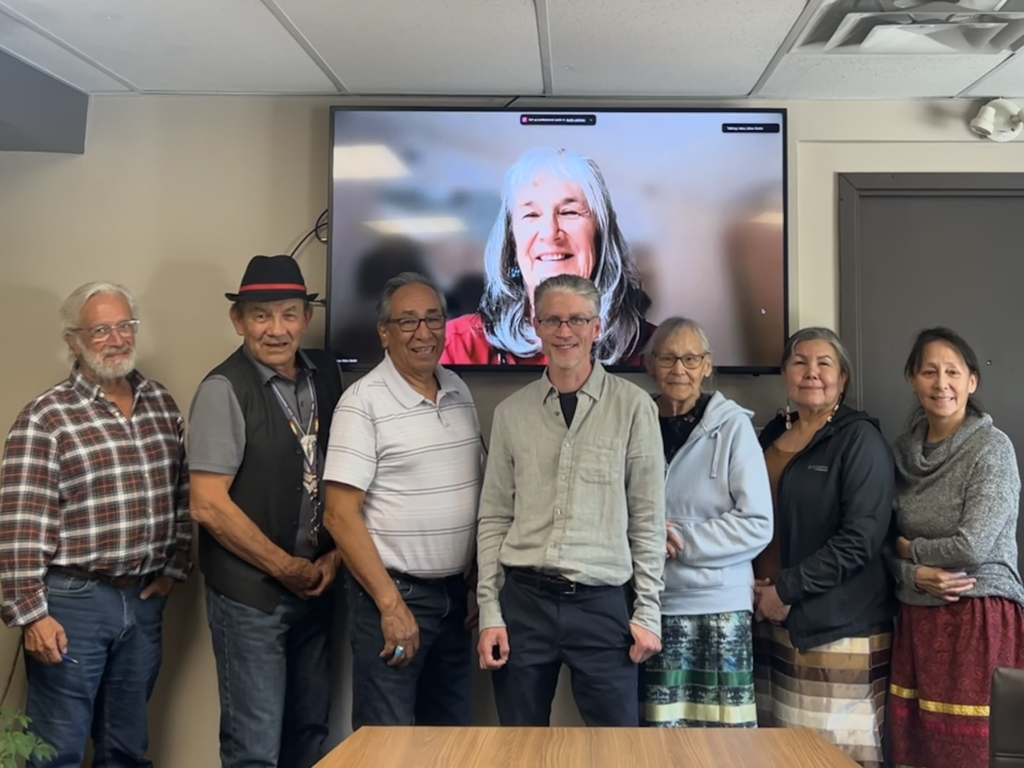
Figure 1: Reconciliation Kenora / Azhe-mino-gahbwewin Elders Circle meeting, June 11, 2025. Left to right front row: Cuyler Cotton, Howard Copenace, Robert Greene, Jeffrey Denis, Jeanette Skead, Sherry Copenace, Kathleen Skead. Back row on computer screen: Mary Alice Smith. [Photo by Daniah Kolur]
1
Executive Summary
What does reconciliation mean in Kenora today? This report shares findings from the Azhe-mino-gahbewewin / Reconciliation Kenora research project, a community-driven effort to understand what reconciliation means in the Kenora area, identify local priorities and barriers, and chart possible paths forward. The project was launched in response to the Truth and Reconciliation Commission of Canada’s Calls to Action and was co-designed by the non-profit Reconciliation Kenora and Dr. Jeffrey Denis, a settler sociologist at McMaster University. It was guided throughout by an Elders Circle and grounded in local knowledge and community relationships.
The project began in 2019 with a youth sharing circle involving 11 Anishinaabe, Métis, and non-Indigenous participants, but was soon interrupted by the COVID-19 pandemic. The research team adapted by conducting 47 in-depth Zoom interviews with Indigenous and non-Indigenous residents, including Elders, Knowledge Keepers, activists, and community leaders. Of these, 17 were Anishinaabe from local First Nations, 5 were Métis, 5 were Indigenous people who had moved to Kenora from other regions, and 20 were settlers. Additional insights came from ongoing engagement with the Elders Circle, participation in community events, and a 2023 public gathering, “Booshkegiin Kenora.”
Findings show that reconciliation remains a powerful but contested concept. Many participants described it as a long-term, relational process grounded in education, healing, respect, and restoring balance—between peoples and with the land. Others emphasized the Anishinaabemowin term Azhe-mino-gahbewewin, meaning “stepping back to go forward in a good way,” as a more locally rooted and culturally resonant framework. Some Indigenous participants questioned or rejected the notion of reconciliation altogether, stressing that respectful, equitable relationships never existed to begin with, and calling instead for decolonization, resurgence, and Indigenous self-determination.
Participants agreed that Indigenous-settler relationships in Kenora have long been marked by inequality, racism, and violence. While some progress has been made—such as increased Indigenous cultural visibility, growing representation, and more cross-cultural interaction—many barriers remain entrenched. These include systemic racism, colonial laws and policies, settler myths and ignorance, tokenism, and persistent power imbalances across institutions. Indigenous Peoples in the region continue to face disproportionate rates of poverty, houselessness, and mental health challenges. These realities are deeply rooted in colonial trauma.
Yet, Indigenous communities are also experiencing resurgence and renewal. Despite its challenges, Kenora is home to a long history of anticolonial resistance and Indigenous-settler bridge-building—from Canada’s first civil rights march in 1965 to the Anicinabe Park occupation in 1974, and numerous grassroots reconciliation efforts since. These include educational initiatives, community celebrations, commemoration events, land-based healing and cultural camps, housing and health supports, Indigenous-led advocacy, and cross-cultural partnerships.
Going forward, participants highlighted the importance of building trust, listening across differences, confronting uncomfortable truths, and taking concrete, collective action. Many said that while reconciliation is everyone’s responsibility, the primary burden lies with settlers and settler institutions, given how they have benefited from colonization.
Key recommendations include investing in Indigenous-led programs, services, and cultural revitalization initiatives; fostering youth leadership and intergenerational dialogues; improving educational curricula; building more affordable and supportive housing; eliminating systemic barriers in healthcare and justice; creating more welcoming, inclusive spaces; fulfilling treaty obligations; returning land to Anishinaabe stewardship; respecting Anishinaabe law and jurisdiction; and developing mechanisms to monitor progress. Above all, the report underscores the need for reconciliation efforts to be rooted in local relationships, guided by Indigenous voices, and sustained through meaningful, structural change—not just symbolic gestures.
Next steps should include further research to better understand the needs and experiences of marginalized residents, particularly those living on the streets, and to identify ways to engage settlers who currently see reconciliation as irrelevant to them. The report recommends a collaborative process for using these findings to help shape strategic action plans to advance reconciliation in the Kenora region. It also calls on local Indigenous and settler leadership—including Grand Council Treaty #3 and the City of Kenora, both of which have expressed commitments to relationship-building—to help guide the implementation of these recommendations. The path forward requires courage, honesty, and collaboration. It also requires developing more equitable and sustainable relationships with each other and the land. This report invites everyone in the Kenora region to play a role in that work.
1
Background
Research Project Origins, Team, and Goals
The goals of this research project were to document what reconciliation means to Kenora-area residents, identify barriers to reconciliation, and highlight actions that have been taken—and should be taken—to advance reconciliation in Treaty #3. The idea for the project originated in 2018 when the non-profit organization Reconciliation Kenora / Azhe-mino-gahbewewin invited Dr. Jeffrey Denis—a settler Canadian and Associate Professor of Sociology at McMaster University—to speak at its annual general meeting (AGM).
Reconciliation Kenora was founded in the wake of the Truth and Reconciliation Commission (TRC) of Canada’s 2015 final report by two Kenora-based lawyers, Janine Seymour and Elaine Bright. Ms. Seymour, an Anishinaabekwe from Wauzhushk Onigum Nation, had worked for the TRC documenting the stories of Indian Residential School (IRS) survivors. Ms. Bright, a settler who had moved from Toronto to Kenora, worked with survivors seeking compensation under the 2006 IRS settlement agreement. Inspired by the TRC Calls to Action (2015) and by their own experiences in Treaty #3, they created Reconciliation Kenora with a mandate to improve local relationships and promote education and healing. They established a board of directors with Anishinaabe, Métis, and non-Indigenous members, and were guided by ceremonial Elders Jeanette Skead and her late husband Clifford Skead (Wauzhushk Onigum). Early initiatives included hosting a reconciliation powwow, workshops on colonialism, land-based learning and reconciliation camps, and the creation of a community medicine garden.
At the 2018 AGM, Dr. Denis presented findings from his earlier research on Indigenous-settler relations in the Fort Frances area (published in 2020 as Canada at a Crossroads). This research documented “boundaries” and “bridges” between Indigenous and settler communities and examined why anti-Indigenous racism persisted even amid widespread cross-group relationships. His findings resonated with the audience, which included Reconciliation Kenora board members, Kenora city councillors, the late Anishinaabe Elder Nancy Morrison (Onigaming), and Grand Chief of Treaty #3 Francis Kavanaugh (Naotkamegwanning).
After the meeting, Reconciliation Kenora board members approached Dr. Denis about applying for research funding to study what reconciliation might look like in Kenora. The rationale was to clarify local Indigenous and non-Indigenous visions for reconciliation, identify priorities for action, and find ways to engage more settlers in the process. It was thought that answering such questions through research could help inform a strategic plan to act on the local vision(s) and develop concrete measures of success. From an academic perspective, Dr. Denis was also interested in how local histories and social contexts shape the meaning(s) of reconciliation and the possibilities for action.
Dr. Denis then applied for and received a Social Sciences and Humanities Research Council Insight Development Grant (SSHRC IDG) to conduct the research. The grant proposal, including the research questions and methods, was developed collaboratively with Reconciliation Kenora board members, including Elaine Bright (co-chair), Kathleen Skead (co-chair), Jeanette Skead, Daryl Redsky, Sarah Beckman, E.W. Stach, Delores Kelly, Lloyd Comber, Martin Camire, Rory McMillan, Will Landon, Jake Boutwell, Candice Holmstrom, and Tracy Lindstrom. Upon receiving the grant, the board appointed a local community coordinator, Sarah Beckman, to help arrange interviews, sharing circles, and logistics. McMaster University students Kerry Bailey, Daniah Kolur, Konrad Kucheran, and Nick Martino were hired as research assistants to transcribe interviews and support other tasks.
In consultation with the board, an Elders Advisory Circle was also formed to provide guidance throughout the project. The initial Circle included ceremonial Knowledge Keepers Jeanette Skead (Wauzhushk Onigum) and Stephen Kejick (Shoal Lake 39), as well as Sally Skead (Wauzhushk Onigum), Daryl Redsky (Shoal Lake 40), Tommy Keesick (Grassy Narrows), and Mary Alice Smith (settler/Omashkiigoo-James Bay Cree). After the passing of Elders Stephen Kejick and Sally Skead, and as the project adapted to COVID-19 pandemic conditions, additional Elders were invited, including Robert Greene (Shoal Lake 39), Sherry Copenace (Onigaming), and Howard Copenace (Naotkamegwanning). Upon the Elders’ advice, a few experienced and trusted settler residents—E.W. Stach and Cuyler Cotton—were also included in the Circle.
In short, the overall aim of this project was to conduct research that could inform an action plan to advance reconciliation locally. To this end, we asked participants what reconciliation means to them, what barriers they see, and what actions have been taken or should be taken to improve relationships in the Kenora area. We also inquired about their perceptions of how Indigenous-settler relationships had changed (or not) over time, reconciliation initiatives in which they had been involved, recent local incidents related to racism or reconciliation, and their hopes and visions for the future.
Research Process: Data, Methods, and Challenges
As a first step, Dr. Denis met with the Elders Circle in 2019 to seek advice on the research design. Following local cultural protocols, Elders were offered tobacco and honoraria. The plan was to hold separate sharing circles with Elders, youth, and people living on the streets—people whose voices are not always heard. In December 2019, one sharing circle was held at Beaver Brae Secondary School with 11 Anishinaabe, Métis, and non-Indigenous youth. The circle was co-facilitated by Daryl Redsky and attended by Elders Jeanette Skead and Tommy Keesick. Rich conversations unfolded over roughly three hours, and the session was video recorded. Student participants received lunch and gift cards in appreciation for their time and contributions.
Although additional sharing circles were scheduled for spring 2020, the onset of the COVID-19 pandemic forced the project to pause for more than a year. As the pandemic dragged on, and as several Elders we had planned to interview passed away, we pivoted to Zoom interviews with participants who were comfortable using the technology and speaking one-on-one. In total, Dr. Denis conducted 47 in-depth interviews, primarily with Elders, Knowledge Keepers, and leaders in local Indigenous and non-Indigenous communities. Of these, 17 were Anishinaabe from local First Nations, 5 were Métis, 5 were Indigenous people who had moved to Kenora from other regions, and 20 were settlers (7 of whom were born and raised in Kenora). Interviews ranged in length from approximately one hour to more than three hours and were transcribed verbatim.
Since 2022, Dr. Denis returned to Kenora multiple times to meet with the Elders Circle and attend community events, including a National Day for Truth and Reconciliation (Orange Shirt Day) walk, the Wauzhushk Onigum Fall Harvest, and the 50th anniversary of the Anicinabe Park occupation. He also met informally with many research participants and spent time at Tunnel Island, the Kenora Fellowship Centre, The Muse, Shoal Lake 40 First Nation’s Museum of Canadian Human Rights Violations, and local IRS memorial sites (St. Mary’s and Cecilia Jeffrey).
In October 2023, a public gathering known as “Booshkegiin Kenora” (“It’s Up to You”) was held in partnership with Kenora Moving Forward, a grassroots coalition of Indigenous and non-Indigenous residents working with people on the streets to improve their safety and sense of belonging (KMF Coalition, 2023). At that video-recorded event, Dr. Denis presented preliminary findings from the Reconciliation Kenora research project and invited further discussion. Feedback from that gathering has been incorporated into this report.
A further challenge that must be noted here is that during the COVID-19 pandemic, the Reconciliation Kenora board stopped meeting and, at least temporarily, ceased functioning as an organization. Nevertheless, Dr. Denis continued to consult with the Elders Circle and, with its guidance, completed the research in hopes that it would still benefit the wider community. The stories and insights shared in interviews and sharing circles were extremely rich and there is much to learn from the project that may inform future research, policies, practices, and strategic action plans.
It should also be noted that, in the sections that follow, some interview and sharing circle quotations are attributed to individuals who gave permission for their names to be used. Others remain unnamed because participants preferred anonymity or did not respond to requests regarding their preferences.
Reconciliation in Context: Key Terms and Local History
Before sharing the research findings, it is important to contextualize this study. This section does so in two ways: (1) by summarizing key debates about reconciliation in the academic literature, and (2) by outlining the local history of Indigenous-settler relations in the Kenora area.
Debates about Reconciliation
Across Canada, dozens of organizations, many of them Indigenous led, are working toward reconciliation (Davis et al., 2017). These include national groups, such as Reconciliation Canada and the National Centre for Truth and Reconciliation, as well as smaller community-based groups like Reconciliation Kenora / Azhe-mino-gahbewewin, the community partner on this project. At the same time, ongoing violence and injustices against Indigenous Peoples—from the crisis of missing and murdered Indigenous women and girls (National Inquiry into MMIWG, 2019) to federal approvals of mines and pipelines without Indigenous consent—have led some Indigenous activists to declare that “reconciliation is dead” (Ballingall, 2020). This sentiment was reiterated after 215 potential unmarked graves of children were uncovered at the former IRS site in Kamloops, B.C., in 2021 (Dickson & Watson, 2021).
Reconciliation is a widely used and much contested term in the academic literature (e.g., Borrows & Tully, 2018; Brant Castellano, Archibald, & DeGagné, 2008; Clark, De Costa, & Maddison, 2016; Craft & Regan, 2020; Daigle, 2019; Denis & Beckman, 2022; Freeman, 2014; Henderson & Wakeham, 2013; Mathur, Dewar, & DeGagné, 2011; Paquette, 2020; Simpson, 2017; Snelgrove, 2021; Stark, Craft, & Aikau, 2023; Whyte, 2018; Younging, Dewar, & DeGagné, 2009). While dictionary definitions tend to emphasize the idea of restoring friendly relations after a conflict, the TRC (2015) noted in its final report that “friendship” never characterized Indigenous-settler relations in some regions. Nonetheless, Treaty #3 was negotiated in 1873 between the Anishinaabe and the Crown in what is now called Northwestern Ontario. From an Anishinaabe perspective, the treaty is a nation-to-nation agreement to share the land and resources, respect one another’s political autonomy, and support one another in times of need (Denis, 2025; Krasowski, 2019; Luby, 2010; Mainville, 2007). In this context, the TRC’s (2015: 113) notion of reconciliation as peaceful co-existence and “healthy relationships … going forward” may still resonate.
Canadian governments, churches, and some Indigenous leaders began promoting reconciliation in the late 20th century, especially after the 2008 federal apology for the IRS system. However, many Indigenous scholars and activists were critical of this focus. Given that colonial policies and practices continue to operate in Canada, they argued that reconciliation put the cart before the horse (Alfred, 2009; Corntassel & Holder, 2008; Coulthard, 2014; Simpson, 2014). In their view, reconciliation was an inappropriate—and potentially harmful—framework, especially if led by colonial governments that retained control over the process. Public apologies, they argued, risked being more performative than transformative (Daigle, 2019), offering settlers a sense of moral relief without addressing structural inequality (Alfred, 2009). They urged Indigenous Peoples to turn away from state-centred recognition politics and toward resurgence—revitalizing Indigenous governance systems, languages, family structures, and ways of life (Corntassel, 2012; Coulthard, 2014; Simpson, 2017).
The TRC (2015), meanwhile, upheld reconciliation as a worthy goal, offering 94 Calls to Action to guide its pursuit. Appointed by the federal government after the 2008 apology, the TRC spent six years investigating the history, experiences, and consequences of the IRS system. Its final report defined reconciliation as a complex, multidimensional, and multi-generational process that must involve education, healing, commemoration, cultural revitalization, respect for treaty, constitutional, and human rights, closing gaps in socioeconomic and health outcomes, and “integrating Indigenous knowledge systems, oral histories, laws, protocols, and connections to the land into the reconciliation process” (TRC, 2015: 3).
Following the release of the TRC report, polls showed that a majority of Canadians supported the principle of reconciliation (Environics, 2016). A growing body of work, much of it by Indigenous authors, offers practical tips on “ways to reconcile” (e.g., LeMay, 2025; Robertson, 2025). To date, however, few of the TRC Calls to Action have been implemented (Jewell & Mosby, 2023). Moreover, reconciliation often means different things to Indigenous and non-Indigenous people. Denis and Bailey (2016) found that while many settlers who participated in TRC events endorsed most aspects of the TRC’s definition of reconciliation, they rarely recognized the centrality of land for Indigenous participants. Although many settlers may support education, healing, and relationship-building, they are less likely to call for dismantling the colonial state or advancing Indigenous land back efforts (cf. Simpson, 2016, 2017).
A Brief Overview of the Local History of Indigenous-Settler Relations
One understudied issue is how the meanings and possibilities of reconciliation depend on local context. What does reconciliation look like—or what could it look like—in Treaty #3? As Anishinaabe Elder Fred Kelly (Onigaming) writes, “If reconciliation is to be real and meaningful,” it cannot be a “generic process … imposed on [Indigenous] peoples without regard to their own traditional practices” (Kelly, 2008: 22). It must be rooted in local histories and relationships, and “embrace the inherent right of self-determination through self-government envisioned in the treaties” (23).
Kenora’s history is rich and complex, marked by colonial oppression, racism, and violence, but also by many efforts to build bridges between Indigenous and non-Indigenous people. While a comprehensive history of Indigenous-settler relations in the Kenora area is beyond the scope of this report, it is important to highlight some features of the local context that have set in motion distinct kinds of relationships and mindsets, and that continue to shape both the barriers and opportunities for reconciliation today. (For a historical timeline, see Appendix).
Once labelled “Canada’s Alabama” for its rigid racial divide (Anglin, 1965; Clarke, 1965), Kenora—whose current population stands at about 15,000, including 12% First Nations, 11% Métis, and a majority white/European-descended residents (Statistics Canada, 2022)—has a longstanding reputation for racism, violence, poverty, and houselessness (Malone, 2018). It has also been a hotbed of Indigenous rights and reconciliation activism (Kinew, 2015; Rutherford, 2020). The surrounding area is home to 10 First Nations within roughly an hour’s drive, with an on-reserve population of more than 4,000, underscoring the region’s strong Indigenous presence.
The Anishinaabe of this region have long been a powerful independent nation, with their own governance systems, economies, social structures, and vibrant cultural practices (Denis, 2020; Grand Council Treaty #3, 2013, 2023; Luby, 2020; Willow, 2012). After extensive negotiation, the Anishinaabe and the Crown signed Treaty #3 in 1873. While the Anishinaabe viewed the treaty as a peace and friendship agreement between autonomous nations, the Canadian government treated it as a legal “surrender” of 55,000 square miles of land in exchange for much smaller reserves, annuities, and the protection of harvesting rights (Krasowski, 2019; Mainville, 2007).
Soon afterwards, settlers and settler governments violated the treaty. In 1876, the federal government imposed the Indian Act on First Nations, seeking to control virtually every aspect of their lives, including identity (‘Indian’ status), marriage, mobility, and voting rights (Joseph, 2018). Across Treaty #3, reserve lands and wild rice beds were flooded, hunting and fishing restrictions were enforced, gold was mined on the Rat Portage (Wauzhushk Onigum) reserve without consent or compensation, Shoal Lake 40 was cut off from the mainland during construction of the Greater Winnipeg Water District aqueduct, and multiple First Nations were forcibly relocated (e.g., Luby, 2020; Perry, 2016; Waisberg et al., 1996). Such actions were upheld by court decisions, such as St. Catharine’s Milling and Lumber Company vs. The Queen (1888), in which the Anishinaabe were labelled “heathens and barbarians,” “rude red men,” and an “inferior race … in an inferior state of civilization” (quoted in Waisberg et al., 1996: 342). In short, the balance of power shifted decisively (Denis, 2020).
The early 20th century brought further trauma, as the Crown expropriated Indigenous lands and resources, and Indigenous families were torn apart. Treaty #3 had one of the highest concentrations of residential schools in Canada, including three in the vicinity of Kenora—Cecilia Jeffrey (1902-1976), McIntosh (1925-1969), and St. Mary’s (1897-1972)—where multiple generations of Anishinaabe and Métis children were abused, neglected, and, in some cases, died (TRC, 2015).
Story Box 1: Name Change
Adolphus Cameron: “When I was seven, I went to residential school. It took me a while to learn English, but my friends that I grew up with around Minaki, they helped me get adjusted. Well, they told me the do’s and don’ts of being around there. I always had long hair and when I got into residential school, you got it shaved off; now, you’re a brush cut. And it was my relatives at Cecilia Jeffrey [CJ] that used to tell me what I was being asked and how I was supposed to do things. But they’d whisper to me in Ojibway because they didn’t want to get into trouble. We weren’t allowed to speak openly in our language. My parents tried to prepare me, and they helped me write my name, which they told me at the time was Douglas Cameron. But according to the band registry, I was registered as Adolphus Hunter. So, when I went to school, some of us were asked to write our names on a blackboard. And we had one of the famous teachers of CJ. [She was] the first teacher I ever had. So, when I wrote Douglas Cameron on the blackboard, she made sure I forgot about that. She slapped her students! And I got slapped a few times, until I got used to the name Adolphus Hunter. [Pause] So, … for me to get away from any type of corporal punishment, I had to learn fast. Learn English. Learn to spell. I also learned not to speak in my language …. As a kid, I thought everything they were trying to teach me was really the best way, so I tried to fit in … I had seen the difference in the way Anishinaabe people were being treated at an early age and I didn’t want to be treated like that. But no matter if I had the best marks in school, if I did things great, it was still the same: nothing changed.”
Meanwhile, white settlers controlled Kenora’s political institutions and monopolized the well-paid jobs in forestry, mining, tourism, and social services (Rutherford, 2020). While some settlers also faced hardship, many benefited—directly or indirectly—from the exploitation of Indigenous lands and resources, and their comfort, wealth, and security often came at Indigenous Peoples’ expense. Indigenous families, by contrast, were coping with the intergenerational impacts of colonial violence, systemic exclusion, and harsh living conditions.
Yet, Anishinaabe and Métis people survived and resisted. In fact, Kenora became an epicentre of Indigenous activism. Amid the extreme inequality, in 1965, more than 400 members of nearby First Nations bussed into downtown Kenora and marched peacefully to protest racism and poverty—an event that came to be known as “Canada’s first civil rights march” (Rutherford, 2020). At that time:
“… on average one indigenous person a week was found dead somewhere on a Kenora street. There was open, random violence against indigenous people [and] indigenous people weren’t allowed in the same restaurants or bars non-indigenous people frequented.” (Paul, 2015: np)
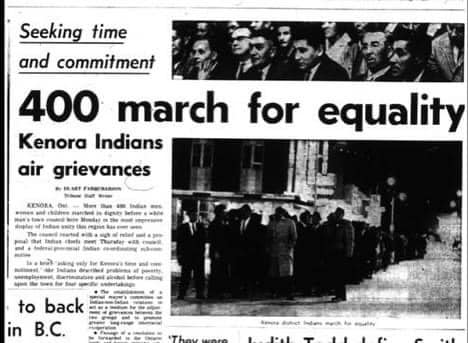
Figure 2: Winnipeg Free Press headline re: Kenora civil rights march, 1965. [Creative Commons]
After securing a meeting with the mayor and capturing media attention, some small and largely symbolic steps were taken, such as the creation of a race relations committee in Kenora. However, racism and poverty persisted, land and resources continued to be appropriated, and Treaty #3 was still being violated.
In 1973, the Concerned Citizens Committee—a subcommittee of the Kenora Social Planning Committee, which included Indigenous and non-Indigenous representatives of various organizations, social services, and government agencies—published the “Violent Deaths Report” (also known as “While People Sleep”). It highlighted the high rate of sudden, “unnatural” deaths among Indigenous people in Kenora (Rutherford, 2020: 87) and recommended more funding for social services, housing, mobile clinics, a detox centre, better police training, recreational facilities on reserve, increased Indigenous participation and control, respect for Indigenous culture, and “major educational efforts to improve white attitudes toward native people” (Concerned Citizens Committee, 1973: 21-22). That fall, the Ojibwa Warriors Society (OWS), led by Louis Cameron (Wabaseemoong), staged a 36-hour sit-in at the Department of Indian Affairs office, calling for “greater economic autonomy for local First Nations, government action on mercury contamination, and an end to the physical brutality, discrimination, and racism they experienced in Kenora” (Rutherford, 2020: 103).
In 1974, with these issues unresolved, the OWS organized a 39-day armed occupation of Anicinabe Park to draw attention to the land question, ongoing colonial violence, and Indigenous Peoples’ dire socioeconomic conditions (Dunk, 2003). They asserted that the federal government had sold the 14-acre park to the City of Kenora without the First Nations’ consent, and called for better housing, education, and health care, and an end to police brutality. In response, a Kenora nurse published the pamphlet Bended Elbow, which blamed Indigenous Peoples’ social problems on their own “irresponsible” behaviour and claimed that white taxpayers were the true victims of “discrimination” (Jacobsen, 1975). The Kenora mayor blamed the federal and provincial governments, and said he hoped the demonstration would lead to positive change for Indigenous Peoples. Eventually, the Ontario premier agreed to meet with Grand Council Treaty #3 to develop a framework for discussions around land disputes, harvesting rights, and conservation. The OWS ended the occupation when weapons charges were dropped, settler governments said they would study the OWS recommendations, and Grand Council Treaty #3 said it would file a land claim for Anicinabe Park (Rutherford, 2020).
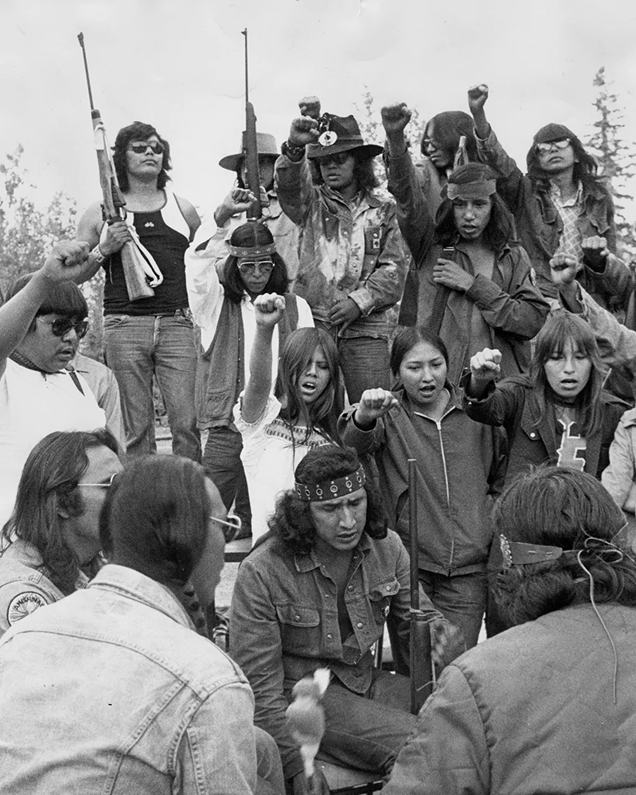
Figure 3: Ojibway Warriors Society (Louis Cameron in the centre) at Anicinabe Park, 1974. [Photo by Canadian Press, reproduced in Harper (1979: 8)]
Yet, racial tensions and inequities persisted. A white gang known as the Kenora Indian Beaters targeted Indigenous residents, especially those living on the streets (Jackson, 2021). Nearby, the Grassy Narrows (Asubpeeschoseewagong) and Whitedog (Wabaseemoong) First Nations suffered the effects of mercury poisoning linked to illegal dumping by a paper mill in Dryden (Willow, 2012). In 2002, Grassy Narrows women and youth initiated what became the longest running anti-logging blockade in Canada to protect their lands from clear-cutting and demand mercury justice (Turner, 2023). Meanwhile, hundreds of Indigenous children across Treaty #3 were forcibly removed from their families and adopted out to white households through the Sixties Scoop and Millennium Scoop (Smith, 2013; Vowel, 2016). By the early 2000s, 94% of Indigenous residents in Kenora reported personal experiences of racial discrimination (Urban Aboriginal Task Force, 2007), and tensions escalated after the killing of Anishinaabe man Max Kakegamic on the city’s streets and a series of lawsuits and investigations into local police misconduct (Makin, 2004).
At the same time, Kenora has been a focal point for Anishinaabe cultural revival. The Lake of the Woods Powwow Club, founded in the early 1970s, sought to regenerate traditional knowledge and cultural practices and to support Anishinaabe residents coping with colonial trauma (Smith, 2014). Members self-consciously (re)learned and reclaimed drum songs and teachings, practiced beading, storytelling, and dancing, and organized annual community powwows. More broadly, Treaty #3 is well known for its spiritual strength, longstanding Midewiwin (Grand Medicine Society) practices, and ongoing efforts to revitalize Anishinaabe language and ceremonies.
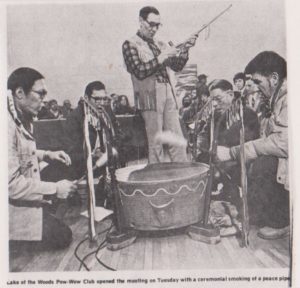
Figure 4: Lake of the Woods Powwow Club, Kenora, late 1970s. [Photo from Smith (2014)]
In addition, Kenora has seen many efforts toward Indigenous-settler alliance-building and reconciliation. Starting in 1965, an Indian-White Committee (IWC), consisting of local Indigenous and settler residents, including Fred Greene (Shoal Lake 39), Harry Shankowsky (settler), and Fred Kelly (Onigaming), met regularly and sought to educate the public by, for example, hosting guest speakers to talk about “cross-cultural tensions” (Rutherford, 2011: 89). They also wrote reports and lobbied for change in Indigenous living conditions. Together, they organized the 1965 civil rights march, and their speeches framed Indigenous and white residents as “neighbours” who were both responsible for finding solutions to their “mutual problems” (Rutherford, 2011: 49-50).
Meanwhile, Daniel Hill, the Black Canadian chair of the Ontario Human Rights Commission, gathered complaints about the mistreatment of Indigenous Peoples in Kenora and advocated on their behalf. White activists, lawyers, and others supported the Anicinabe Park occupation. Another group, led by Anishinaabe residents Richard Green and Joe Morrison, created the Kenora Street Patrol to ensure safety, food, and shelter for the city’s mainly Indigenous houseless community (Maxwell, 2011). The Ne-Chee Friendship Centre further contributed by organizing “Red and White Socials” that brought together Indigenous and non-Indigenous residents in fun social events.
Bridge-building efforts picked up again in the early 2000s when the Anishinaabeg of Treaty #3 and the City of Kenora entered a unique partnership known as the Common Ground Initiative. This “local process of formal government-to-government relationship-building and negotiation” involves the co-management of Tunnel Island, land formerly owned by the Abitibi Consolidated forestry company and over which the city previously sought unilateral control (Wallace, 2013: 137). Aiming to reconstruct “an equitable treaty partnership,” Common Ground has fostered inter-community group dialogue, centred Anishinaabe ceremonies and worldviews, and drawn on personal and collective stories tied to the land to work towards a common vision for the future (138).
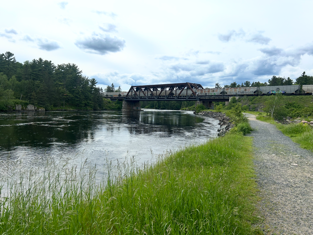
Figure 5: Tunnel Island or Wassay Gaa Bo, site of the Common Ground Initiative, 2024. [Photo by Jeffrey Denis]
More recently, as this report will highlight, local reconciliation—as well as healing and resurgence—efforts have proliferated. Following the TRC’s (2015) final report, a small group of Indigenous and settler residents formed the non-profit Reconciliation Kenora / Azhe-mino-gahbewewin. Calling for local implementation of the TRC Calls to Action, the group elected a board of directors and adopted a mandate “to undertake and support community initiatives in the Kenora/Treaty 3 Region, which promote reconciliation, … improve relationships between indigenous and non-indigenous people, … and promote education and healing” (Reconciliation Kenora, 2017: np). This research project was launched to help inform their work.
Although many Kenora residents may not be aware of this history—as our youth sharing circle, described below, suggests—it nevertheless has shaped today’s relationships, material conditions, and political landscape. This report asks: How do residents—especially Elders, youth, and community leaders—perceive Indigenous-settler relations? What does reconciliation mean to them? What do they see as the main barriers? What actions are they taking to improve relationships, and what further steps do they recommend? The “Findings” section will examine these questions, starting with participants’ descriptions of Indigenous-settler relations and how they have changed (or not) over time.
1
Findings and Analysis
Overview
This section summarizes the major findings from our research. It identifies and analyses key themes in participants’ responses to seven questions:
- How would you describe relationships between Indigenous and non-Indigenous communities in the Kenora area, and how, if at all, have these relationships changed over time?
- What does the term reconciliation mean to you?
- Who do you think is responsible for reconciliation?
- What are the barriers to reconciliation in the Kenora area?
- What reconciliation initiatives have you been involved in, and which (if any) would you identify as models to build upon?
- What additional actions do you think should be taken to advance reconciliation in the Kenora area?
- What is your hope or vision for the future, especially as it concerns Indigenous-settler relations?
Participants discussed a wide range of ideas, initiatives, and recommendations in response to these questions. While many common themes and areas of agreement emerged, there were also conflicting perspectives. Some frequently mentioned ideas and initiatives (e.g., cultural sensitivity training; safe consumptions sites) were praised by some and critiqued by others. Such divergence is unsurprising given the complexity, emotional weight, and power dynamics surrounding reconciliation.
Indeed, a core challenge, as some participants emphasized, is transforming existing power structures within (and beyond) Treaty #3 without provoking so much backlash that it jeopardizes the entire project. For this reason, they stressed the importance of continuously building respectful relationships, trust, and opportunities for ongoing learning and education. This is the spirit in which the present report has been written.
Describing Indigenous-Settler Relations in Kenora
Story Box 2: Welcome Wagon
Jeanette Skead: “It was around 1970, and we had just moved [to Kenora] from the [Wauzhushk Onigum] reserve. One day, me and my auntie were home with her little baby girl [who] was about 6 months old. My uncle went to work. And that afternoon there was a knock on the door … I opened the door. There was this woman standing there, a white woman, and she was holding a big basket, you know, with flowers sticking out and everything, little goodies on the side. [Chuckles] Well, anyway, she asked us where we were from. My auntie said, ‘we are from here, from Rat Portage,’ you know? It was just, no housing, and my uncle found this house and that’s why we moved into town. And the old lady says, ‘oh, okay, well, it was nice to meet you,’ and rushes off …. She took away the basket. She didn’t leave any flowers [or] goodies behind. Nothing. She left and that was it. So, that was my experience moving into town. That was the welcome wagon woman.”
Participants were asked to describe relationships between Indigenous and non-Indigenous communities in the Kenora area and if or how these relationships had changed over time. Responses depended on whether participants were born and raised in Kenora or a nearby community, or had moved there later in life, as more than half of the settler interviewees and a few of the Indigenous interviewees did. In other words, participants’ perceptions reflected their reference points and the moment when they became aware of Kenora’s social dynamics.
Even so, virtually all participants agreed that Kenora had a troubled history of Indigenous-settler conflict, racism, inequality, poverty, violence, and colonial trauma. Many regarded Indigenous-settler relations and Indigenous living conditions in Kenora as worse than in other parts of Canada. Many also agreed that the racism and conflict had been more overt in the past, though there was some difference of opinion around how much relationships and conditions have changed over time.
When describing what relationships were like when they were growing up or when they first arrived in Kenora, participants commonly pointed to overt racism and violence against Indigenous Peoples, segregation and exclusion, the visibility of public drinking among a range of residents (including but not limited to Indigenous people living on the streets), the social and mental health effects of IRS trauma, ongoing assimilation pressures, and the strong sense of ‘us vs. them,’ mistrust, and division between Indigenous and settler communities.
Most of the older Anishinaabe interviewees were IRS survivors, and some shared traumatic childhood memories. Some also contrasted their IRS experiences with their family experiences, suggesting that although they may not have been economically rich as children, they were happy and healthy living a more traditional life among their kin. Elder Jeanette Skead recalled:
“All the Anishinaabe families from all over [Treaty #3] would group together for blueberry picking … every summer we were basically like that. Then, in the fall, all the families would move again, out on the lake, and we’d go rice picking …. In those days, families were families. We wouldn’t leave anybody behind.”
Some Anishinaabe also described visiting Kenora for supplies or services, but not being allowed in certain stores or restaurants, and being warned to be cautious around white strangers. As Elder Skead explained:
“[We] mostly travelled by canoe and boat …. It was just my parents that were allowed to go and shop, and come right back, and then we’d head home. [They told me to] stay close to the boat and watch my little brothers [and] be wary of people, especially the white people.”
Many Indigenous participants reflected on experiences with racism, police brutality, and violence in the Kenora area. For example:
“On one occasion, I had symptoms of a heart attack … pain in my chest … short of breath. My lower jaw was hurting …. I came in by ambulance, and then waited for the doctor, and they did tests …. They were all negative …. So, I asked the doctor, ‘why is this happening?’ …. His response was, ‘most Indians that drink a lot will have those symptoms.’ Me and my wife were sitting there, and we both laughed. We don’t drink!” – Grand Chief of Treaty #3, Francis Kavanaugh
“I remember one time we [Anishinaabe] got into a big fight with [some white guys in] Kenora. They had to phone fire trucks on us and the police. They hosed us down. There was a street brawl between, oh, 30, 40 people, right in front of the Lake of the Woods. We were all having a good time, drinking beer. We didn’t know that the [white] people were just waiting for us [outside]. I got knocked down under somebody’s truck …. Somebody hit me, almost knocked me out. And when I came to my senses, all I seen was this muffler, and I heard ‘brrrr!’, and I said, ‘oh, wow, I better get outta here!’” – Tommy Keesick (Anishinaabe)
Some participants, especially those from mixed backgrounds, also discussed racism within their families.
“I remember growing up and experiencing racism …. There’s no other way of putting it …. Even within my own family, there were … very disparaging and rude comments about our First Nation population. I remember looking at family photos and one of my great uncles saying that, you know, we’re not, we don’t have Indian in us. It was ‘Mexican.’ And it’s like, okay, yeah, ‘cause there’s a really big Mexican colony on Lake of the Woods! But because First Nations people were so poorly regarded, [some] people didn’t want to admit they had First Nations ancestry … if they could hide it, they often would.” – Métis participant
Younger Anishinaabe participants who grew up on reserve were sometimes startled when they visited Kenora to see the racialized inequality, including the visibility of Indigenous people living on the streets. They spoke about feeling shame, sadness, anger, and injustice, and about learning early on about colonial trauma.
“I’d travel [to Kenora] a lot for groceries, for doctors and dentist appointments, and just necessities to bring back to the rez …. I remember the adults in my family, they’d tell us to be careful …. I witnessed a lot of racism …. I also saw a lot of homeless people …. [They’d often] lay in the grass by the old Zellers …. And my grandpa used to talk to them [in] Ojibwe. I don’t know what they were saying, [but] I never saw them as people to be scared of.” – Anishinaabe participant
Settler participants who grew up in Kenora echoed many of these themes. Many recalled witnessing racism and exclusion and being concerned about the large number of Indigenous people living on the streets. According to former City Councillor Rory McMillan (non-Indigenous):
“[In the 1960s-70s], people from First Nations would come into town to conduct their business and sometimes they wouldn’t be able to get home, so they’d find a place to stay overnight, whether it was near a dock or wherever. [And] there were stories shared that [white] people were coming along and pushing [First Nations] people off the docks and into the lake and, in some cases, there were deaths. It was a very major concern.”
Many settlers remembered seeing stark inequalities and assuming Indigenous people just “kept to themselves,” but now realized that they lacked the historical and political context to make sense of the situation:
“I think, as a child growing up, there was a lack of knowledge of the history and some of the challenges that exist as a result … I had questions about why things were the way they were, you know, why certain people don’t have access to the same things we do, why their home life is so different, why so few of them graduated from high school. At that point, I couldn’t comprehend why, but I knew there was differences.” – settler participant
Locally born settlers were also more likely to discuss cross-group childhood friendships. Some older white and Métis men recalled playing hockey against First Nations peers and even visiting them at nearby residential schools. According to a non-Indigenous former municipal politician:
“There was an exchange, so kids from CJ [Cecilia Jeffrey IRS] would come to Valleyview [Public School] and we went to CJ. They had one of them neat fire escapes on the third floor, like a water slide you could go down … as a young kid, when I had my birthday parties, kids from CJ would come.”
In retrospect, some settlers also acknowledged their parents’ racist attitudes or their own past problematic views.
“I’m sure, at certain points in my life, I said some very stupid things and things that I regret. And it’s still a challenge for me to sometimes get my head around it. But obviously residential schools, anybody who’s had children, you feel it in your gut when you hear how children were taken away from their parents and everything that happened to them.” – settler participant
Both Indigenous and non-Indigenous interviewees who moved to Kenora later in life often compared their experiences unfavourably with other places. Many said they were appalled by the overt racism and racialized poverty that they encountered in Kenora, and their overall sense was that relationships were “tense and bitter.”
“I’d say it was a culture shock because I come from a community where my whole schooling, my whole neighbourhood, was so multicultural, so many different nationalities, and then to come to a town where it’s essentially red and white, that was a shock for me. And a shock at the racism in this town. It was an eye opener. I’d experienced some racism in Winnipeg, but not to the extent when I first moved here.” – Tania Cameron (Anishinaabe)
“My first exposure to Kenora was driving through on my way to Winnipeg … I was with a friend, and we were like, ‘what is going on here?’ There was just something so apparently wrong with this picture … there were street people everywhere … almost all the faces were brown, and that image has stayed with me ever since.” – former Executive Director for Waasegiizhig Nanaandawe’iyewigamig (WNHAC) Anita Cameron (Indigenous)
“When I moved to Kenora, you did not see an Indigenous person working anywhere in town …. And I don’t think it’s because there was a lack of will. I think it was a racial thing. My social world includes some real rednecks who grew up during that time, and there’s no doubt about it, all the stories about, you know, Friday night, the boys go out, they’re gonna beat up an Indian, right? That was definitely happening.” – non-Indigenous participant
Some participants also offered vivid metaphors for the distance between communities:
“It really was two ships in the night. If you went to non-Indigenous events, very few Indigenous people came. If you went to Indigenous events, and it’s still—I can almost name on two hands the number of people who are not Indigenous who go to … powwows, feasts, or whatever.” – Sallie Hunt (settler) [Italics added]
“I moved into town with my mom in grade three, and it was a very different side of the tracks … I didn’t know I was poor until I left the reserve. And then that’s when town told me I was poor and I looked that way and you’re, you know, bullied and [there was] lots of racism.” – Anishinaabe participant [Italics added]
At the same time, long-term residents offered nuanced analyses. Even during the overt racism and violence of the 1970s, including the Anicinabe Park occupation, some said the city wasn’t completely divided and there were always people in both communities trying to build bridges and seek social justice. Many of these participants had cross-group friendships. Many also described how some settlers acted as allies—from Indian-White Committee members to white activists, lawyers, teachers, boarding parents, doctors, and church ministers who supported Indigenous families and causes.
Have Indigenous-Settler Relations in Kenora Improved Over Time?
Overall, most interviewees agreed that Indigenous-settler relationships in the Kenora area have improved in some ways, but opinions varied on how meaningful these changes have been. Some viewed recent shifts as mostly symbolic, while others saw more substantial progress. Reported improvements included:
- Positive changes in the education system, including improved school curricula and more Indigenous students graduating, pursuing postsecondary education, and often returning to their communities to “give back.”
“The curricula are changing. And instead of the condemnation and obliteration of the language and culture, in some schools, the Ojibwe language is being taught. Elders are involved in school programs. And culture is increasingly being recognized and celebrated.” – retired judge E.W. Stach (settler)
- More awareness among settlers. As one Anishinaabe participant said, “the gap in understanding has closed a bit.”
- More cross-group interaction.
“In that 50-year span from when I was in public school to now, … I’ve seen much more interaction between the Indigenous and non-Indigenous communities. I see Indigenous people in workplaces where I don’t recall ever seeing it growing up. And there’s more cultural sharing.” – non-Indigenous participant
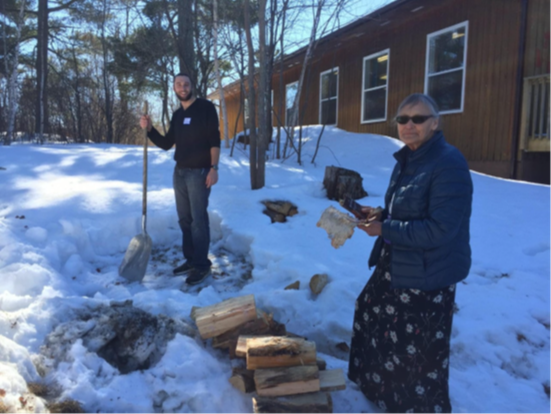
Figure 6: Reconciliation Kenora board members Jake Boutwell (settler) and Jeanette Skead (Anishinaabe) working together at Wauzhushk Onigum, ca. 2018. [Photo by Kathleen Skead]
- More Indigenous people working in ‘mainstream’ organizations and broader representation across sectors.
“I’ve seen a lot of improvements …. I’m seeing Indigenous students working in the stores now. You know, that never happened in the past …. People are a bit more open-minded now. So, it’s starting. And I think it’s up to us to continue the work that’s been started by the [Elders].” – Daryl Redsky (Anishinaabe), speaking to the youth sharing circle
- The growth of Indigenous organizations, some with substantial resources (though some Indigenous participants also raised concerns about corruption and growing inequality within Indigenous communities).
“[Indigenous] people are certainly allowed in restaurants and stores now …. There are so many more Anishinaabe people working in town …. And like in other communities in the region, Indigenous organizations have grown from basically none in the late 1960s to dozens today …. I’d say at least 1,000 people here work directly for Indigenous organizations.” – Mary Alice Smith (settler/Omashkiigoo-James Bay Cree)
- More collaboration and partnerships between Indigenous and non-Indigenous organizations in health care, social services, and beyond.
“There seems to be a bit more cooperation than before. You know, if you look around not only at the reserve communities, but at the towns of Kenora, Dryden, Fort Frances, … there is a lot of commonalities in the issues we’re facing. So, I’ve had several meetings with mayors and reeves across Northwestern Ontario … about how we’re going to deal with these problems, you know, housing, mental health, the drug issues … and we’ve begun to create partnerships.” – Grand Chief of Treaty #3, Francis Kavanaugh
- Greater visibility and celebration of Indigenous cultures, languages, and identities.
“I think for young people and those with perhaps a more progressive mindset, the relationship is probably a lot better … and some of that has to do with the involvement with powwows and Indigenous Day and [other] big, exciting Indigenous events that have been put on.” – Dr. Jonny Grek (settler)
- Less overt racism, public intoxication, and violence—and less tolerance for such behaviour.
“Compared to when I first arrived in Kenora [30+ years ago], there didn’t seem to be nearly as many people on the street [and] public drunkenness seemed to have subsided …. The conversation and the situation with racism seemed to be improving. But I now wonder if it just became less socially acceptable to be overtly racist. Like how much of it is just sort of outward behaviour?” – Indigenous participant
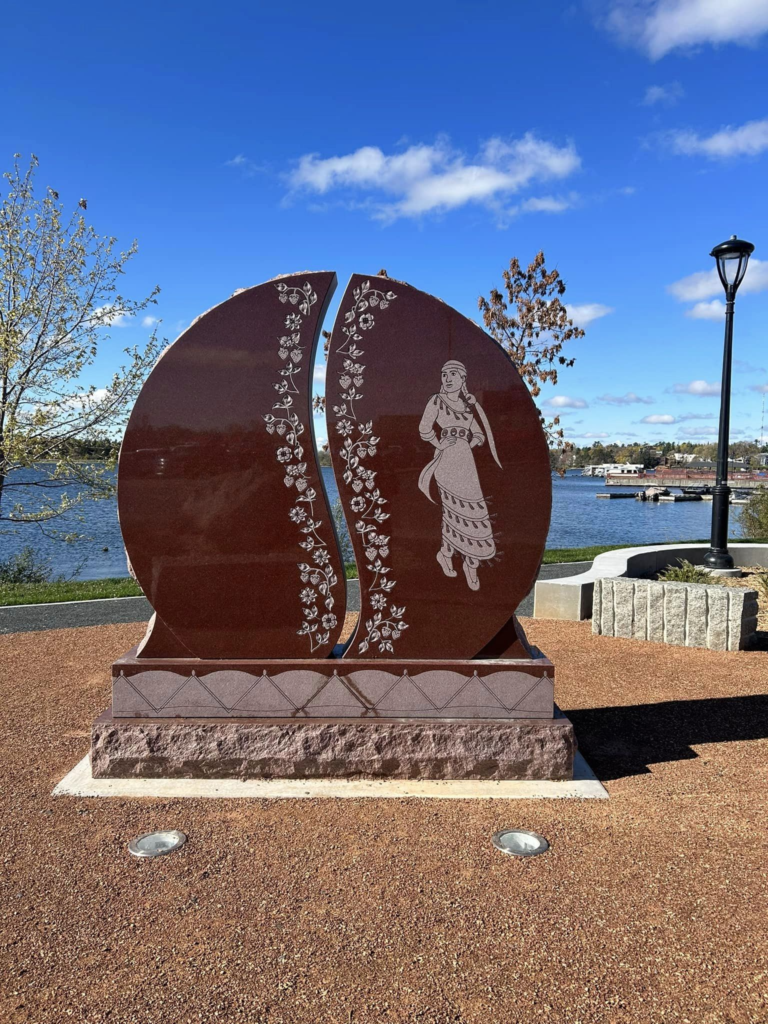
Figure 7: Missing and Murdered Indigenous Women and Girls (MMIWG) Memorial in Kenora, 2023. [Photo by Jeffrey Denis]
Indeed, despite these positive steps, many participants stressed that longstanding inequalities and conflicts remain, and some believed that nothing has fundamentally changed. In describing current Indigenous-settler relations, participants noted:
- A persistent divide between ‘us and them,’ along with polarized views on many social issues.
“I think I’m fortunate to straddle worlds, because I have my redneck world and my politically correct world, and … the rednecks just won’t go to [Indigenous] events, or they’ll say nothing if they find themselves there because of the animosity between the two groups …. There’s also a huge resentment about the businesses downtown being bought up by Indigenous agencies. [And] the longstanding [white] Kenora citizens say they’re afraid to go downtown now, which I think they’re exaggerating.” – non-Indigenous participant
- A deeply entrenched power imbalance, despite recent gains by Indigenous communities.
“I think the biggest challenge in this whole reconciliation conversation [is] that there’s a power dynamic in this town …. I don’t think I’ve ever encountered anything quite like it, but where a certain portion of the community has the power, the privilege, and it is just so deeply ingrained. It’s so taken for granted that the concept of things being any other way is just unfathomable.” – Anita Cameron (Indigenous)
- An ongoing houselessness and mental health crisis, which disproportionately affects Indigenous Peoples due to colonial trauma (Bombay, Matheson, & Anisman, 2014), and which, if anything, worsened in recent years.
“As I grew up, I felt like there was more and more houseless Indigenous people in Kenora. And they were young, like my age or younger. And I was like, ‘what the hell is going on?’ … [During the COVID-19 pandemic, Kenora Moving Forward] opened warming spaces at the churches, and I helped with that. I even stayed there alongside another woman, and I got to see like all the houseless community in there … and I noticed a lot of them have mental health issues.” – younger Anishinaabe participant
- Unresolved conflicts around land and treaties, including ongoing land claims and concerns about treaty violations.
“I think a good show on the part of the settler community [would be] to give this land back. If not those particular chunks, at least an equal amount somewhere, because they’re always taking land. They always have.” – Anishinaabe participant
- Continued exploitation of Indigenous lands and resources, despite Grand Council Treaty #3’s Manito Aki Inakonigaawin (Great Earth Law).
“Nothing has changed. We’re nothing but a dollar sign to a lot of people.” – Kelvin Boucher-Chicago (Anishinaabe), Treaty #3 Grassroots Citizens Coalition

Figure 8: A clear-cut section of the Whiskey Jack Forest, Grassy Narrows, 2006. [Photo from freegrassy.net]
- Frequent clashes over control of services and decision-making authority, including whose laws—Indigenous or settler state—should take precedence.
“The whole intent was to create a safety net for the street people in Kenora. [But due to] politics or posturing or whatever you want to call it, control, that didn’t work out. [Another organization took over and] they’re more of a western mindset, even though a whole bunch of Indians work there.” – Anishinaabe participant describing how a grassroots initiative to support houseless people was co-opted by a Western-style organization
- Continued incidents of racism and violence. For example, several participants discussed an incident in 2022 when a houseless Indigenous man with mental health issues entered the downtown store, Island Girl, and allegedly assaulted the owner (though the owner’s video shows the man on the floor and her holding a hammer). In response, hateful comments were posted online, including at least one calling for “vigilante justice.” In an apparent reference to the Starlight Tours (Green, 2006), a white resident wrote, “Kenora police, when we had them, would drive people like this to the edge of the town and would leave them there. Why can’t we do that?” (cited in Fleury, 2023). In my interviews, Anishinaabe Elders confirmed that this had happened in Kenora’s past. The online comments were condemned by Indigenous and non-Indigenous activists, and Kenora city council held a special public meeting, which led to the promise of a new Community Safety and Well-Being Plan.
“It’s sad that such terrible views are still held in this community. And I think some people just don’t get how dangerous it is for the vulnerable in this town …. You’re not allowed to call for violence on a segment of people …. We have to call out racism. [And] we have to look at the vulnerable as humans [who] need proper care, mental health services, and access to safe, affordable housing.” – Tania Cameron (Anishinaabe)
- Concerns about tokenism, even as more Indigenous people are working in town and serving on boards.
“I’m welcome to be a part of the larger community as a token, [and] that is a very uncomfortable place to be after a while. When you get all your personal issues sorted out and you don’t need that kind of ego stroking anymore, you just feel used.” – Indigenous participant not originally from Kenora
- A growing backlash among some settlers, who feel threatened by decolonial movements and recent changes that have benefited Indigenous Peoples.
“I know there’s always been divides, but sometimes it feels like the divide is becoming more intense. Especially after those recent incidents with the street community, a lot of [non-Indigenous] people seem threatened and scared.” – Elauna Boutwell (settler participant)
“My children who are now raising their children in Kenora are, I would say, shockingly racist. And it didn’t come from me …. It may have come from a culture that felt the pendulum had swung too far, and now [white people] weren’t being treated fairly.” – settler participant
- Many initiatives seem to ‘preach to the converted.’ Although a strong core of Indigenous and non-Indigenous activists works well together, many participants believed there is still widespread ignorance and fear among settlers and limited interaction between the communities overall.
Story Box 3: Bystander Effect
Mary Alice Smith: “The racism and stereotypes are so ingrained here. Sometimes it seems that things haven’t changed much over the years. My late mother-in-law Ada Morrison shared a vivid memory of an experience in downtown Kenora back in the ‘70s when she was working at the courthouse. She’d had severe rheumatoid arthritis since her late teens. With a knee and ankle fused, she always walked with a cane and was in constant pain. One day she was crossing a busy intersection by the chip truck, in the middle of the day, when her leg gave out and she fell to the pavement. Unable to get up on her own, she just laid there; people walked by and around her. Nobody looked down at her or asked if she was okay. She said she lay there for a long time until finally someone who knew her came by. ‘Oh, Ada! Are you okay?’ They helped her up and to the other side of the street. I often imagine what that must have been like to be lying there and having people walk around you, like you didn’t even exist … ‘oh, there’s another drunk Indian lying on the street, how disgusting, how sad.’ You might think, ‘oh, but that was 50 years ago.’ Yet just last winter [2020] the same thing happened to our family’s auntie Dorothy. She was walking down Matheson Street by the laundromat, in the winter. It was icy. She fell and broke her hip, couldn’t move. She was in a lot of pain, moaning. And people just kept walking by. Again, another Anishinaabe person who knew her was driving by, and they pulled over right away and got her to the hospital. But it’s the unresponsive bystander phenomenon where people usually don’t stop to help if someone is different from them; you don’t think of them as part of your community. It’s like the brain is wired to say, ‘they’re not one of us, ignore them, it’s not my problem.’ But if it’s someone like us, our empathy kicks in.”
Given these perceptions of past and present relationships, the next section will examine what ‘reconciliation’ means to Indigenous and non-Indigenous participants today.
What Reconciliation Means
All participants were asked what the term reconciliation means to them. Not surprisingly, they shared a wide range of perspectives, which tended to fall into three broad categories.
- A process of learning, healing, and building better relationships.
Many participants echoed the TRC (2015), defining reconciliation as a combination of learning about the historical and ongoing mistreatment of Indigenous Peoples, healing from past traumas, and working toward more equitable and respectful relationships.
- A preference for the Anishinaabemowin term, Azhe-mino-gahbewewin.
Some participants favoured the name gifted to Reconciliation Kenora by the late Elder Clifford Skead. As he explained at the 2018 AGM, Azhe-mino-gahbewewin means “stepping back to go forward in a good way.” He also said it was about “returning to a place of good standing,” as envisioned by Anishinaabe leaders when Treaty #3 was negotiated in 1873. Because it is locally rooted and expressed in the Anishinaabe language, several participants felt it was more relevant than the generic English term ‘reconciliation.’
- A rejection of reconciliation as a concept.
Others, especially Indigenous participants, argued that reconciliation is a misplaced goal because Indigenous and non-Indigenous people never had good or equitable relationships in Treaty #3 to begin with, at least on a nation-to-nation level. In principle, they said, there may be nothing to reconcile. Several Anishinaabe Elders and leaders stressed that revitalizing Indigenous languages, cultures, and ways of being should take priority, rather than seeking reconciliation with settlers who may not be ready or willing to pursue it.
To elaborate on this range of views, the following ideas were each mentioned by three or more participants in response to the question, “What does reconciliation mean to you?”:
- Rebuilding relationships—between and within groups
- Working together to address social issues (e.g., houselessness, addictions)
- Creating spaces where everyone feels welcome
- Treating one another well in everyday interactions
- Listening to and learning from Indigenous Peoples
- Education—especially for settlers; learning about the past to understand present dynamics and avoid repeating harms
- A personal learning and healing journey: reconciling with self and family; for Indigenous Peoples, understanding and healing from the impacts of colonization; for settlers, looking in the mirror and questioning one’s assumptions and biases
- Honouring treaties
- Restoring balance—within oneself (i.e., mental, emotional, physical, spiritual) and between groups (i.e., balance of power)
- Revitalizing Indigenous languages, cultures, and traditions
- Making things right—rectifying inequalities and injustices (e.g., funding gaps, boil-water advisories) and promoting fairness, equity, and inclusion
- Implementing the TRC Calls to Action
- Addressing and eliminating racism
- Breaking down organizational silos and developing partnerships
- Peace and friendship
- Mutual understanding and respect
Many participants emphasized that reconciliation cannot be achieved by a single event or individual. It is an ongoing process involving many people and multiple generations. Some added that truth-telling must come first, and that reconciliation requires concrete action, not just symbolic gestures. Several participants, especially Anishinaabe Elders, also stressed that reconciliation is not only about relationships between or within peoples, but also about relationships with the land. Some connected this idea to the fact that Canada was founded on Indigenous dispossession and argued that any meaningful reconciliation must involve the return of land and governing authority to Indigenous Peoples.
In Participants’ Own Words
- “To me, reconciliation is about bringing back what was, in a lot of cases, taken away from Indigenous people. It’s about educating people … understanding what the treaty’s all about, … understanding the 94 Calls to Action [and] that those things need to happen.” – Martin Camire (Métis)
- “Reconciliation means trying to restore us to a respectful partnership in the sense that was intended by the First Nations at the time of treaty-making.” – E.W. Stach (settler)
- “To have reconciliation, you have to get rid of the racism …. If there’s no common understanding, and if there’s always going to be the settlers up here [gestures high] and the native person down here [gestures low], then reconciliation won’t happen.” – Bepgogoti (Kaiapo)
- “To me, reconciliation is the day-to-day stuff. It’s not an event …. It’s walking down the street or having coffee. Pre-COVID, every Sunday, I used to sit down and have breakfast with a couple of non-Indigenous friends, and we’d talk about different things—things that are comfortable and things that are not so comfortable. That’s the process of reconciliation.” – Adolphus Cameron (Anishinaabe)
- “I think the [term] Azhe-mino-gahbewewin is more helpful. And my understanding of that is sort of like restoring the good life … it’s about journeying towards the good life together.” – Meg Illman-White (settler)
- “That word ‘reconcile’ doesn’t really sit well with me because we were never on good terms anyway. If there wasn’t a good relationship in the beginning, there’s nothing to reconcile, nothing to go back to.” – Kathleen Skead (Anishinaabe)
- “I have nothing to reconcile with the settlers. I do have a lot to reconcile with myself and my family and my community as a result of what happened. The tragedy that I have lived through. The consequences of my actions because of the generational trauma.” – Daryl Redsky (Anishinaabe)
- “It has to be about action. What are we gonna do to make this [relationship] right, to better ourselves, to educate our friends? … Reconciliation is a slow road, but reconcili-action is the shortcut.” – Craig Lavand (Wauzhushk Onigum)
Youth Sharing Circle – Recognition Matters
In the youth sharing circle, both Indigenous and non-Indigenous participants expressed general support for reconciliation. Although they had a positive impression of the term and perceived it as an important goal, many were unsure how to define it. One student even asked Dr. Denis to explain what the TRC meant by reconciliation.
Still, the youth demonstrated clear, implicit understandings of reconciliation through discussion of activities they had been involved in, such as participation in a First Nations youth council, a local cadets program seeking to involve Indigenous youth, and Orange Shirt Day events at school. These initiatives, they said, helped bring people together and raise awareness about the conditions facing Indigenous Peoples. As one settler student put it:
“I think how to engage people in the process of reconciliation is just doing more things together …. By working together, we can talk to teach other and make more connections. And by doing that, we can learn more and … people will understand.”
Youth were also asked to think of something—an object, person, group, or activity—that symbolizes reconciliation. Their insightful responses included a mixed-heritage family (First Nations father, white mother), a memory of a man from the Netherlands who danced at a local powwow and spoke fluent Anishinaabemowin, and Indigenous artwork and street signs in Anishinaabemowin around Kenora.
Furthermore, reconciliation was exemplified by some of the young people’s actions during the sharing circle itself. Early on, a young Anishinaabe woman said she attended Beaver Brae, but also had a son; as a teenage mother, she had to follow an unconventional educational path. She explained:
“For me to reconcile with people, it’s for people to see who I am. Mostly [people will say], ‘oh, well, you’re not going to graduate high school.’ But here I am. I am graduating. So, it’s just me trying to prove myself [and show] people that we can live together, as human beings.”
After a pause, a young Métis woman responded: “I totally get what you mean …. You’re trying to break the stigma that you can’t finish high school because you decided to have a kid.” She said reconciliation was about combating stereotypes and stigma.
The Anishinaabe co-facilitator Daryl Redsky then praised these young people, saying:
“This is exactly how reconciliation should work—understanding each other …. Just by these two individuals that have engaged, it tells me we’re on our way. You know, [the first student] shared something about herself, and you [the second student] responded in a positive, understanding, and supportive way. To me, that’s reconciliation work.”
This interaction illustrates an important point. Despite academic criticisms of recognition politics (the idea that justice can be achieved simply by being recognized by others), there is value, at the interpersonal level, in being seen as one wishes to be seen, in breaking stereotypes and acknowledging one another’s humanity (cf. Green, 2019). Recognition alone will not undo the unequal power relations between Indigenous and non-Indigenous people, but it is a minimal and necessary starting point for reconciliation—or something like it—to occur.
Responsibility for Reconciliation
When asked “who is responsible for reconciliation?” slightly more than half of all participants said it is everyone’s responsibility. However, many also specified different roles for different groups. Several grounded this view in the idea that, as residents of Treaty #3, “we are all treaty people” with rights and responsibilities that vary depending on one’s Anishinaabe or non-Anishinaabe identity. As Ed Mandamin (Anishinaabe) put it, “we all have a responsibility to research our past in order to see where we want to go in the future … and we’re all binded by the treaty, whether you like it or not.”
Many participants said a key role for settlers is to educate themselves on first principles: learning about the historical and ongoing impacts of colonization, questioning their assumptions, and reflecting on how their own (in)actions and ways of life may support or impede reconciliation. Settlers, they noted, can also support Indigenous-led reconciliation and decolonization initiatives—financially or otherwise—and call on their governments to implement the TRC Calls to Action.
Meanwhile, participants said, Indigenous Peoples’ roles may include being open to sharing their truths and giving settlers a chance to learn and develop more equitable relationships. However, they also stressed that this would take time, and that different people are at different stages in their healing journeys—a process that must be respected. As a young woman of mixed descent in the youth circle explained:
“Healing is really hard, especially for residential [school] survivors. There’s a lot of healing that needs to happen [and] it’s a very long process …. They are still hurting. And I think we have to accept that they have to heal before we can have reconciliation for everybody.”
Further, some participants noted that although many Indigenous people are very generous with their time and willing to educate settlers and include them in events, it is unfair to expect them to always be the teachers. Many said Indigenous communities have been doing most of the heavy lifting on reconciliation and it is beyond time for settlers to step up.
Indeed, many interviewees argued that the primary onus rests with settlers who have benefited from colonization. Some stressed the role of ordinary settlers, at the grassroots level, and the need for reconciliation to be locally driven and part of everyday life. Others put more emphasis on governments, churches, and corporations that imposed colonial policies, operated residential schools, and profited from the theft of Indigenous lands and resources. While ordinary settlers also hold responsibilities, some participants noted that they may not have been fully informed about colonialism and/or may lack the power to directly change harmful laws, policies, and institutions.
Several participants also raised concerns about avoidance or passing the buck—a pattern that must be stopped by taking action when and where one can. Anita Cameron (Indigenous), the former Executive Director of WNHAC, expressed frustration at the “duck and dive exercise” when it comes to implementing the TRC Calls to Action:
“[Governments] just constantly say, ‘that’s not our mandate.’ And if it wasn’t the ‘it’s not a municipal responsibility thing,’ then it would be ‘it’s council—no, it’s administration—no, it’s council—no, it’s administration.’ Or [the province] will say it’s a federal responsibility, and the feds will blame the province.”
In Participants’ Own Words
- “We’ve always been taught that everyone has a role and a responsibility. No one is better or less than anybody, and everyone can contribute to what we now call reconciliation. But it’s really about having healthy relationships …. And I think before we get there, we have to heal together.” – Elder Sherry Copenace (Anishinaabe)
- “It can’t just be political leaders, Chiefs, and prime ministers saying, ‘we need reconciliation’ …. It has to be through bringing everyone, Indigenous and non-Indigenous, to a place of mutual understanding.” – local settler politician
- “I think it’s a responsibility of all of us. When you’re in a relationship, you both need to be working at it, and if there’s been a rift, both need to be seeking reconciliation. If only one party is interested, it’s not likely to happen.” – non-Indigenous participant
- “First of all, [settlers] have to educate themselves. They’re the ones that have to take responsibility for reconciliation, not the Indian. We didn’t do anything wrong.” – Anishinaabe participant
- “It’s a heck of a burden on the Anishinaabe to have to teach the white guys over coffee all the time and to deal with every racist comment …. We non-Anishinaabe have to take some responsibility. We need to have those uncomfortable conversations within our community. It can’t be landing on Anishinaabe people to carry that weight.” – Cuyler Cotton (settler)
- “I think First Nations have to lead it, and we’ll only know if it’s successful when First Nations tell the story—not non-First Nations writing a book about how wonderful they were in reconciling with First Nations.” – non-Indigenous participant
- “I think when we talk about reconciliation now, it’s always us, Indigenous people, trying to bring it about. To bring in settlers and reconcile with the settlers. I have nothing to reconcile with the settlers. I didn’t come and take your land. I didn’t come into your homes to take your children … and bring them to an institution, to kill their spirit, to take away their language, their culture, their family …. To me, it’s the settler community that should be leading reconciliation, coming to me … to show me reconciliation. But it’s always us.” – Daryl Redsky (Anishinaabe)
Barriers to Reconciliation
When asked about “barriers to reconciliation,” participants identified a wide range of obstacles—21 different types, each mentioned by at least three people. While many are common across Canada, others are more unique to the Kenora area. Despite the long list, many participants expressed hope that these barriers could be overcome.
- Ignorance: Participants widely agreed that many settler Canadians are ignorant about colonialism, Indigenous cultures, and the historical and current realities of their Indigenous neighbours. Overcoming this barrier requires open-mindedness and a willingness to learn.
- “Lack of education. Lack of understanding. Stereotypes …. Many people [have] preconceived notions of who Indigenous people are.” – Sallie Hunt (settler)
- “A lot of people in Kenora, they don’t even know what residential schools are and they don’t know a lot of the tragedies that happened. So, when they see our homeless population, a lot being Indigenous, they’re like, ‘Oh, they chose to be like that, they’re just lazy.’ And then those adults teach their kids that, and then their kids grow up with those values. If it were taught in school, … you could end that ignorance.” – settler youth participant
- History of colonialism: Colonialism itself is a barrier because it has meant the appropriation of Indigenous lands and resources and the attempted assimilation of Indigenous Peoples. As many participants said, this process has created tremendous pain, trauma, and mistrust that reverberates across generations. Moreover, colonialism has not ended; many colonial laws, policies, and structural inequities remain in place.
- “Colonization. Manifest destiny …. And intergenerational trauma because of what my mom experienced [in IRS] and what my ancestors experienced.” – Geri Kakeeway (Anishinaabe)
- “The Indian Act … I think it was in the documentary Colonization Road where [Stó꞉lō poet] Lee Maracle said [paraphrasing], ‘It’s difficult to offer forgiveness when you’re still standing on my foot.’” – settler participant
- “I don’t think there’s ever been a year where First Nations people can grieve or heal …. Like, there hasn’t been a year where a friend hasn’t died, or there wasn’t some kind of major event that added to the trauma, and I never had the chance to mourn or to heal because it’s one thing after another …. Even if somebody is living on the street, that’s a huge trauma in itself, and it only exacerbates the use of substances in order to cope with that sort of reality.” – Will Landon (Anishinaabe)
- Racism: Anti-Indigenous racism, discrimination, and stereotypes have long been used to justify colonial policies and practices and the inferior treatment of Indigenous Peoples in Canada and abroad. Many participants agreed racist attitudes remain “entrenched”—perhaps less overt than before but still widespread, often passed down through white settler families, and amplified by right-wing media. The stigmatization of people living on the street—who are disproportionately Indigenous and often intergenerational survivors of the IRS system and direct survivors of the child welfare system—remains a particular concern. Many Indigenous participants also shared painful personal experiences.
- “I experienced a lot of racism [in] high school. You know, my first day in grade 11, one of my shop teachers came and sat in front of me …. He put his arms on the backrest, looked me in the eye, and said, ‘Francis, you already have grade 10. Why don’t you go to vocational school? Why don’t you learn a trade? Indians are only good with their fingers.’” – Grand Chief of Treaty #3, Francis Kavanaugh
- “When I was like 13, I remember sitting in front of the Subway and I had long hair at the time. I remember [a police car] rolling by and being like, ‘hey, you Indian faggot, why don’t you get your mop cut?’” – Will Landon (Anishinaabe)
- “There is an underlying attitude. And unfortunately, it’s still here in Kenora …. I’ve had family members who’ve had issues with the hospital …. I personally have been followed in stores. I’ve advocated for when cashiers refuse to recognize [Indian] status cards.” – Geri Kakeeway (Anishinaabe)
- “Ongoing racism is one [barrier] …. There’s a lot of systems that are still very prejudiced. Even the healthcare system, … a lot of it is not accepting of Indigenous teachings.” – Martin Camire (Métis)
Story Box 4: Calling Out Racism
Anishinaabe participant: “I’m not going to apologize for my community activism. If you don’t like me calling out racism, then don’t be racist, or at least hide it better. They’re not really good at hiding it. I’ve heard stories. There’s business leaders, community leaders, in Kenora that I heard were part of the Kenora Indian Beaters club. There’s people [now in their 40’s who as youth] were advised by family, by community, ‘if you’re going into town, stay in a group. Don’t be caught alone.’ Because there was a gang of guys waiting to find people alone to just beat up, and, in some instances, to rape the girls. One woman told me she got separated [from her friends] and they had to run when they realized guys were waiting for them in the bush. She told me she lost her shoe running for her life. Another young person said they saw a noose hanging and they just ran …. And the saddest thing about the Kenora Indian Beaters is [they included] a set of visibly white brothers who later in their lives realized they actually come from Indigenous heritage, from a local reserve …. But there are people in this town who were part of the KIB. And Indigenous people know who they are. And unfortunately, they pass those values down …. My son is very fair …. And throughout high school, he had mostly white friends …. Around 2016, they were playing basketball and hanging out at the rec center. And then one of the kids said, ‘let’s go walk the shoreline and beat up some Indians.’ And like, ‘what?’ And then someone said, ‘hey, do you know [my son] is an Indian?’ And they all looked. And a couple of his friends were like, ‘forget that.’”
- Lack of agreement on what ‘reconciliation’ means: Without a shared vision or goal, moving forward is difficult.
- “I think it’s the different understandings of what reconciliation means. You know, the [IRS] apology is often taken as ‘we did our part, now let’s move on.’ I heard comments like that. But I know a lot of people would like to see more of the ongoing dialogue or doing things together or even just appreciating and accepting each other’s differences.” – Anita Cameron (Indigenous)
- Lack of Indigenous representation: Although more Indigenous people are working in Kenora than in decades past, they remain under-represented, perhaps especially in leadership positions. This is an inequity in itself and makes it difficult for Indigenous Peoples’ voices to be heard.
- “Some younger people have joked that maybe reconciliation is when they hire an Indigenous person at the local movie theatre because there’s never been one … for someone else, it’s, you walk into a courtroom, and all the judges and lawyers are white and all the people in custody are Indigenous.” – settler participant
- “[As a judge,] one of my functions was to preside over jury trials. And when you looked out in the courtroom to the jury panel, you didn’t see very many brown faces. And that increasingly became a concern of mine.” – retired judge E.W. Stach (settler)
- “There’s a lot of very qualified Anishinaabe people in Kenora, and yet those [city council] positions are still taken up by settlers.” – Métis participant
- Performativity and tokenism: In response to concerns about Indigenous representation, some organizations have hired Indigenous individuals or displayed symbols in support of reconciliation (e.g., Every Child Matters posters). While these steps can be important, they may be seen as tokenistic—that is, more about public performance or impression management—if not backed by broader substantive change. Some participants extended this idea to pro-forma consultations with Indigenous communities regarding resource projects (e.g., mining). If a decision has already been made, or if consultations have no bearing on the decision, the process only exacerbates mistrust and hinders reconciliation.
- “I think the change is starting to happen, but … sometimes it’s performative. Like ‘look at what we’re doing here!’ But there isn’t any real substance … for instance, public school boards … having one or two Indigenous representatives. It’s still tokenism.” – Geri Kakeeway (Anishinaabe)
- Denial and minimization of harms: Some settlers deny that Canada is a settler colonial society, that anti-Indigenous racism exists, or that residential schools harmed Indigenous Peoples (Carleton, 2021). Until such attitudes change, it is difficult to imagine how reconciliation could happen on a wide scale.
- “To me, the biggest barrier is that a lot of non-Indigenous people don’t think there is a problem … they think, ‘oh that was in the past, why don’t we just let it go, things are fine now.’” – settler participant
- Lack of welcoming spaces: Participants lamented the lack of inclusive public spaces in Kenora. Some observed that community events are often cliquish and segregated by race, class, and age. Some also criticized city actions—such as removing benches, cutting shade trees, and adding rocks to grassy areas to discourage sitting—as making public spaces less accessible, especially for the already marginalized people living on the street.
- “Safe spaces don’t really exist in the community anymore …. We used to have places like the mall. There was a chicken shop there [and] Zellers … there was places of gathering that don’t exist now.” – Anishinaabe participant
- “In town, there aren’t many big spaces that you can just have access to where you can come together as community … and smudging is welcome, and drumming is welcome ….” – Meg Illman-White (settler)
- Lack of resources: Some participants said inadequate funding for reconciliation initiatives—and for Indigenous-led initiatives in general—remains a barrier. Often, residents have ideas for improving relationships but lack the resources to act on them. For example, a settler who volunteered to support and advocate for people on the streets said they would like to do the work full-time but needed a paid day job to sustain these activities. Others had creative visions for housing projects and cultural festivals, but no funding to implement them.
- “As much as I’d like to say money doesn’t matter, it does. Unfortunately, we don’t have the capacity [to implement reconciliation initiatives] because we don’t have a budget …. You can’t do very much without significant resources.” – Anishinaabe participant
- “We still see First Nations that have boil-water advisories. Whose education is different from other Canadian children in terms of the amount [of funding] they are given [and] the schooling that’s available …. A lot of them still have to move away from home to attend high school …. Housing continues to be an issue both on and off reserve as well.” – non-Indigenous participant
- Poor coordination of services: Other participants believed the problem was not just a lack of resources, but an inequitable distribution and poor coordination among service providers. Specifically, they said, health and social service organizations compete for funding, duplicate services, and rarely communicate well with one another. Consequently, the system is inefficient and there are gaps in service provision. For example, some participants criticized the perceived “empire-building” of Kenora Chiefs Advisory (KCA), which they felt had jeopardized the functioning of smaller grassroots organizations. Another oft-cited example was the gap in shelter access where, for years, people on the streets had nowhere to go between 4:00 PM and 9:00 PM. While volunteers, such as Kenora Moving Forward (KMF), scrambled to set up warming and cooling spaces and offer meals, their efforts were often resisted by neighbours, and they were forced to move and innovate without a regular budget. Fortunately, in fall 2024, after years of lobbying by KMF and others, the Canadian Mental Health Association (CMHA) began opening its shelter at 4:00 PM. KMF still provides a community space a couple evenings per week. Yet, the broader point stands:
- “Everything is in isolated pockets … it’s tough when not everyone’s working together and everyone’s scrapping over what little funding there is to address these problems.” – Anishinaabe participant
- “You know, the government funds this organization, that organization, and they’re all doing similar work. Is that the best way? How can we collectively work together? …. I understand it’s about protecting your own resources, making sure your staff aren’t without a job. But how can we work together [to] make sure there aren’t gaps [in service]?” – Métis participant
- Co-optation: Still other participants argued that some activists, including Indigenous people, have been co-opted by the lure of money or financial security. They may begin with a genuine desire to make meaningful change but become tied to their positions—working for the paycheque and avoiding actions that might “rock the boat.”
- “Our own people historically have been used by these [political and economic] systems, and they get offered a lot of money. That’s a barrier because … it’s the weaponization of poverty. If you gas up people and give them enough money, … that’s their ticket out of whatever they’re living, right? And then their views get distorted, and they don’t realize they’re being used as a tool of oppression …. You can see this with the nuclear waste [storage proposal]. They’re hiring First Nations people to come and destroy our land …. They’ve lost that spiritual connection.” – Will Landon (Anishinaabe)
- Lack of motivation to change: A further barrier is the lack of motivation among many residents to change. Some participants emphasized that middle-class white settlers are often comfortable with the status quo from which they benefit. Others noted that Kenora’s economy depends, to a significant extent, on providing health care and social services to Indigenous people whose challenges often stem from colonialism. Together, these factors reduce incentives for structural change.
- “I think some people aren’t interested in a relationship, or they don’t think it’s important enough to make an effort, and so that cultural divide is just fine with them.” – settler participant
- “The Indian industry is alive and well here in Kenora …. What I’m trying to tell the street people is ‘you guys are being used for other people to prosper from your misery’ …. And I’ve told that to the elected officials, but they [considered their voters’ interests and] said: ‘we can’t jeopardize our bread and butter.’ So, they won’t do nothing.” –Kelvin Boucher-Chicago (Anishinaabe)
- “Canada profits off of our trauma. They make billions off of us. And I wish people knew these things. I wish our people could grasp what is actually going on.” – Anishinaabe participant
- Power imbalance: Relatedly, some participants stressed that a key barrier is the longstanding power imbalance between Indigenous and settler peoples in the region. After the negotiation of Treaty #3 in 1873, the balance shifted in settlers’ favour (Denis, 2020). While settlers built towns, cities, roads, and railways on Indigenous lands and profited from the exploitation of Indigenous resources, Indigenous people were displaced, sent to residential schools, and subject to oppressive laws and policies. More recently, Indigenous Peoples have been healing from these traumas, re-asserting their rights and ways of life, and reclaiming control. In response, many settlers feel threatened and fear losing power and privileges.
- “I think privilege is the biggest barrier … and it just happens to be white, middle-class, middle-aged, possibly Christian people who’ve traditionally owned much of the downtown here and many of the businesses. And [the attitude is] ‘I own this building, I own these streets, I want to keep hold of that’ …. Once people arrive in that privileged position, you’re gonna do what you can to defend your castle.” – Dr. Jonny Grek (settler)
- “For the longstanding [white] residents of Kenora, it’s fear …. They’re afraid to walk downtown … [But the fear] comes from a loss of power, loss of standing, the status quo being changed.” – non-Indigenous participant
- “By controlling the funding models and program approaches, the [federal] government seeks to control the wellbeing of Indigenous Peoples … they prevent our people from having any real power in so-called Canada.” – Anishinaabe participant
- Clash of worldviews: Some participants spoke to philosophical differences—distinct understandings of land, health, and knowledge. To the extent that Anishinaabe and white people, for example, tend to hold different assumptions (about the nature of reality and ways of knowing) or different values (beliefs about what is important or sacred), reconciliation may be a serious challenge.
- “A lot of white people … think they know it all. [But] they have no concept of their relationship with the earth. And that’s what they do, they plunder it. Like when a hurricane hits, what do they talk about? … Money. ‘Oh, it’s going to cost us a billion dollars.’ Not realizing that the forces of nature are still here …. We have to keep the balance of nature.” – Sally Skead (Anishinaabe)
- “A lot of healthcare settings don’t really accept the Indigenous teachings [about] traditional medicines [and] spirituality in the healing process. They don’t understand that the holistic part needs to be fulfilled—the mental, emotional, spiritual, and physical.” – Métis participant
- Communication: A further barrier cited by many participants is poor communication between Anishinaabe, Métis, and non-Indigenous communities. In part, this may stem from a lack of meaningful relationships, though many residents do have cross-group friendships and mixed families. It also may stem from some of the above factors, including the clash of worldviews, settlers’ fear of losing power, colonial trauma, and the lack of welcoming spaces to gather and discuss such issues. For all these reasons, conversations about reconciliation, racism, and colonialism can be very difficult and uncomfortable.
- “Barriers? I guess a lot of people are set in their ways [and] they don’t want to talk about the racism, hatred, bigotry.” – Anishinaabe participant
- “There isn’t much relationship between the cultures here, even though they’ve lived in the same vicinity for a long, long time. And one of the places I notice that is parents who think they’re going to change it by really encouraging that [cross-group] relationship with their kids, and they have the best hopes that if their kids play together, they will grow to be friends and … that’ll pave a new road. But what they often report is that when the kids become discriminating enough to really understand the different worlds they’re walking in, it just peters out. The relationship doesn’t continue.” – Meg Illman-White (settler)
- Gaps in school curricula: Many participants criticised Ontario’s education system for failing to adequately teach about Indigenous histories, cultures, treaties, or settler colonialism. Although local efforts have been made to improve school curricula, especially since the TRC (2015), there is still a long way to go—in both the public and Catholic boards. One teacher even described how their school board “banned” them from showing their class the 8th Fire series—a 2012 Canadian Broadcasting Corporation (CBC) documentary hosted by the now Premier of Manitoba Wab Kinew (Onigaming)—in case it “upset” anyone.
- “I took Canadian history, and we did learn a bit about Indigenous history, but it wasn’t one of the big topics. I feel like if we did learn more about it and if it was mandatory, … then everyone would have a better idea about it and would be more open to [reconciliation].” – settler youth participant
- “A lot of non-Indigenous students, they’re in a system that … doesn’t tell them the truth … and they continue to view our people [in racist ways].” – Anishinaabe participant
- “I know school is meant to teach you how to be a critical thinker, but for the most part, I always felt … it just teaches people how to be a good Canadian.” – Will Landon (Anishinaabe)
- Appropriation: A few participants said “pretendians”—non-Indigenous people falsely claiming Indigenous identity (Leroux, 2019)—are a growing barrier as well. Some of these settlers have taken jobs, scholarships, or other resources intended for Indigenous Peoples (to make up for historical injustices) or started “Indigenous” businesses, profiting from the sale of Indigenous cultural items. Such actions may be economically driven or may stem from a desire to fill a void in their own lives or to alleviate settler guilt (Tuck & Yang, 2012). Whatever the motivation, it deepens mistrust and undermines reconciliation.
- “Pretendians, they’re called. Like Joseph Boyden … accessing Indigenous funds. Getting awards under the Indigenous umbrella …. There’s lots in Kenora. They access a lot of Indian money. Even in things like sports.” – Anishinaabe participant
- Lateral violence: Some participants spoke about lateral violence, or in-group fighting among Indigenous Peoples. For example, they noted tensions between local Anishinaabe and Métis communities or between First Nations people living on and off reserve. Often, these tensions are rooted in colonial laws and policies, such as the Indian Act, that seek to ‘divide and conquer,’ for example, by offering Indian status to some and removing it from others, or by forcing communities to compete for limited resources. This point illustrates how reconciliation is about relationships not just between but also within communities.
- “My coworker, when I first started working with [a local organization], said, ‘I’m surprised so and so is an Indian now.’ I’m like, ‘what?’ He’s like, ‘he used to beat up all the Indians.’” – Indigenous participant
- “I chose to live off reserve …. And I’ll be honest with you, I am so glad my children did not grow up on reserve … because I know they would not have been [seen as] Indian enough. And it hurts me to say that, because that’s how I was treated …. I speak my language. I have deep family connections to [my First Nation]. I go back and visit …. But I know my children would’ve been bullied. They would’ve been mistreated.” – Anishinaabe participant
- “We’ve tried to recruit Indigenous employees. But one challenge is … we didn’t get Anishinaabe candidates [for a position]. And so, there’s a concern around Métis or Cree individuals taking that position … even the three First Nations that are adjacent to Kenora, they don’t always agree. Grand Council Treaty #3 doesn’t always agree with them individually. The Métis Council doesn’t always agree with Treaty #3. So, it’s hard to make everybody included at once.” – settler participant who works for the City of Kenora
- Social media: Some participants noted how social media can be a barrier. While Facebook, X, and other platforms may connect people across vast distances and build awareness about social issues, they can also be a source of misinformation that helps spread racism and fear. Some cited demeaning comments on the local ‘Rant N Rave’ Facebook group about people living on the streets. Others described how local racialized conflicts were aggravated by social media posts. Indeed, the seeming anonymity of online spaces may lead to the expression of more extreme views that hinder reconciliation.
- “Social media doesn’t help [because] there’s a lot of fear mongering and negativity …. It’s really easy to type something on your computer screen and complain and say all kinds of nasty things that you’d never say to somebody’s face.” – Métis participant
- COVID-19 pandemic: Unsurprisingly, given the timing of this research project, several participants cited the COVID-19 pandemic as a further barrier to reconciliation. It meant that for months, people were unable to meet in person, especially in large groups. Promising initiatives had to be paused, mental health challenges worsened, and it was harder to maintain relationships.
- “Obviously with the COVID stuff in the last two years, it’s been very difficult to move anything forward. We’re probably ten steps back now, to be honest.” – Tracy Lindstrom (non-Indigenous participant interviewed in 2022)
- Time: A few participants also described time as a barrier to reconciliation. Some were referring to frustration with bureaucracy or ‘red tape’ that must be navigated before change to policies, institutions, and structures can happen. Others were referring to the fact that healing and relationship-building take time—and yet time is scarce, as everyone is busy with “life,” i.e., work, school, and family obligations. To advance reconciliation, they said, we must prioritize it and make time for it.
- “[Due to colonialism,] there’s a lot of pain and resentment from both sides and it takes a while for that to go away …. I think time is our biggest barrier because some of us might not even be here to see it [change] by the time it actually happens.” – Métis youth participant
- “Everyone wants simple cosmetic solutions, and nobody wants to work for those deeper things that we can effectively change within a few generations … but these are human beings that are going to require time to heal. And to repair these schisms within the community at large will take a very long time.” – Anishinaabe participant
Local Reconciliation Initiatives: Models to Build Upon
Despite the many barriers noted above, participants highlighted dozens of past and present reconciliation initiatives in the Kenora area. Indigenous and non-Indigenous residents have worked together toward common goals, built meaningful relationships, and created spaces for learning and healing. While some activities have produced mixed reactions—welcomed by some and critiqued by others—many may be viewed as promising models to build upon as more and more people take up the challenge of Azhe-mino-gahbewewin.
The most frequently cited initiatives are summarized below. Each was mentioned by multiple interviewees. For clarity, we have grouped them based on (1) whether they have been led by grassroots activists (usually Indigenous), government or other formal organizations, or church groups, and (2) whether their primary focus has been health/healing, education/awareness, housing/street-focused work, social/relationship-building, cultural revitalization, economic/infrastructure development, or Indigenous sovereignty, rights, and justice.[1]
Of course, these categories are not perfectly distinct. Many reconciliation initiatives could reasonably fit under several headings. For example, some educational efforts are also about healing and relationship-building, and some housing initiatives are also concerned with mental health and addictions. Nevertheless, categorizing the initiatives in these ways helps illustrate the most common types of activities and the kinds of actors typically involved. As shown below, many Indigenous-led grassroots initiatives focus on cultural revitalization and have a strong “land back” emphasis; church-led initiatives more often focus on education, relationship-building, and housing; and government-led initiatives tend to prioritize health care, education, and economic or infrastructure projects. It should also be noted that many government and church initiatives (e.g., housing projects, antiracism training, renaming efforts) only emerged after years of Indigenous-led protest, lobbying, and mobilization.
Moreover, participants highlighted pros and cons to different types of reconciliation activities. For example, initiatives led by government or formal organizations tend to have abundant resources, but sometimes lack the ongoing commitment and relationships needed for sustainability. Grassroots initiatives often face the opposite challenge: committed, creative participants with enduring relationships who lack the necessary resources (funding, space, time, etc.) to act on their ideas. In some cases, more collaboration across sectors would be beneficial, yet this cannot be done at the expense of Indigenous sovereignty or self-determination.
[1] We recognize that this list is not exhaustive. There have been other important reconciliation initiatives in Kenora, and new ones are popping up all the time. The initiatives described here are simply those discussed by multiple participants.
- Grassroots-Led Initiatives
A. Health/healing
- Compassionate Kenora: Founded by non-Indigenous health care professionals Dr. Jonny Grek and nurses Becky Shorrock and Jen Carlson in 2019, Compassionate Kenora was a downtown clinic that offered primary care, harm reduction and addiction services, and a safe warming space and meals for houseless and under-housed persons. According to Dr. Grek, it was meant for clients who had “fallen through the cracks of the conventional medical system” (CBC, 2020). Some clients were “not allowed on certain property” and others didn’t “feel comfortable in traditional medical settings, due to discrimination or because they need[ed] to use drugs to prevent … withdrawal sickness” (CBC, 2020). While appreciated by many clients and intended to combat the stigmatization of houselessness and addiction, Compassionate Kenora faced resistance from local businesses and residents, and was evicted from its building after complaints about loitering.
- Land-Based Healing and Cultural Camps: Since 2015, at least three land-based healing and cultural camps have operated in the Kenora area. Some of these, such as Gamikaan Bimaadiziwin (Bug Lake), focus on supporting Indigenous people who have been released from jail and/or are struggling with addictions to heal, reintegrate, and prevent recidivism by grounding them in their cultural identity and building skills, confidence, and hope. Others have targeted more general audiences for land-based education and relationship-building. For example, Pabaamashi (organized by Knox United Church in partnership with Anishinaabe Elders) brought together Indigenous and non-Indigenous families for several days of activities, such as picking blueberries, harvesting wild rice, making fires, building shelters, learning Indigenous teachings and histories, and sharing stories (Ratcliffe, 2020). Participants described the experience as transformative and life-giving, and some went on to form longer-term friendships.
- Tonkiri: An Integrative Wellness and Learning Centre on the Whitemouth River in Sandilands Provincial Park, Tonkiri is located on the borders of Treaty #1 and Treaty #3, off-grid, and surrounded by an old cedar forest and wetlands. Inspired by the teachings of Asháninka (Peruvian) shaman Juan Flores, Tonkiri provides land-based healing primarily for Indigenous clients. It specializes in healing from trauma, using a holistic approach that combines local Anishinaabe ceremonies (e.g., sweat lodge) with wilderness activities (hiking, canoeing), clinical therapy, and Ayahuasca (Kamarampi). One interviewee described it as an innovative model that has helped Anishinaabe clients find balance and reconnect with their own traditions and that has potential to help many more people.
B. Education/awareness
- Reconciliation Field School: In 2016, Shoal Lake 40 member Daryl Redsky, in partnership with University of Winnipeg professor Jobb Arnold, ran a Reconciliation Field School. As part of their course, Indigenous and settler university students based in Winnipeg not only read academic literature about Indigenous resurgence and reconciliation but also engaged in land-based learning with high school students from Shoal Lake 40 First Nation. Together, they spent a week on the land learning survival skills, sharing stories, canoeing, and building relationships. For many participants, the experience was transformative. One participant said:
“I learned that as a society we are going to need to do a lot more investigation, a lot more questioning of assumptions and a lot more listening to Indigenous communities directly before we can attempt to say that reconciliation or decolonization can be realistically attempted.” – Quoted in Schlegel (2016)
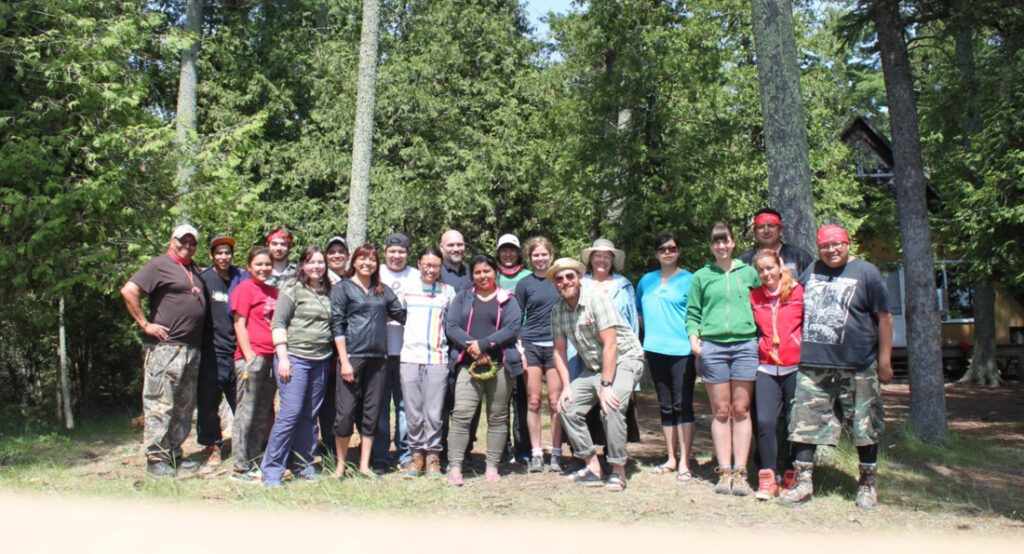
Figure 9: Shoal Lake 40 First Nation community members, high school students, and University of Winnipeg students who participated in a Land-Based Reconciliation Field School with Daryl Redsky (pictured far left), 2016. [Picture from Schlegel (2016)]
- Reconciliation Kenora Forum: In 2019, Reconciliation Kenora / Azhe-mino-gahbwewin held a public forum at Wauzhushk Onigum to discuss what reconciliation means and how it might be achieved in Kenora. The forum was co-facilitated by Cuyler Cotton (settler) and Adolphus Cameron (Anishinaabe), and featured rich discussions by Indigenous and settler residents, many of which resonate with the contents of this report. Specifically, participants developed a vision of reconciliation based on peace, love, respect, equity, accountability, and understanding. They emphasized the importance of honouring treaty obligations and identified five “actionable strategies” to move towards their vision, including: building connections, media advocacy, land-based gatherings and whiteness education, honouring the land, and digging deep (i.e., self-education and self-reflection) (Reconciliation Kenora, 2019). Some interviewees pointed to the forum as a model for the kinds of conversations and action-oriented educational initiatives that need to happen more frequently and on a wider scale. It was one of several promising activities initiated by Reconciliation Kenora, alongside a reconciliation powwow and a medicine garden at Seven Generations Education Institute, before the group’s momentum slowed during the pandemic.
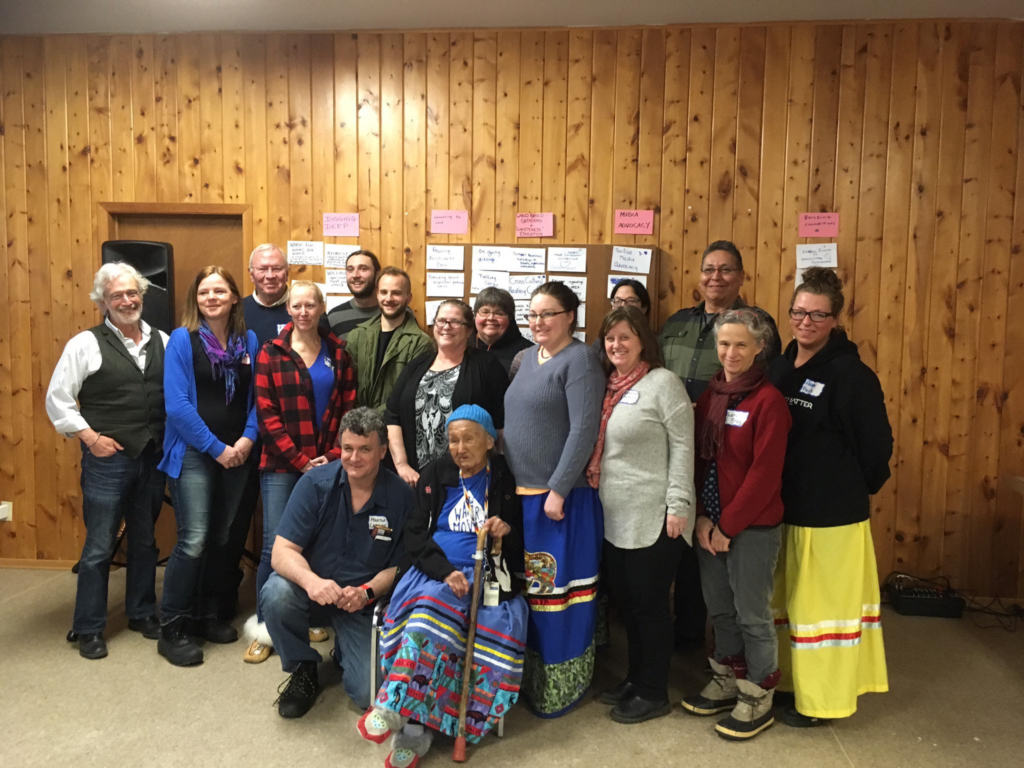
Figure 10: Reconciliation Kenora / Azhe-mino-gahbewewin board members pictured with Public Forum participants, 2019. [Photo from Tracy Lindstrom]
- Wabaseemoong Strong: While many acts of reconciliation are taking place in the Kenora area, Indigenous people also continue to experience racism in town. What is striking about recent incidents of racism, however, is the strong, organized, and almost immediate response led by Anishinaabe residents and increasingly supported by settlers. In winter 2021, Wabaseemoong Independent Nations experienced a COVID-19 outbreak. Subsequently, some Wabaseemoong members reported being denied service in Kenora stores and stigmatized as if they all had COVID-19 (Turner, 2021). Local Anishinaabe women called out racist comments on social media. In response, white residents called the police claiming they were the victims of cyberbullying. However, the Anishinaabe women held firm. They organized a webinar with human rights lawyers to explain what happened, as well as to educate residents about their rights and how to file human rights complaints. Numerous settlers also expressed solidarity with Wabaseemoong. For example, many settler-owned businesses distanced themselves from the racism by saying everyone was welcome in their stores; some donated food and supplies to the First Nation while they were in lockdown. Some interviewees described such incidents as critical moments when stereotypes can be challenged and relationships (re)built. The vigorous responses and expressions of solidarity are also signs of Indigenous resurgence and an ongoing shift in the local balance of power.
C. Housing/street-focused work
- Kenora Street Patrol and Makwa Patrol: In 1973, the “While People Sleep” report found that 200 Indigenous people had died on the streets of Kenora over a 3.5-year period. Most of these deaths were ruled accidental, with an emphasis on the involvement of alcohol, but the report also estimated that 8-10 per year were homicides. Some of the so-called drowning victims had been severely beaten, with arms and legs bound. While most white residents ignored Indigenous people on the streets, a white gang known as the “Kenora Indian Beaters” (KIB) actively attacked and harassed them, as several participants recounted. The Kenora Street Patrol emerged in response to this violence, stigmatization, and the inadequate response of local police who were accused of failing to investigate and sometimes being complicit. Some Elders recalled stories of the Kenora Police Service allegedly engaging in “starlight tours” (Green, 2006), picking up Indigenous people and abandoning them on the outskirts of town. In this context, the Street Patrol’s goal was to help meet basic needs and ensure the safety of people on the streets, most of whom were Indigenous survivors of the IRS system and other colonial traumas. It was a volunteer, Anishinaabe-led effort and an early model for current initiatives such as the Makwa Patrol. Since 2020, the Makwa Patrol—which also started as a grassroots initiative but is now administered in collaboration by KCA, the Kenora District Services Board (KDSB), Treaty #3 Police Service, and the Ontario Provincial Police (OPP)—“provides a range of supports to people in need on a 24/7 basis, including handing out meals and water, connecting and transporting people to additional services, and supporting emergency response by police and ambulance services” (CBC, 2021).
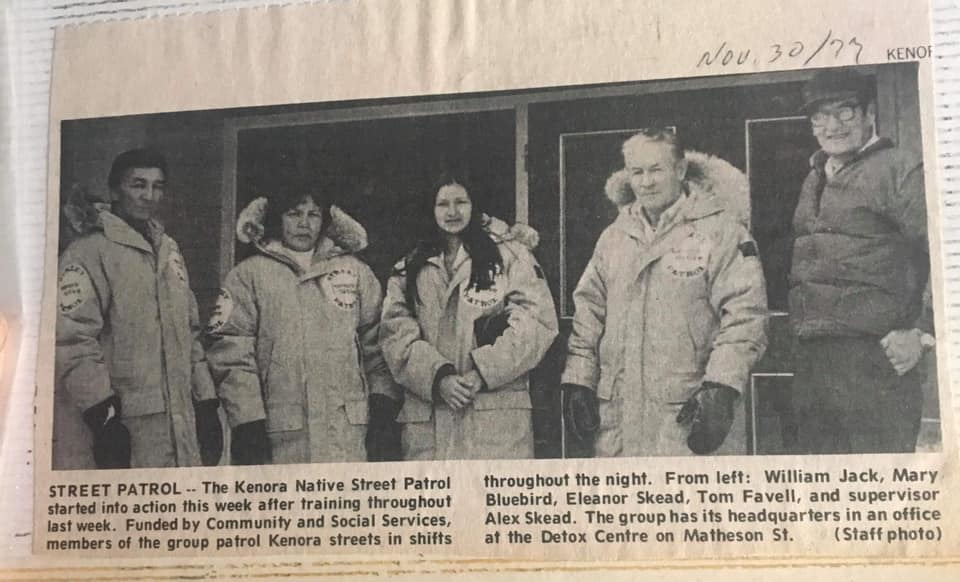
Figure 11: Kenora Street Patrol. [Photo from Kenora Miner & News/Klein Media, November 30, 1977]
- Ishkode: In 2020, Indigenous and non-Indigenous activists successfully mobilized against a proposed anti-loitering municipal bylaw that was seen as unfairly targeting people living on the streets. Their efforts influenced several city councillors to change their positions and vote against the bylaw. As an Ontario Human Rights Commission letter said, this bylaw would “not solve the homelessness crisis or other social issues facing Kenora” (Izri, 2020). Despite lacking financial resources, activists also organized a four-day sacred fire (Ishkode) with the street community to help identify specific needs and concerns, build relationships, and develop an action plan. In 2021, another four-day Ishkode was held during a “CommUNITY Week of Healing and Reconciliation” to raise awareness of ongoing housing and health needs and in recognition of the first National Day for Truth and Reconciliation.
Figure 12: Ishkode, 2020. [Photo from Kenora Moving Forward Facebook group]
- Kenora Moving Forward (KMF): Picking up from Compassionate Kenora and Ishkode, and in the wake of the anti-loitering bylaw, KMF was formed as a “grassroots coalition” of Indigenous and non-Indigenous residents “working alongside the street community for safety and belonging in Kenora” (KMF Facebook group, 2020). Run mainly on a volunteer basis, the coalition has opened warming and cooling spaces in the evening hours when shelters are not open, provided hot meals, facilitated conversations, and advocated for the basic needs and humane treatment of people facing houselessness, racism, trauma, addictions, and mental health issues. Despite struggling for resources, the coalition has made a positive difference in the lives of people on the city’s streets. At the Booshkegiin Kenora public gathering in October 2023, a young Anishinaabe man from a nearby First Nation who had been living on the street, explained:
“What I want to say about KMF and everything they’ve done for me is like it’s made me want to be a part of something. Like I see change with what they’ve done …. For them to step up and take charge and … be a voice for those who didn’t, or didn’t know how, it’s big, man. Like I got mad respect for that.”
Figure 13: Kenora Moving Forward CommUNITY Coordinator Elauna Boutwell pleads with city councillors to open a permanent warming and cooling space for houseless and underhoused people in the city, 2023. [Photo by Bronson Carver]
D. Social/relationship-building
- Café Conversations: In the 1970s and 1980s, a small group of Indigenous and non-Indigenous Kenora residents met regularly at a local restaurant to discuss set topics. Conversations ranged from social and political issues to sports and entertainment. The goal of Café Conversations was to foster cross-group dialogue, trust, and friendships. Several participants looked back fondly on this initiative.
- Camping and canoe trips: Recently, multiple camping and canoe trips have been organized in the region, bringing together Indigenous and non-Indigenous people to travel and spend time with one another on the land. By engaging in such activities, which often last multiple days, several participants noted that deep bonds may be formed. To make these bonds more sustainable, it is important that these trips not be one-off events, but rather annual experiences supplemented with more regular interaction.
- Pabaamashi Women’s Group: At an Elders circle in 2025, Jeanette Skead shared how, for years, she has met regularly for tea or lunch with a small group of Anishinaabe and non-Anishinaabe women who were originally part of the Pabaamashi initiative (see above). Although their conversations sometimes touch on political issues like racism and land rights, they are more often about “catching up” and enjoying “a good time.” When asked what keeps the group going, Jeanette said it was the feeling that, among friends, one was free to “talk about anything.” This is likely not the only informal group in Kenora that contributes to reconciliation on an interpersonal level. The larger question is how to create more of these kinds of trusting, sustainable relationships over time and on a wider scale.
- Red and White Socials: In the late 1970s, the Ne-Chee Friendship Centre began hosting “Red and White Socials” to bring together Indigenous and non-Indigenous residents for dancing, dinners, and other social events. Mary Alice Smith (settler/Omashkiigoo-James Bay Cree) recalled:
“The original idea was that because the two cultures rarely socialized, people thought, ‘well, let’s just get together not for meetings, but to do something fun and people can get to know each other.’ And that’s what happened. They always had a good turnout, a good mix of people.”
Although the Red and White initiative no longer exists, some interviewees thought it was a model that could be reinvigorated—perhaps with a more multicultural emphasis—to promote cross-group relationships today.
E. Cultural revitalization
- Fall Harvest: Several participants described the local First Nations’ Fall Harvest traditions as fostering both cultural revitalization and reconciliation. Some highlighted the participation of Kenora schools at the annual Wauzhushk Onigum Fall Harvest as a chance for young people to learn about Anishinaabe ways of life, on the land, directly from Elders and land users, and to build respectful relationships. Participants also mentioned other school field trips to First Nation communities and IRS memorial sites. Elder Jeanette Skead recalled:
“They called me up from Evergreen and said, ‘we want you to take us to the [St. Mary’s IRS] memorial.’ [So], we went to the memorial site … put down tobacco, showed them how to do this … and then we went to Powwow Island. We rode on the bus with the kids and had a great time. And the questions they were asking! Grade six. I was surprised.”
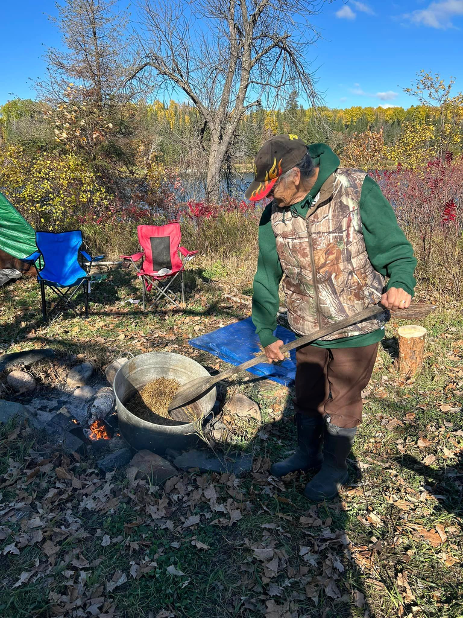
Figure 14: Elder Jeanette Skead prepares wild rice at Wauzhushk Onigum Fall Harvest, 2023. [Photo by Jeffrey Denis]
- Language Classes: Several participants stressed the importance of local efforts to revitalize and pass down the Anishinaabe language. Some Treaty #3 First Nations have started their own language immersion programs. One recent example is known as “Reclaiming Anishinaabemowin for Silent Speakers.” This program, run by an Indigenous non-profit, works with Anishinaabe adults who “can understand the language fluently, but [experience] a trauma reaction that blocks their ability to speak” (Pugliese, 2025). In addition, many public and Catholic schools in the Kenora area now offer Anishinaabemowin classes. After years of discussion with local Elders, the Catholic Board also launched the “Anishinaabe Omiinigoziiwin Language App.” All these efforts contribute to reconciliation by helping to bring back and protect the very language and cultural resources that residential schools tried to destroy.
- Nibi/Water Gatherings: Each spring, a multi-day Nibi (water) gathering is held at Whiteshell Provincial Park (85 km west of Kenora). The event centres around the theme of Nibi Onje Biimaadiziwin (“Water is life” or “Everything needs water to live”). It is organized by multiple partners, including Grand Council Treaty #3, Decolonizing Water, and the First Nations Health and Social Secretariat of Manitoba. Treaty #3 Elders have been involved as speakers and Knowledge Keepers, and the gatherings are well attended by Indigenous and non-Indigenous people. Elder Sherry Copenace described the gatherings as a chance to “build relationships, especially with the waters and the earth,” and to identify and affirm one’s responsibilities.
- Powwows: Several participants described the role of local powwows in fostering reconciliation. When mentioned during the youth sharing circle, Anishinaabe co-facilitator Daryl Redsky affirmed that powwows are “celebrations of life [that] bring people together from all walks of life.” In the Kenora area, many powwows are annual events led and hosted by the First Nations. Some have also taken place in schools and on special occasions, such as the National Day for Truth and Reconciliation (September 30). Elder Robert Greene stated:
“One thing that has helped is our social gatherings, our powwows. Non-Indigenous peoples were welcomed to be part of it, and they would keep coming back year after year, bringing their family and friends. So, that kind of a welcoming attitude, I think, is what needs to be done. We’ve opened our doors and now it’s time for the other side to open theirs.”
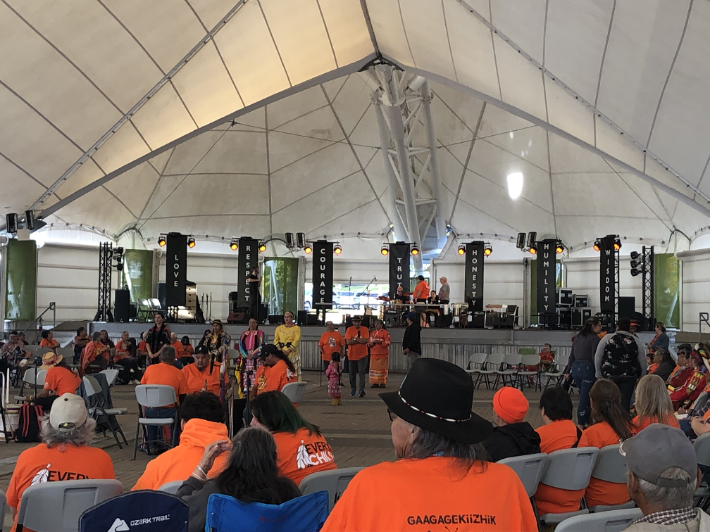
Figure 15: Orange Shirt Day (National Day for Truth and Reconciliation) Powwow at Kenora Harbourfront, 2022. [Photo by Jeffrey Denis]
- Revitalizing Original Teachings and Traditional Practices: Several participants also shared examples of efforts led by Anishinaabe Elders and/or communities to bring back customs and traditions that the residential school system and other colonial policies sought to erase. For many Indigenous people, this revitalization process is essential for healing and reconciliation. These efforts include language programs to foster Anishinaabemowin fluency, as well as the renewal of ceremonies such as Makoosekawin—coming-of-age teachings and ceremonies for young Anishinaabe women (an annual initiative led by Elder Sherry Copenace).
F. Economic/infrastructure development
- Potato drive: In 2020, early in the COVID-19 pandemic, Anishinaabe activist Tania Cameron initiated a potato drive that began to build cross-group relationships and enhance food security. Noticing that a (settler) farmer, who had lost customers due to pandemic-related restaurant closures, was selling 50-lb bags of potatoes for just $15, Cameron advertised the deal on social media. Some people bought multiple bags, some for themselves, others to give away to families in need. Ultimately, Cameron facilitated the discount sale of 185,000 lbs of potatoes to 30 First Nations and numerous towns across Northwestern Ontario, benefiting both the farmer and residents, Indigenous and settler alike (Ward, 2022). According to Cameron:
“We need to take care of each other. As much as we rely on the government to help us go through the pandemic, … we also rely on each other as neighbors and as a caring community to say, ‘let’s do this together.’” – Quoted in Ward (2022)
G. Indigenous sovereignty, rights, and justice
- Anicinabe Park: The armed occupation of Anicinabe Park in 1974 was a landmark event in the history of Indigenous resistance to colonialism (Rutherford, 2020). It inspired dozens of other direct actions by Indigenous Peoples across Turtle Island to defend their lands and waters and assert Indigenous sovereignty. Some participants described it as a point of pride for local Anishinaabe and an important articulation of Indigenous needs, rights, and desires. Some also noted the role of settler allies in supporting the occupation by, for example, providing food, supplies, and/or legal assistance. At the same time, the occupation elicited racist backlash, including the publication of the Bended Elbow pamphlets and violent attacks on the occupation’s organizers. More than 50 years later, some of the organizers’ demands still have not been met, and ownership/stewardship of the land remains contentious. In 2024, three local First Nations—Niisaachewan, Wauzhushk Onigum, and Washagamis Bay—filed a land claim to pursue the return of Anicinabe Park (Carver, 2025). Several participants also emphasized the importance of the 40th and 50th anniversary celebrations of the occupation, viewing them as opportunities to commemorate the survivors, educate the wider public about the local history, and inspire constructive change and “reconcili-action” (Craig Lavand, Wauzhushk Onigum).
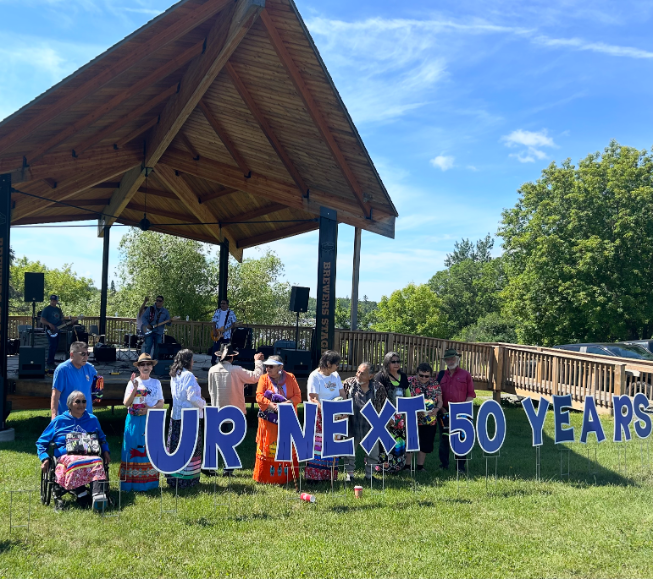
Figure 16: Anicinabe Park occupation veterans line up for a picture at the 50th anniversary celebration, 2024. [Photo by Jeffrey Denis]
- Civil Rights March: Almost a decade before the Anicinabe Park occupation, in 1965, more than 400 Anishinaabe men, women, and children marched from Knox United Church to the Legion Hall in Kenora to protest racism and poverty. Inspired by the non-violent civil rights movement in the US, the marchers peacefully but assertively called for better living conditions and more respectful treatment. According to retired law professor Norman Zlotkin, this event “helped initiate the rebirth of the [Indigenous rights] movement” in North America (Paul, 2015). Local leaders of the march included Fred Kelly (Onigaming), Fred Greene (Shoal Lake 39), and Pete Seymour (Wauzhushk Onigum) (Rutherford, 2020).
- Free Grassy Narrows Campaign: Some participants also mentioned the Free Grassy Narrows Campaign as a long-running Indigenous-led initiative that has helped mobilize many non-Indigenous allies in Kenora and beyond to support Indigenous sovereignty and rights and environmental protection. The campaign focuses on advocating for Asubpeeschoseewagong (Grassy Narrows) First Nation’s right to self-determination over land use decisions on their territory (including logging and mining), and for justice after decades of mercury poisoning. While some Kenora residents oppose the campaign’s use of road blockades and other protest tactics, the campaign has raised public awareness, built relationships among activists, and garnered widespread support.
Figure 17: Grassy Narrows youth blockade logging trucks, 2002. [Photo from freegrassy.net]
- Freedom Road Campaign: As part of its longstanding campaign for all-season road access and clean drinking water, in the 2000s and 2010s, Shoal Lake 40 First Nation consciously built strong alliances with other Indigenous and non-Indigenous communities and individuals and employed creative strategies and tactics to achieve change (Davis et al., 2022). To highlight its situation, the First Nation created a Museum of Canadian Human Rights Violations, which many visitors described as a transformative educational experience. The collaborative, Indigenous-led process by which Freedom Road itself was built has also been called a “model … for communication and cooperation between First Nations and federal and provincial governments” (Thompson, 2019). As the former Chief of Shoal Lake 40 First Nation, Erwin Redsky, put it:
“During our campaign, we always said Shoal Lake 40’s story is the outcome of a trail of broken relationships. [But with the construction of Freedom Road in 2019, it could be] a story of the road to reconciliation.”
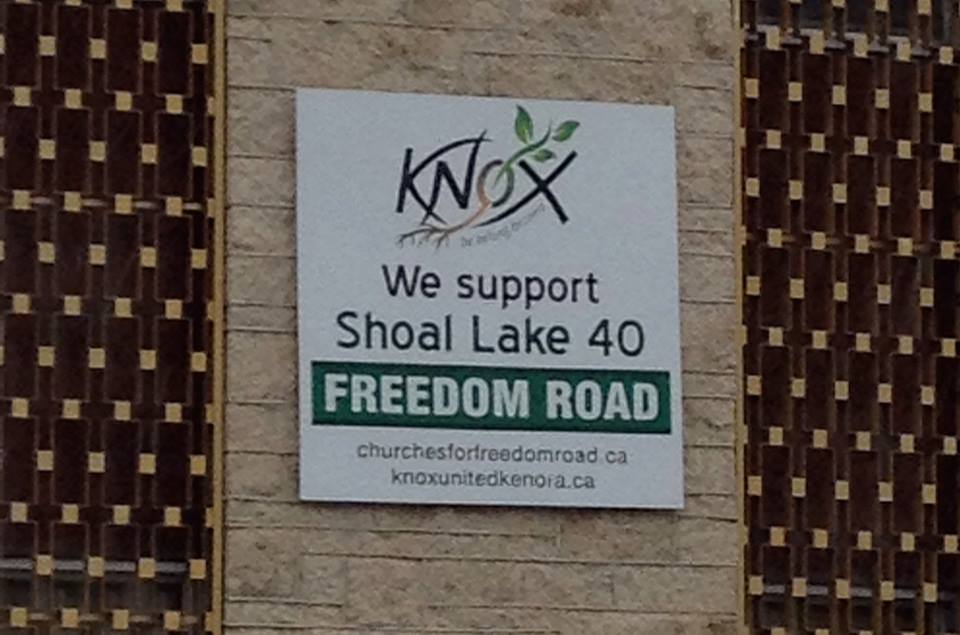
Figure 18: Sign supporting Shoal Lake 40 First Nation’s Freedom Road campaign, displayed at Knox United Church in Kenora, 2015. [Photo from Friends of Shoal Lake 40 Facebook group]
- Indian Residential Schools (IRS) Unmarked Graves Investigations: Following the revelation of 215 potential unmarked graves at the former Kamloops IRS in B.C., investigations into possible burials at other residential school sites, including in and around Kenora, were launched. Ground-penetrating radar at the St. Mary’s site revealed 171 anomalies (Miner & News, 2023). A similar search at the McIntosh site revealed 114 “unmarked burial features” (Allan, 2025). Investigations are ongoing at the Cecilia Jeffrey sites. Importantly, these processes have been led by Indigenous survivors of the relevant residential schools (e.g., Kaatagoging Survivors Group) and have closely followed Anishinaabe protocols. Several participants mentioned these investigations and suggested that reconciliation requires giving survivors time and space and respecting this challenging process.
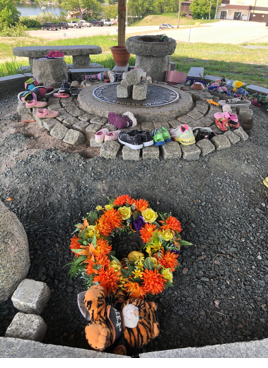
Figure 19: Memorial at St. Mary’s IRS site, 2022. [Photo by Jeffrey Denis]
- Government or Formal Organization-Led Initiatives
A. Health/healing
- All Nations Health Partners and Building of New Hospital: Some participants pointed to the All Nations Health Partners (ANHP) as an example of the kinds of promising partnerships that are being developed across the non-profit sector in Treaty #3. Stemming from “the Kenora Area Health Care Working Group, which formed in 2015 to address a critical doctor shortage and cross-border issues,” the ANHP includes Indigenous, municipal, and health care leaders who pledged to work together for “a seamless, patient-centered health care system” (ANHP, 2025). Partners include Grand Council Treaty #3, Kenora Chiefs Advisory (KCA) – Ogimaawabiitong, Métis Nation of Ontario, Kenora District Services Board (KDSB), Lake of the Woods District Hospital (LWDH), Northwestern Health Unit (NWHU), and Waasegiizhig Nanaandawe’iyewigamig (WNHAC), among others. In addition, the LWDH has “worked in partnership with the Kenora Chiefs Advisory, Ontario Ministry of Health, and [local] communities to plan a much-needed new hospital facility,” one of whose primary aims is to better meet the needs of Indigenous clients (ANHP, 2025). Planning for the new hospital has involved extensive community engagement to ensure accessible, culturally safe health care, following the TRC Calls to Action. Plans for the new hospital include a ceremonial room, Indigenous Resource Centre, traditional kitchen, traditional healing rooms on every floor, and externally a sweat lodge, landscaped spaces, and access to water. While many participants praised these developments, some were wary of particular organizations or individuals attempting to dominate the process and overriding grassroots Indigenous perspectives.
- Mobile Health / Rapid Response Teams: Several participants discussed the role of mobile healthcare or rapid response teams in meeting the basic needs of marginalized people in Kenora, such as those living on the streets and/or struggling with mental health and addictions. These teams travel to clients to provide urgent services like first aid or overdose medication. Multiple mobile health units were mentioned, including the Kenora Mobile Crisis Response Team (run by CMHA-Kenora Branch and the OPP), the Mobile Mental Health and Addictions Clinic (MMHAC), the Kenora Rapid Access Addictions Medicine (RAAM) Clinic, and the Northwestern Health Unit – Kenora Mobile Outreach.
- Native Healers Program, LWDH: In 1979, the Lake of the Woods Powwow Club—a cultural organization that sought to revitalize and preserve Anishinaabe traditions, songs, and teachings, and provide peer support—partnered with physician Dr. Allan Torrie to start a “Native Healers Program” at Lake of the Woods District Hospital in Kenora. This program aimed to integrate Indigenous healing practices with Western medical services (Maxwell, 2011). With provincial funding, Anishinaabe Medicine People, such as George Councillor, Randy Councillor, and Madeline Skead, were hired to address communication barriers with Anishinaabe patients and provide more holistic care and spiritual support (New York Times, 1979). Several interviewees said the program was groundbreaking and helped a lot of Indigenous patients. Although it no longer exists, it is a model that could be revived at the new All Nations Hospital.
“By honouring and applying Indigenous knowledge within an institutional space historically controlled by the European biomedical paradigm, this [Native Healers] programme embodied a powerful challenge to continuing colonial domination of Indigenous people in the region.” – Krista Maxwell, settler Canadian anthropologist (2011)
- Patient Navigators: A few participants in the healthcare field also highlighted the Indigenous Patient Navigator program at LWDH as a step towards reconciliation. Through agreements with KCA and WNHAC, navigators work in the hospital assisting Indigenous patients with translation and general health system navigation, ensuring care is culturally sensitive and patients can access traditional healing opportunities. Navigators also support patient care in learning community and cultural protocols, fostering relationships between care providers and patients and their families.
B. Education/awareness
- Antiracism Training: Many organizations in the Kenora area have implemented some form of antiracism or cultural competency training. Several participants spoke positively of the KAIROS Blanket Exercise (Hiller, 2025), though others were wary of its form and content. While such initiatives are intended to educate people (especially white settlers) about Indigenous cultures, histories, racism, and power dynamics, they may vary widely in quality and are often met with mixed reactions (Srivastava, 2024). One common criticism is that they tend to ‘preach to the converted,’ while facing resistance from people who perhaps most need to hear it. Moreover, if such trainings are one-time events, they may be perceived as performative and therefore dismissed. The question is how to engage individuals who do not want to participate in educational activities and may become angrier and more defensive in response.
- School Curriculum Reform: Some participants highlighted ongoing efforts to decolonize, Indigenize, or otherwise improve school curricula. Although the process is complex, with many curriculum requirements being set by the province, much can be done and is being done by local schools and school boards. These initiatives include Anishinaabe language classes (though at least one participant worried that they are not always taught by Anishinaabe teachers), more comprehensive Indigenous studies classes (though some participants thought more Indigenous content should be integrated throughout the curriculum), field trips to First Nations and former IRS sites, inviting Elders and other Indigenous speakers into classrooms, and holding school powwows and other events to mark the National Day for Truth and Reconciliation, National Treaties Week, etc. In addition, the Four Directions Program at Kenora-Patricia District School Board (KPDSB) offers student support navigators and graduation coaches for Indigenous students, nutritional support, and a Four Directions Room that is meant as a safe and welcoming space for all students. Despite such efforts by both public and Catholic schools, some participants said there is still inconsistency in what is taught and how it is taught, and many Indigenous students continue to experience racism.
- Seven Generations Education Institute (SGEI): Several participants highlighted the contributions of SGEI, as an Indigenous-owned and controlled post-secondary organization. Founded in 1985, SGEI provides student-centred, self-paced high school programming, accredited college and university-level courses, employment training, and cultural programming for both Indigenous and non-Indigenous people. The Kenora campus also features a cultural room, a telepresence room, a supper pantry, and a medicine garden.
- The Muse: Multiple participants cited the role of The Muse, or Lake of the Woods Museum and Douglas Family Art Centre, in educating the public about Indigenous history and culture, the IRS system, and reconciliation. They especially emphasized the value of the special exhibits “Bakaan nake’ii ngih-izhi-gakinoo’amaagoomin: We were taught differently” (which was developed with the Ne-Chee Friendship Centre and the Lake of the Woods Ojibway Cultural Centre, and highlighted Indigenous Peoples’ experiences at St. Mary’s and Cecilia Jeffrey in the context of the Canada-wide IRS system) and “Shiibaashka’igan – the jingle dress” (which featured 50 sacred healing dresses, along with stories and teachings). Notably, an Indigenous Advisory Council provided input on these exhibits. That said, some participants thought the museum’s regular exhibit could better highlight local Anishinaabe history and the importance of Treaty #3. Some also worried that residents who could most benefit from the special exhibits were unlikely to attend. Nonetheless, the significance of the Muse’s work was widely recognized. For former museum director Lori Nelson (non-Indigenous), the “We were taught differently” exhibit “had a profound effect on me personally, and when we presented it [to the public], it had a good effect, in terms of education.” According to Anishinaabe Advisory Council member Geri Kakeeway:
“When we did the exhibit, ‘We were taught differently,’ that’s when I first saw photos of my mother at residential school. ‘Cause I asked my mom one time, ‘how come there are no pictures of you in school?’ And she didn’t say anything … it wasn’t until after she passed away, and I was on this project, that I saw her class pictures and I started digging and found some more stories related to what had happened.”
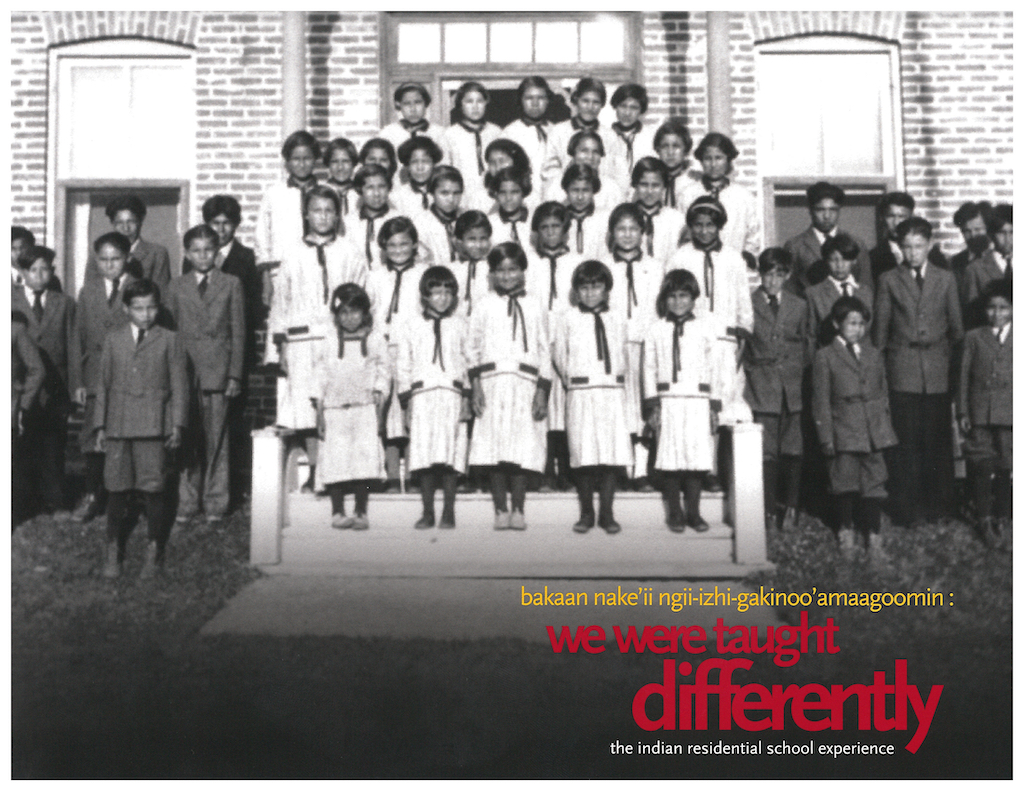
Figure 20: “We were taught differently” was an award-winning special exhibit on Indigenous Peoples’ residential school experiences, focused especially on the Cecilia Jeffrey and St. Mary’s Indian Residential Schools. It premiered in September 2008. [Image courtesy of The Muse: Lake of the Woods Museum & Douglas Family Art Centre]
C. Housing/street-focused work
- Government Funding of Local Housing Projects: Many participants emphasized the need for stable, adequate public funding for both emergency and long-term housing to address the houselessness crisis in Kenora and beyond. Some were cautiously optimistic about recent investments in housing projects, such as Miikana Ridge, a 56-unit seniors affordable housing complex on 8th Street South that includes dedicated health services and supports. Opened in May 2025, Miikana Ridge is owned and operated by the Kenora District Services Board (KDSB) and was funded by multiple partners, including the Canada Mortgage and Housing Corporation, the Federation of Canadian Municipalities, Ontario’s Ministry of Long-Term Care, Ontario’s Ministry of Municipal Affairs and Housing, the City of Kenora, and KDSB itself (Carver, 2025). Other recent initiatives include a 30-unit supportive housing project near the Kenora Armoury (in partnership with Ontario Aboriginal Housing Services) and 20 affordable housing units on Matheson Street (Stimpson, 2024). While still insufficient to meet current needs, given that there were over 600 people on the housing waiting list a few years ago, many interviewees saw these projects as important steps in the right direction.
D. Social/relationship-building
- Indigenous Relations Office, City of Kenora, and other Indigenous liaison positions: Several participants, especially those involved in municipal politics, mentioned the creation of an Indigenous Relations Office as a promising initiative aimed at improving local relationships. In 2024, Iskatewizaagegan (Shoal Lake 39) member Ed Mandamin was hired as the city’s first Indigenous relations adviser. He described it as a “groundbreaking” role meant to “develop relations with First Nations” and promote Kenora as a place for everyone “to live and to love and to prosper” (Stimpson, 2025). Increasingly, other formal organizations in the Kenora area are also creating Indigenous liaison positions.
- Ne-Chee Friendship Centre: As described on its website, the Ne-Chee Friendship Centre is “a place of community, culture, and support for Indigenous individuals and families in Kenora” (Ne-Chee, n.d.). Incorporated in 1976 as a welcoming space for Indigenous people in the city, the Friendship Centre has organized many events and programs aimed at fostering Indigenous wellbeing and reconciliation. Today, it continues to offer a “range of programs and services focused on empowerment, healing, and wholistic health” (Ne-Chee, n.d.).
- Space: In the 2010s, Indigenous and non-Indigenous residents worked together to create Space, an intercultural 2SLGBTQ+ community group for teens and young adults in the Kenora area. Initially run out of the Kenora Sexual Assault Centre and later at Knox United Church and other organizations, the group is now associated with the KCA Youth Wellness Hub. Recently, Grand Council Treaty #3 also created an LGBTQ2S+ Council as part of its National Governance Structure. These initiatives seek to create a more welcoming, inclusive environment, which is essential to reconciliation. Commenting on Space specifically, Meg Illman-White, who was the Knox United Church pastor when the initiative was hosted there and who co-led it with founder Wynne DeGagne, said:
“The ratio of intercultural mix at any given event was 60/40 or 40/60, [which] was pretty amazing for Kenora … it was a space unlike any other spaces I was experiencing, where the kids just worked together on a variety of projects like doing a Halloween party or putting some muscle behind Pride events. And at the biweekly meetings, they ate together and worked together and did games together … the relationship really thrived.”
- Tunnel Island and Common Ground Initiative: For millennia, Tunnel Island, or Wassay Gaa Bo, was a gathering and trading place for Indigenous Peoples. In the 20th century, it was the site of the Kenora paper mill, owned by Abitibi Consolidated (Davidson-Hunt et al., 2017). After the mill’s closure in 2006, the island was gifted to the Rat Portage Common Ground Conservation Organization (RPCGCO), a stewardship entity consisting of the City of Kenora and Memino Aaki, an organization founded by the then Grand Chief of Treaty #3, Diane Kelly, on behalf of three local First Nations (Wauzhushk Onigum, Washagamis Bay, and Niisaachewan) (City of Kenora, 2022b). Over time, the island has hosted many Anishinaabe ceremonies and gatherings. Between 2009 and 2015, it was the site of a Community-University Research Alliance project aimed at building cross-cultural collaboration and social learning for regional sustainability (CGRF, n.d.). Tunnel Island is also home to scenic walking trails and a rich diversity of plants and trees vital to the local ecosystem.
Several participants highlighted the Common Ground Initiative as a step towards reconciliation and a space where an Anishinaabe understanding Treaty #3 might be realized: “The RPCGCO’s governance structure, with its equal partnership among settler and Indigenous signatories, echoes the spirit and intent behind our treaty: that as people who share a place, we have an obligation to share in the governance and management of all resources, for the mutual benefit of all our people” (CGRF, n.d.). This is in keeping with the Joint Proclamation of Treaty Relationship signed by Grand Council Treaty #3 and the City of Kenora in May 2008. Wassay Gaa Bo is the physical expression of this relationship. Although one interviewee said the lands should be returned exclusively to First Nations control, the late Anishinaabe Elder Adolphus Cameron recalled:
“We had an Anishinaabe group and a group representing Kenora come to the table. And there was kind of an impasse on ‘this is our land.’ And the other group’s saying ‘no, it’s ours.’ After some dialogue, we concluded that when the settlers first came in, yes, we can argue the point that they had no rights to the land. But the people of today, a lot of them were born here. And it’s a shared land. And if they can agree that it’s something that both groups want to take care of and look after, then that’s a shared responsibility. And it is our [Anishinaabe] land …. That’s how Tunnel Island started to develop into shared goals and shared commitments, [for example] that there would be no developments there unless both groups came together and had a common understanding about it.”
E. Cultural revitalization
- National Indigenous Peoples Day and other annual recognition events: Several participants described local efforts to celebrate annual national or provincial events, such as National Indigenous Peoples Day (June 21), the National Day for Truth and Reconciliation or Orange Shirt Day (September 30), and Treaties Recognition Week in Ontario (first week of November) as opportunities to raise awareness about Indigenous history and colonialism, bring residents together, and (re)build relationships. Such events include powwows, walks, ceremonies, and educational activities, and are often well attended.
“[At Beaver Brae Secondary School] we recognize Orange Shirt Day. We do a big thing there in connection to Cecilia Jeffrey. We take students there and we bring in some teachings about residential schools. In October, we commemorate the signing of the treaty here. Then in November, we have National Treaties Week, which again is an opportunity to highlight the treaties and what they mean. And then we also recognize Louis Riel Day.” – Tracy Lindstrom (non-Indigenous teacher)
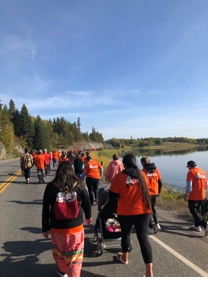
Figure 21: Hundreds of Kenora-area residents wearing orange shirts walk in honour of the National Day for Truth and Reconciliation, 2022. [Photo by Jeffrey Denis]
- Renaming Initiatives: For some participants, reconciliation also means reclaiming Anishinaabe place names, removing colonial ones, and honouring Indigenous heroes. In Kenora, several such renaming initiatives—usually prompted by Indigenous lobbying—have taken place. For example, Colonization Road was renamed as an extension of Nash Street (Thompson, 2017), Highway 17A, the bypass route through Kenora, now carries the name Miikana Way (“Path Way”), and downtown streets increasingly feature wayfinding signs in Anishinaabemowin. The Kenora Armory was also renamed in honour of David Kejick, a celebrated World War I veteran from Shoal Lake 39 First Nation.
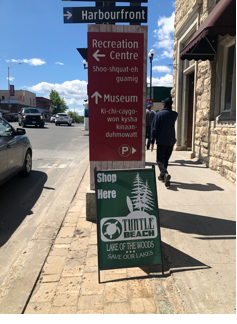
Figure 22: Anishinaabemowin way-finding signs in Kenora, 2022. [Photo by Jeffrey Denis]
- Treaty #3 Flag: A few participants also referred to the flying of the Treaty #3 flag at City Hall as a step towards reconciliation; others thought it was merely performative. While such symbolic gestures can be important, they must be accompanied by substantive change for reconciliation to be meaningful.
F. Economic/infrastructure development
- Miisun forest management: A few participants noted the importance of Miisun, a First Nations-owned natural resource management company that specializes in forest management and road construction (Miisun, 2025). Founded in 2010 and based in Kenora, Miisun incorporates traditional Anishinaabe knowledge and values and “promotes strong working relationships between First Nations and Industry partners” to support sustainable development and expand employment opportunities. This development is significant given the importance of forestry to the region’s economy and the history of settler companies exploiting Indigenous lands, resources, and labour (e.g., Luby, 2020; Willow, 2012).
- Niiwin Wendaanimok Partnership and Twinning of Trans-Canada Highway: A major ongoing infrastructure project in the region is the Twinning of the Trans-Canada Highway west of Kenora. Importantly, the multi-year construction project, which will add two lanes to an approximately 40 km stretch from the Manitoba-Ontario border to the Highway 17/17-A Junction, is being completed in partnership with Indigenous communities. The Niiwin Wendaanimok (Four Winds) Partnership (2025) is a corporation owned and operated by four local First Nations—Wauzhushk Onigum, Washagamis Bay, Shoal Lake 40, and Niisaachewan—“dedicated to providing construction, contracting, and environmental monitoring services in Treaty #3 territory.” It led an impact assessment process that combined Manito Aki Inakonigaawin with Western scientific research. Indigenous people have been involved in planning from the start and are now employed in construction; their active engagement will continue throughout the project. Grand Chief of Treaty #3 Francis Kavanaugh described the Twinning project as a positive example of “working together.” Similarly, local Conservative Member of Parliament (MP) Eric Melillo stated:
“The Province of Ontario has moved forward on the first stage of the Highway Twinning, but it was not without intensive consultation and work with the local First Nations, and the local First Nations have done an incredible job to see that move forward. And I think that’s something where everyone will share in the value of it …. It’s important for reconciliation as well because there was that engagement, and it really was a First Nation-led initiative.”
However, Leon Mandamin, Chief of Iskatewizaagegan Independent First Nation (Shoal Lake 39), has raised concerns about being excluded from the process. Specifically, regarding the Manitoba portion, he has accused the Manitoba government of “offering jobs and contracts to other local First Nations for twinning the highway, while leaving out his community” and ignoring the potential impact on “spiritual areas, travel routes, and medicinal areas” (Thompson, 2025).
- Sewer and water connection between Kenora and Wauzhushk Onigum: In 2020, the connection of the City of Kenora’s water and sewage system to Wauzhushk Onigum Nation was completed. The project was supported by $14.6 million in funding from Indigenous Services Canada. The extension of such basic infrastructure (which most Canadians take for granted) to First Nations is an important step in the reconciliation process. Then Mayor Dan Reynard called it “a mutually beneficial collaboration that meets the needs of the First Nation” (Skead, 2020). Chief Chris Skead likewise celebrated the “partnership with the City of Kenora” and the fact that “citizens of our First Nation … will finally have safe drinking water after being on a boil water order for over 3 years.”
G. Indigenous sovereignty, rights, and justice
- Manito Aki Inakonigaawin: Described by Grand Council Treaty #3 as “a manner of thought, a way of feeling and a way of living,” Manito Aki Inakonigaawin, or the Great Earth Law, was written and ratified by Treaty #3 Elders in 1997 (GCT3, n.d.). It focuses on “the duty to respect and protect lands” and emphasizes the need for meaningful consultation and the consent of Anishinaabe communities before any new developments on Treaty #3 lands. Manito Aki Inakonigaawin is “an inherent law to Anishinaabe in Treaty #3” (GCT3, n.d.). Since being adopted as a temporal law of the Nation through ceremony, it has been applied to various resource development activities, including the Dibaajimowin fibre optic project and revenue sharing agreements. Since passing Manito Aki Inakonigaawin, Grand Council Treaty #3 has also passed laws about the rights of and responsibilities to water (Nibi Declaration) and children (Abinooji Inakonigaawin). Some participants emphasized that respecting and complying with Anishinaabe laws was an act of reconciliation, and it appears that settlers and corporations are increasingly doing so.
- Kenora Justice Centre: Opened in 2023, the Kenora Justice Centre offers “wrap-around programs … delivered by specialized teams that include Indigenous-led organizations, and mental health and addictions counsellors” (Government of Ontario, 2023). Developed in collaboration with Indigenous leaders, it aims to hold individuals accountable for crimes, but also to address the root causes of crime and support the healing and reintegration of “at-risk” youth. The centre is housed in a building owned by KCA and offers services such as a cultural liaison room with on-site Elders and interpreters, on-site social services, including housing supports, mental health, and employment, and a primary health care room. Informed by Anishinaabe traditions and processes, it is part of a wider movement in Kenora and beyond to Indigenize the legal and criminal justice systems, putting more emphasis on healing and reconciliation rather than criminalization and punishment.
- Church-Led Initiatives
A. Education/awareness
- Roads to Reconciliation: Roads to Reconciliation was a six-part series hosted by Knox United Church and organized in consultation with community partners and Indigenous Elders in 2017. During the search for Delaine Copenace, a 16-year-old Anishinaabe girl who went missing from Kenora in 2016 (and tragically was found deceased), Knox United had become a gathering spot for the volunteer, Anishinaabe-led search party. At that time, deep conversations were held and meaningful relationships developed between the searchers. To expand the dialogue and learning, the Roads to Reconciliation series involved dozens of Indigenous and non-Indigenous participants doing a KAIROS blanket exercise, watching the film Colonization Road, walking around Kenora looking for signs of Indigenous presence, hiking at Tunnel Island, and having a feast and sharing circles. According to settler organizer Meg Illman-White, “The sharing circle became a sacred story-telling space. Many settlers … heard stories about Indigenous [experiences] that they never heard before … they began to come into relationship through the circles and time together” (Russell, 2017).
- TryLight Theatre Company: For more than 30 years, the TryLight Theatre Company, operating out of the First Baptist Church, has put on performances in Kenora. Recently, it has sought to include more Indigenous performers and audiences and to play a role in reconciliation. For three summers, Indigenous and non-Indigenous young people were hired to lead historic walking tours around Kenora. One year, a Toronto playwright was commissioned to interview Indigenous and settler people and to write a collage of stories around water, referencing Indigenous Creation stories. According to one of the organizers, “the kids [employed by the Theatre Company] had so much fun tearing around the city, telling the stories, [and] wearing costumes … they worked together and became friends,” while also helping to educate residents and visitors.
B. Housing/street-focused work
- Spirituality Meets Homelessness: Many reconciliation-related initiatives have arisen in response to the housing and addictions crisis in Kenora, and some of these have been church-led. In 2019, when the Community Services Hub at Knox United Church was shut, small groups of mostly Indigenous underhoused people would gather regularly on the lawn to sing, drum, smudge, share stories, and converse about their needs and desires. Settler activists, including ministers from the local United, Baptist, and Presbyterian Churches, would often sit, listen, and reflect on the roles they could play in addressing houselessness and advancing reconciliation. The group called itself Spirituality Meets Homelessness. This initiative was a precursor to the Ishkode, Compassionate Kenora, and Kenora Moving Forward initiatives described above.
- Kenora Fellowship Centre: Many participants also described the Kenora Fellowship Centre (KFC) as a safe, welcoming space for low-income, houseless, and otherwise marginalized people. Built in 1971 by the Presbyterian Church, the KFC was originally intended as a place for Anishinaabe to stay when they came to Kenora for medical services, meetings, or to visit their children at residential school, a function previously served by “Indian House” at Anicinabe Park. Today, the KFC continues to operate as a drop-in centre during the day and as an overnight emergency hostel. Several participants highlighted executive director Yvonne Bearbull’s hard work and caring approach as exemplifying a spirit of reconciliation.
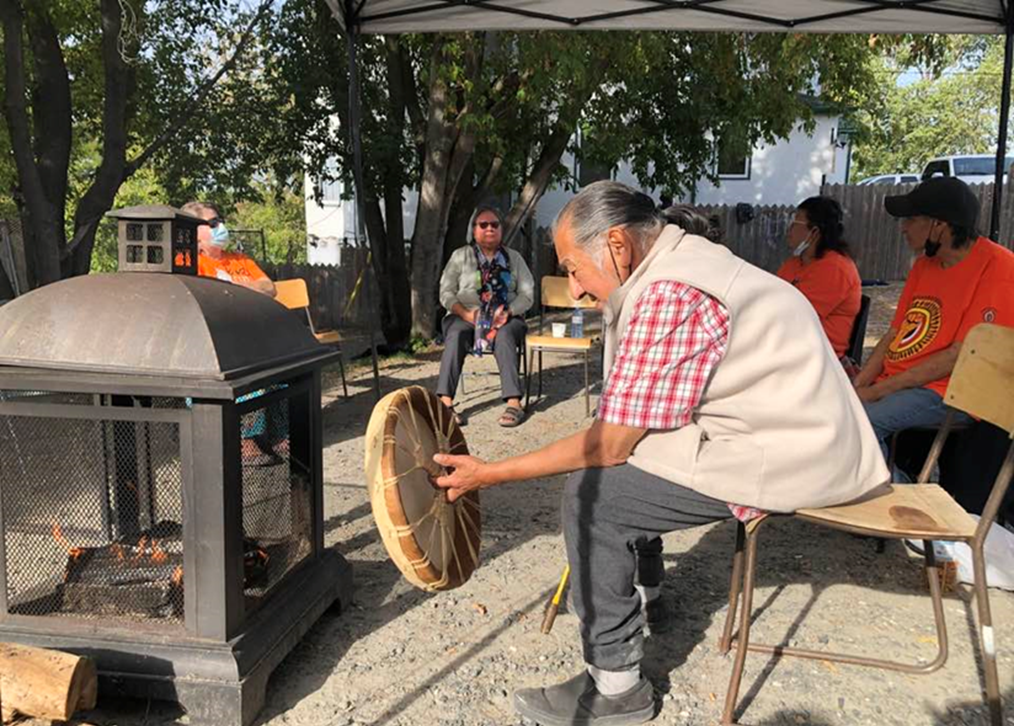
Figure 23: Tommy Keesick warming his hand drum outside the Kenora Fellowship Centre, with Yvonne Bearbull (centre) and colleagues looking on, National Day for Truth and Reconciliation (Orange Shirt Day), 2022. [Photo by Jeffrey Denis]
C. Social/relationship-building
- Youth-led multicultural night: One promising initiative in the 2010s was a youth-led multicultural night at Knox United Church. One participant recalled that the event was attended by a multi-generational group of about 70 people with backgrounds ranging from Kenya to the Philippines to Scotland. Intended to build cross-cultural relationships beyond the Indigenous-white binary, the event featured an open mic, Anishinaabe drummers, and a diversity of traditional foods brought by attendees. While the impact of one-time events may be limited, and while the unique position of Indigenous Peoples must not be lost in the multicultural mix, there is an appetite for more multicultural events in Kenora.
D. Indigenous sovereignty, rights, and justice
- Return of the original Cecilia Jeffrey IRS land to First Nations: In 2013, the Presbyterian Church formally apologized to survivors of the Cecilia Jeffrey IRS. National church leaders attended, and a memorial was placed at the site. The church also committed to returning the original IRS land to the local First Nations (Shoal Lake 39, Shoal Lake 40, and Northwest Angle 37). Peter Bush, a non-Indigenous Presbyterian church leader who spoke at the commemoration event, recalled:
“It was profound …. Three survivors spoke—wonderfully, with a blended humour and pain that is that story—and then we had a feast …. And then a couple came up to me … they were children of survivors. And they said, ‘we received these settlement payments and the words of the confession in a letter …. My mother got that. But somehow hearing you speak today carried more weight.’ And I have to admit, I left weeping.”
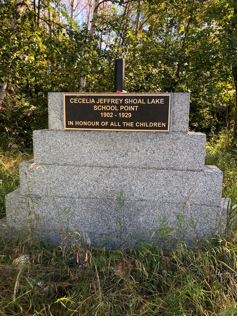
Figure 24: Memorial at the original Cecilia Jeffrey IRS site (School Point), 2022. [Photo by Jeffrey Denis]
In addition to the above activities, events, organizations, programs, and partnerships, several participants shared deeply personal moments of reconciliation. For example, a non-Indigenous retired pastor told the following story:
“A few years ago, I was invited to pray at the lighting of a sacred fire at the Fellowship Centre in recognition of the National Day of Truth and Reconciliation. I wasn’t sure why I had been invited, but I was honoured to be asked. There were various items on the agenda for the opening ceremonies, including drumming and smudging. My time came to offer the prayer, and for some reason, I got very emotional as I started to pray and struggled to get the words out. As I prayed and struggled, I suddenly felt a presence beside me. One of the [Anishinaabe] drummers had left the drum circle, stood beside me and put his arm around me as a comfort and an encouragement. It felt like a moment of reconciliation, and I was grateful for it and amazed at its kindness. It is something I will never forget.”
In short, participants identified many local reconciliation initiatives, which are often seen as models for improving relationships and fostering Indigenous healing and resurgence. Some of these are broad in scope, crossing multiple sectors and communities; others are more focused or even personal. Many of these initiatives have had positive effects on social conditions and community dynamics, and some are ongoing. Clearly, there is much good work to build upon in the Kenora region.
Additional Actions Needed to Advance Reconciliation
As shown in the previous section, Kenora-area residents have undertaken an impressive range of reconciliation-related initiatives. Yet, participants also identified many additional actions that they believe should be taken to advance reconciliation in Treaty #3. Each of the following was mentioned by at least three participants:
- Continue the dialogue: Since reconciliation is an ongoing process, participants emphasized the need for better communication and sustained dialogue, both within and between communities.
“I think a key action is to encourage communication [between the City of Kenora] and the Treaty #3 organization, and to try and engage in discussions and dialogue as much as possible. The goal being to learn from what is shared and to move forward in a positive direction and not repeat historical wrongs.” – former City Councillor Rory McMillan (non-Indigenous)
- Learn Anishinaabemowin: Because colonialism has sought to eliminate Indigenous languages—and because Anishinaabemowin was forbidden in residential schools—restoring fluency is vital for Anishinaabe communities. Some Indigenous participants also said they appreciated the small number of settlers who are learning the language and hoped others would follow.
“I always say to [settlers], ‘Learn my language. Show me how committed you are …. If we are truly to communicate, you need to speak Ojibwe. To understand me. Where the voice of my spirit is coming from …. Some [settlers] have said ‘yes.’ They are making an effort. And I’m very proud of those people … because it shows that they are real about this word ‘reconciliation.’” – Daryl Redsky (Anishinaabe)
- Increase Indigenous representation: Although Indigenous people are increasingly employed by ‘mainstream’ institutions, participants stressed the need for greater Indigenous representation, particularly in leadership positions in government, school boards, and workplaces.
“I’d like to see a local Anishinaabe person run for city council and get on city council because there are lots of Indigenous people in the city, but they don’t think they belong there because it’s basically a white person’s town.” – settler participant
- Build affordable and supportive housing: Although several new housing projects have been completed over the past few years, and others are in the planning or construction stages (see above), participants agreed that more affordable and supportive housing is desperately needed to address the houselessness crisis, which disproportionately affects Indigenous people. A non-Indigenous City of Kenora staff member acknowledged in a 2023 interview, “we don’t have enough units of housing that are affordable and that can support vulnerable populations.” Speaking in 2021, retired lawyer Sallie Hunt (settler) added:
“No one has invested in housing for so long … the social housing we have comes from the ‘70s and ‘80s. There hasn’t been a lot of money for repair. Our federal [and provincial] governments haven’t invested in it. Municipal government says, ‘it’s not our issue.’ They know there’s housing [needs], but they won’t put money in it.”
- Address mental health and addictions: Likewise, participants emphasized the urgent need to improve access to counselling, treatment, and healing programs, including harm reduction options. Several were supportive of creating a safe consumption site in Kenora, accompanied by culturally appropriate treatment services.
“We need a treatment facility here … it needs to be drug-specific … and for the really complex cases, we need assistive living where they can have that 24/7 support.” – Executive Director, Ne-Chee Friendship Centre, Patti Fairfield (Métis)
“[We need] a drastic change in perspective on addiction …. The hospital needs to update its policies …. We have a detox centre here, but it’s full of these big book thumping fanatics, so it’s like AA or nothing …. We need to stop talking about addicts as pieces of trash that need to be policed …. These are human beings that are going to take time to heal and repair.” – Will Landon (Anishinaabe)
- Invest more in reconciliation initiatives: Several participants said Kenora residents have many creative ideas about how to improve relationships and foster (un)learning and healing, but often lack the funding, staffing, or space to implement them.
“It would be great for the government or someone to fund positions where we could make this a reality and let us determine ourselves what that would look like …. Instead of just putting out reports, … give us what we need to work together to make reconciliation happen.” – Métis participant
- Honour Treaty #3: Many participants emphasized the importance of honouring the spirit and intent of Treaty #3, as understood by Anishinaabe leaders in 1873. Substantial research has questioned the validity of Ottawa’s “official” written text (Kinew, 1995; Krasowski, 2019; Luby, 2010).
“[Settler Canadians] need to know that the lands they’re living on, … they should start taking care of it. That’s the obligation under the treaty: [to] make sure that the land and resources are available to the next seven generations. To make good use of those lands. To ensure that the waters are clean and pure. And to accept the fact that they are now living under Anishinaabe law. And to follow those laws as we have been doing since we were given those original instructions, [for example] to only take what you need.” – Elder Robert Greene (Anishinaabe)
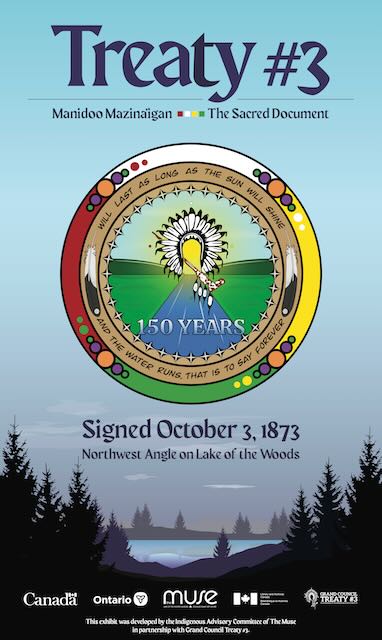
Figure 25: Poster for the Muse Exhibit celebrating the 150th anniversary of Treaty #3, 2023. The exhibit, known as “Treaty #3: Manidoo Mazina’igan | The Sacred Document,” was a collaboration between Grand Council Treaty #3, The MUSE, Library and Archives Canada, the Government of Canada, and the Province of Ontario. [Image courtesy of The Muse: Lake of the Woods Museum & Douglas Family Art Centre]
- Respect Anishinaabe law and jurisdiction: Honouring the treaty and advancing reconciliation requires respecting Anishinaabe law and jurisdiction, not just federal, provincial, or municipal authorities. One example may be resource companies complying with Manito Aki Inakonigaawin.
“Respect for Anishinaabe jurisdiction …. Because unless there is that structural change, we’re still in a mode of compromise, like, ‘if we can just get people assimilated enough, then everything will be acceptable.’ But it’s not addressing the fundamental relationship, which is a treaty relationship and a nation-to-nation relationship that is supposed to be respecting [Anishinaabe] law and jurisdiction …. The thing that actually needs to get reconciled is the two laws. Two jurisdictions.” – Cuyler Cotton (settler)
Story Box 5: Transformative Experience
Grand Chief Francis Kavanaugh: “I became Grand Chief in 1997. Treaty 3 had just signed the framework agreement for self-government discussions …. So, we developed a work plan and a budget, and … the following year, we were still trying to get it approved by the federal team. Then, in frustration, I asked the federal negotiator, ‘well, if you don’t understand who we are, you don’t understand our unwritten constitution, you don’t understand our traditional laws, then you need to come and visit me at my home. You can stay with us for three, four days. I’ll bring home a flip chart. I’ll conduct a pipe ceremony every morning. Smudging. I will put on that flip chart what I did. I will tell you what happens in the pipe ceremony. That pipe is the way our people communicate with the spiritual side of who we are … you load your pipe, you smoke it, and then you convey a message to the creator or a spirit, and the message comes back through the pipe’ …. So, I explained that process …. I also have a trap line …. So, I showed them what’s done in trapping as well. How we take care of the animals we harvest, how we put them back with respect …. I also talked about what happens in sweat lodges and shake tents. I explained how traditional lawmaking occurs. I explained how traditional decision-making occurs … I also told them, ‘I’m not providing you with a special diet. You’re eating what we eat as a family.’ So, after the third day, they said, ‘Chief, we now understand. We’ll go home tomorrow.’ So, they did. And the following week, the Minister of Indian Affairs, Jane Stewart, she called me and said, ‘Chief, why don’t you come to Ottawa? Bring your work plan. Bring your budget. We have an agreement.’”
- Return land: While the process is complex, many participants believed that reconciliation cannot occur without returning significant amounts of land to Indigenous control or stewardship. Focal points include Anicinabe Park and Tunnel Island. Several area First Nations also have outstanding land claims. At least one participant called for the creation of an urban reserve.
“When I talk about land back, it’s not about taking away people’s houses! Give us the public land, quote unquote, Crown land …. We don’t care about your houses because we agreed we’re going to share. It’s just that we need to protect [the land] because non-Indigenous people don’t tend to see generations ahead.” – Anishinaabe participant
- Improve school curriculum: Many participants emphasized the importance of teaching the “real” history of Indigenous-settler relations and Treaty #3, not a sanitized colonial version. In our youth sharing circle, students were clearly interested in Indigenous cultures, colonialism, and reconciliation, and wanted to learn more. However, they knew little about the local history or many of the reconciliation initiatives noted above. Out of the 11 students present, none said they had heard of the 1965 civil rights march or the Common Ground Initiative, and only a few were aware of the 1974 occupation of Anicinabe Park. While most students had heard of the TRC, none could name a single Call to Action. Students agreed that school curricula must be improved.
“The local history is extremely important because … what makes a large picture is the fine details. We’ve got to get down to those local levels to understand where things went wrong, where things have been good …. If we’re just looking at it from a national perspective, it’s always going to be this narrative of Indian versus white people, which, for the most part, it has been, but there are times, and there are great examples of working together and making things better. ‘While People Sleep.’ The work of my grandparents. If we lose that history, we lose the lessons of how to improve the current situation. So, it has to go back to the province to mandate that local history. And maybe it’s got to scrub things that aren’t relevant to the local context.” – Will Landon (Anishinaabe)
- Expand Elders’ roles: There was also strong support for expanding the role of Anishinaabe Elders in schools and other community settings to ensure that the local history, knowledge, stories, and skills are passed down across generations.
“I was surprised the students didn’t know nothing about that [local history]. And that’s what I was trying to tell [Grand Council] Treaty #3 too at one time, you know, that they should have more sessions with the youth and Elders in a group. Tell them about the history as far back as you remember, like the old people, the first time we had hard times [and] what we know about the treaty.” – Elder Jeanette Skead (Anishinaabe)
“I do think there should be more engagement with communities, with First Nation leaders and Elders, perhaps bringing them to classrooms, to youth, to share those stories, because without that knowledge, it becomes impossible to understand.” – local Conservative MP Eric Melillo (non-Indigenous)
- Provide anti-racist or cultural safety training: Although some participants were sceptical of standard workplace training programs—and indeed the literature is mixed on their effectiveness (e.g., Srivastava, 2024)—many believed that some form of ongoing education is important.
“What I’d like to see is to have these … circles where non-Indigenous people are taught about white supremacy [and] racism and patriarchy …. For the white people in Kenora to learn these things …. Like even for the youth, I think they need to be taught the truth. But for the adults [and] people in positions of power, … I think it would be good to have like cultural sensitivity workshops.” – Anishinaabe participant
- Prioritize reconciliation in the City’s strategic plan: At the time of our initial interviews, reconciliation was not identified as a priority for the City of Kenora. Many participants said it should be. However, the City’s 2022-2027 Strategic Plan lists “Relations with Treaty 3 Partners” as a strategic focus area and states that the city will:
- “partner with Anishinaabe and other Treaty Partners to advance reconciliation, inclusion, and relationships, and enhance our understanding and awareness of Truth and Reconciliation;” and
- “foster meaningful and beneficial relationships with Treaty Partners creating joint communication and engagement protocols and advancing the Tunnel Island Common Ground Initiative.” (City of Kenora, 2022a).
- Support Indigenous tourism and businesses: Several participants noted the importance of supporting Indigenous businesses, especially Indigenous tourism and sustainable ventures.
“There’s virtually no culturally relevant Indigenous tourism opportunities in Kenora …. I’d like to see that change so that visitors as well as local people can learn more about Anishinaabe culture …. For that matter, there aren’t many Indigenous-owned businesses in Kenora. So, I’d like to see more support for Indigenous business initiatives.” – settler participant
- Create more safe gathering spaces: Many participants noted the need for more welcoming, inclusive spaces for residents to gather and talk, including more Elder-and-youth gatherings to pass along stories and ideas, and more safe spaces for houseless and underhoused people.
“To me, homelessness is not just about a roof. It’s about belonging somewhere. Belonging where nobody is trying to chase you away …. And, in Kenora, when we don’t have welcoming spaces available, there’s kind of a mass migration from one place to the next … that somebody throws you out of, tells you you’re not welcome there, and then you have to go somewhere else, and it just repeats.” – settler participant
- Hold more community events: Several participants wished to build on recent community initiatives that have brought Indigenous and settler people together, such as music and arts festivals or sporting events.
“Doing more fun stuff together would be the best way, I think … powwows, celebrations, picnics, community events.” – Métis youth participant
“I just see going forward more events … bringing cultures together. I’d love to do a music festival where we have everyone present, you know, of the medicine wheel and talking about that and educating people in a good way …. Music, arts, culture: a lot of people don’t realize they’re healing because they’re the mental, physical, emotional, and spiritual. When you expose them to all those elements, they’re gonna heal, whether they like it or not.” – Craig Lavand (Wauzhushk Onigum)
- Keep an open mind: Some participants stressed the importance of keeping an open mind. Settlers in particular must listen to and learn from Indigenous Peoples, and humbly reflect on their own beliefs, identities, and actions.
“I think it often comes down to just an openness and a willingness to learn. Each of us needs to grapple with … the decisions we make in terms of reconciliation …. If there are ways we can encourage people to start to challenge their thinking, but in a way that doesn’t shut them down, you know, in a gentle kind of way … because self-examination is what we all need to do …. I think the changes are going to come on an individual level before they come on a governmental or an organizational level. The will has to be there by individuals.” – non-Indigenous participant
Story Box 6: Critical Awakening
Tracy Lindstrom: “People would talk about the racism in Kenora, and I didn’t really understand it until I started teaching and I could see what was going on and how it affected [Indigenous] kids and families …. I started teaching in 1996, the year the last residential school closed. Did I know that at the time? …. No. I had no idea how important that would be to the history of Canada and education itself. So, I reflect on that quite often. [A few years later, I was tasked with] implementing Indigenous education programming throughout the school board, which was difficult because it wasn’t something I’d experienced or grew up with …. I relied very heavily on Eleanor Skead, who was the Indigenous Advisor to the Director. And oftentimes we’d travel in the same car if we were going to Dryden or Ear Falls or Red Lake, and we would just talk …. I always called her my critical friend because I could ask her absolutely anything and she would fill me in. And we had taught together at Beaver Brae …. We had been friends for years. But I did not know any of this stuff she was sharing with me, which was shocking to me having grown up here. And the more she told me, the more I wanted to know. And so, I began digging into a more global perspective, like the Murray Sinclair perspective, and trying to understand the big picture of Canada and then zooming more into what happened in Treaty 3, what happened in Kenora …. One time, we brought in Indian Horse as a movie to watch with a panel of guest speakers to talk about their [residential school] experiences. And Marty [Camire] came and said, ‘you know, we have some openings on the Azhe-mino-gahbewewin board. Do you want to be part of it?’ And I’m like, ‘Tell me more!’”
- Challenge settler myths: Relatedly, settler myths and racist stereotypes and assumptions must be challenged and discarded. As some participants noted, this is not a one-time event, but an ongoing process.
“If you look at the facts, [including] the history of colonization [and] the continuing practice of colonization, where it leads in that conversation is to question the values, the principles, the arrogance that Western civilization [is built upon] …. The discomfort is questioning who you are as a nation, as a person. That everything you had and everything you were taught becomes questioned. Everything you assumed; all the mythology becomes false …. To be forced to look in the mirror, that’s the first step in reconciliation: the non-Indigenous people have to figure out who they are and [who they] have been as a society. And, you know, it’s not just about a relationship with the Anishinaabeg; it’s relationship with the land, it’s relationship with all things. There needs to be transformative change, transformative thinking in the non-Anishinaabeg community in order for there to be any hope of reconciliation …. There needs to be respect for [Anishinaabe] law and jurisdiction. There needs to be land back. There needs to be a huge power adjustment.” – Cuyler Cotton (settler)
- Celebrate the wins: Some participants said Kenora-area residents didn’t give themselves enough credit and that it was important to celebrate the wins. This includes publicly acknowledging Indigenous contributions and efforts towards reconciliation.
“It’s important to learn the sad and painful stuff, but it’s also important to celebrate together what we’ve achieved so far and what we’ll continue to achieve. So, I think just having more celebrations and fun events that the whole community, the whole treaty, can come together and have fun with.” – Métis youth participant
- Take better care of the earth: Anishinaabe Elders underscored that reconciliation is not just about relationships within or between communities, but also about relationships with the land. Indigenous and non-Indigenous people must uphold our stewardship responsibilities. As Howard Copenace put it at an Elders circle meeting, if we do not take care of “the life on earth,” humans will cease to exist. Sherry Copenace added that we have a shared duty to be respectful of all elements of Creation—land, air, fire, water—for they can both give and take life. Likewise, in an interview, Sally Skead stated:
“If they [settlers] want to make things better, they have to learn to respect the earth …. Keep the balance of nature …. Listen to tribal people. Not just Anishinaabe, but, you know, there’s tribal people all over the world …. They have good things to say about how to live a good life.” – Sally Skead (Anishinaabe)
Hopes and Visions for the Future
Participants were also asked about their hopes and dreams for the future, particularly for relationships between Indigenous and non-Indigenous people in Treaty #3. Their visions echoed many of the recommended actions highlighted in the previous section, though they tended to be framed more broadly. Many participants were both ambitious and cautiously optimistic, and their responses often combined themes from throughout this report. Across interviews, the following themes stood out (in alphabetical order):
- Abolish colonial laws and policies, including the Indian Act and “Indigenous Affairs” bureaucracy
- Acknowledge Wauzhushk Onigum as the original name for Kenora and recognize the land as Anishinaabe territory
- Anishinaabe leadership in ‘mainstream’ roles, such as mayor, premier, or prime minister (shortly after this vision was shared, Wab Kinew of the Ojibways of Onigaming First Nation in Treaty #3 was elected Premier of Manitoba)
- Better health and quality of life, especially for Indigenous Peoples
- Better school curricula and more opportunities to learn the truth
- Celebrate Indigenous cultures
- Change the story of what Canada is about and who Indigenous Peoples are
- Clean land, air, and water, including addressing mercury contamination at Grassy Narrows and Whitedog
- Continued Indigenous resurgence, including revitalization of Anishinaabe language and ways of being
- Continued relationship-building, both within and between communities
- Embrace diversity
- Equity or fairness
- Greater sense of community, understanding, acceptance, and appreciation
- Healing—for everyone, in different ways
- Honour treaty promises
- Implement all 94 TRC Calls to Action
- Indigenous self-determination, including control over programs and services
- Land back and expanded Indigenous land stewardship
- Less talk, more action
- Live up to the Seven Grandfather Teachings (Humility, Bravery, Honesty, Wisdom, Truth, Respect, and Love)
- Live together in harmony, with mutual support and care
- More Indigenous representation in workplaces and institutions
- More settlers engaging in Indigenous-led events, learning, and asking questions
- More settlers speaking out against racism
- More opportunities to gather, talk, and have fun
- No more racism
- Peace and friendship
- Protect the earth from climate change and other environmental threats
- Respect—for all peoples and the land
- Restore balance, including the balance of power
- Safe and welcoming community
Most of these themes are deeply interconnected, and many participants combined multiple ideas as they described their visions. Their words below help illustrate the richness and range of these hopes and dreams.
In Participants’ Own Words
- “I’d like to see the progress continue. And I think I’m optimistic about that happening and want to remain so. I think in learning about the history of Canada as it really was, learning about treaties, having access in the school system as well to celebrations of Indigenous culture and traditions, that’s where the real hope lies for me, is with the young people. And growing up with the knowledge and understanding makes me hopeful that they will be the agents for change that will get us to the pinnacle of where we need to go.” – E.W. Stach (settler)
- “It may not change in my lifetime. Maybe my sons, my daughters, will pick up the work and carry on. Maybe your children, your family’s children, the neighbour across the street can pick up and carry on what we’re talking about today. Maybe they will be happy. Maybe they will live in a world where there is no systemic racism, no classes, no levels. Just understanding and acceptance and appreciation. That’s what I long for.” – Daryl Redsky (Anishinaabe)
- “Reconciliation starts with the settlers acknowledging and owning the creation of Canada and the continuation of Canada, which is founded on the displacement of Indigenous Peoples. And but then it’s daily life, the daily grind. It’s being followed around in the drugstore, it’s a whole bunch of things …. If we can get to a point where the Anishinaabe no longer have to be resilient, where the impacts [of colonialism] stop, they end, and there’s respect, opportunity, and celebration of language … I think that’s a measure of reconciliation.” – Cuyler Cotton (settler)
- “My hope for the future is being able to get along and live together … to take care of the land and water and air … to share our lands and resources in the way that was intended by the treaty … and it doesn’t matter who you are, that you can have access to food and clothes and medicine and the help that you need.” – Robert Greene (Anishinaabe)
- “I would like to drive into town and see a sign just as big as ‘Welcome to Kenora’ that says you’re entering the lands of the Anishinaabe, of particular First Nations. I’d like to see all kinds of opportunities to experience Indigenous culture. I’d like people to walk into stores and see Indigenous staff, go to schools and it feels like Indigenous people go there, and the curriculum teaches an understanding of Indigenous issues … and the courtroom doesn’t feel like a white person’s system, but an Indigenous system supported by Indigenous people and focused on keeping people out of prisons and healing.” – settler participant
- “I’d like to see where there’s no need for Reconciliation Kenora or the 94 Calls to Action anymore … that we’ve taken care of everything to do with that. I’d like to see that we live together in harmony. It would be beautiful. And everybody can celebrate their cultural identity without any kind of judgment or prejudice.” – Martin Camire (Métis)
- “I wish we were all equals …. And by that, I mean there’s no discrimination, no racism, no us versus them …. You know, people are people. We all need the same equity in access to services, in housing, in being able to get a job, in seeing yourself wherever you go.” – Métis participant
- “I think there are people who just keep saying, ‘We should all be one melting pot living happily together ever after.’ But what we really need is a community that celebrates all its diversity and that respects every member equally …. We are all one, but some of us need different things …. Doesn’t make us better or worse. It just makes us all different. Why can’t we respect and celebrate that instead of expecting everyone to be ‘just like me’?” – Anita Cameron (Indigenous)
- “I’d love to see an urban reserve in the traditional lands of the three First Nations. I’d love to see the business community in Kenora recognizing and supporting the urban reserve. I’d love to see … meaningful action. Not flying our flag at your city hall. Not doing a land acknowledgement. Do a land back. That says reconciliation to me.” – Tania Cameron (Anishinaabe)
- “I think honouring the treaty is a way to connect us all. And it is its own form of reconciliation because it’s bringing us all together. And like what [an Indigenous student] said, we all have to work together because we’re all on this planet together and we have to keep it clean and safe.” – settler youth participant
Story Box 7: Kokum Scarves
Tania Cameron: “When Russia invaded Ukraine, I was watching the news, and it was disturbing to see the violence …. And then one evening I was on social media, and I could see the stories being shared of the relationship between early settlers from Ukraine to Canada, with the Cree, with the Anishinaabe, and the relationships and friendships that were built. And then I learned that’s where the Kokum scarves came from; they were the Ukrainian ‘babushka’ that Ukrainian women wear, the floral scarves … I had no idea … a lot of my childhood had been spent in the far north, at Sachigo Lake, Big Trout Lake, Pikangikum, Cat Lake, all those little reserves, [and] they would wear the floral scarves … I didn’t realize that was a gift from Ukraine …. So, I didn’t have a scarf, and I wanted to get one and celebrate and stand in solidarity. So, I called a shop in Winnipeg, and they said that if we buy a scarf, proceeds will go back home to Ukraine. And so, I posted on social media, ‘my sister-in-law’s gonna buy me a scarf. Who wants a scarf? It’s this much and proceeds are going to Ukraine.’ I bought that man’s scarf inventory out. He had 90 in stock, and I got them all because so many women wanted to wear scarves. And it wasn’t just Indigenous women …. It spread so fast on social media …. I also didn’t realize Kenora had such a strong Ukrainian community. So, some of the Ukrainian women there were ordering scarves from me …. One woman said, ‘can you bring it to me?’ …. So, I stopped by, and I thought, I’ll just run to her door. And she’s waving me in. She’s this little Ukrainian woman, a senior, and she’s like, ‘you’re coming in [for] coffee. I wanna meet you.’ …. So, she gave me a big bear hug, and … she made [my sister-in-law and I] some Ukrainian dessert and she started sharing her story about how her family came from Ukraine. And how heartbreaking it is for her to watch the news, to see what’s going on in her homeland. Her relationships with Indigenous people in the surrounding First Nations all these years. And what it means to stand in solidarity with Ukraine. And it was just a beautiful coming together and sharing of stories. So, I said, ‘well, I got your scarves. Like here’s what you wanted.’ And she gifted me her grandmother’s scarf. And I was really touched by that …. So, it was an emotional visit, but I mean that was a good act of reconciliation.”
“Booshkegiin Kenora” Gathering: Community Feedback
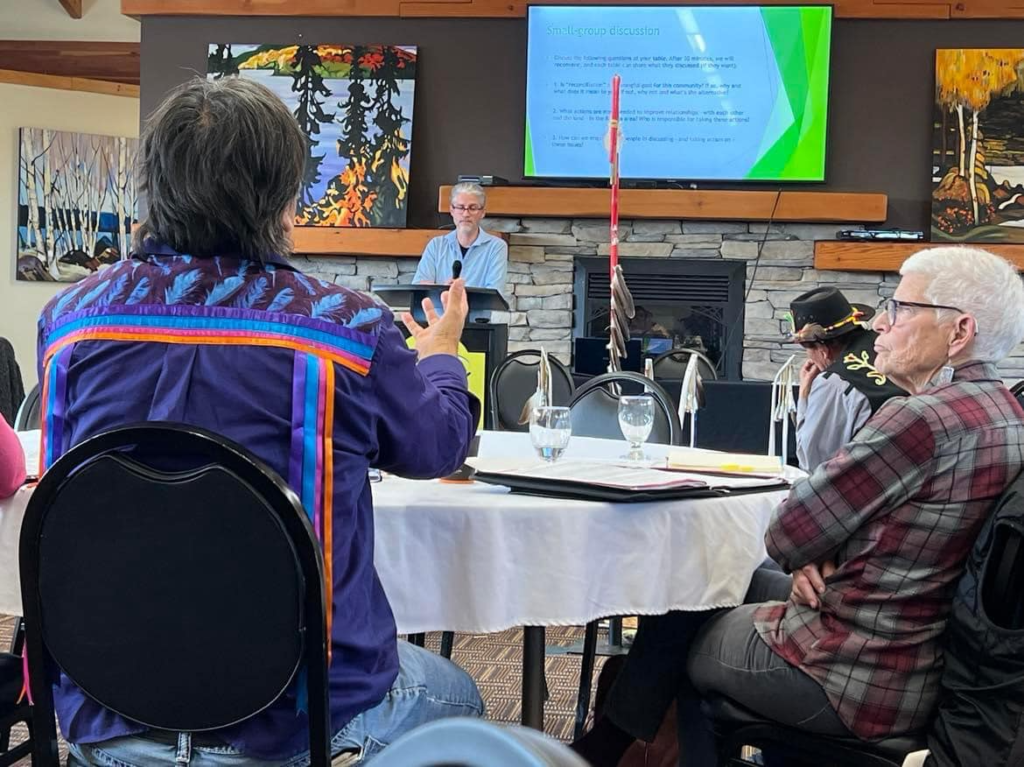
Figure 26: Ed Mandamin (seated left) addresses Dr. Jeffrey Denis (podium) at the Booshkegiin Kenora gathering, 2023. [Photo by Jon Thompson]
On October 12, 2023, Anishinaabe, Métis, and non-Indigenous residents from across Treaty #3 gathered at the Super 8 (Minis Hall) in Kenora for “Booshkegiin Kenora – It’s Up to You.” The purpose of the gathering was to share findings from two recent research projects and to promote dialogue about reconciliation and belonging in Kenora (KMF Coalition, 2023). First, Dr. Denis shared results from the Reconciliation Kenora / Azhe-mino-gahbewewin project, including ideas discussed in this report around what reconciliation means to residents, barriers to reconciliation, and actions needed to improve relationships. Then, Elauna Boutwell and Laine Hughes of Kenora Moving Forward and the Debwewin Truth project presented a Be/Longing zine that was created with street-involved youth to highlight what home and belonging mean to them. Several of the youth also spoke and shared personal experiences.
Overall, more than 60 people attended, including Grand Chief of Treaty #3 Francis Kavanaugh, Kenora City Councillor Lindsay Koch, and members of organizations ranging from the OPP to the KFC. Participants were invited to share feedback and discuss priorities for action. The gathering was emceed by Elder Howard Copenace. Elders Jeanette Skead, Tommy Keesick, Robert Greene, and Sherry Copenace gave opening remarks, and the Ogimaawabiitong (KCA) drum was present throughout.
As part of the Reconciliation Kenora portion, attendees were asked to discuss in small groups: (1) whether reconciliation, or Azhe-mino-gahbewewin, is a meaningful goal for the community (and if not, what’s the alternative?), and (2) what actions are most needed to improve relationships in the Kenora area. Participants engaged in lively discussions at their tables, after which some shared their thoughts with the wider group.
Based on the publicly shared feedback, there was a consensus that reconciliation, or Azhe-mino-gahbewewin, remains a meaningful goal for the region. Although many residents are critical of the term “reconciliation” (as discussed above), many also expressed deep respect for the TRC’s work and a belief that implementing its 94 Calls to Action is essential. While wary of some of the ways in which the idea of reconciliation has been interpreted and applied, many residents believe strongly in—and are still working for—more just and sustainable relationships in Treaty #3. As outlined in this report, they have engaged—and plan to continue engaging—in many initiatives that aim to build bridges between communities and contribute to education, healing, well-being, and social justice, which are all key elements in common definitions of reconciliation.
Summarizing her group’s conversation, Elder Sherry Copenace said, “We were for reconciliation … to set things in a good way.” At present, she continued, “we need that, and we all have a responsibility for that.” Acknowledging Shawanoong Banaise’seek, the Grandmother Drum that attended the gathering, she added:
“It’s about acknowledging all the harms that have happened thus far but going beyond that and finding solutions. She [Grandmother Drum] is showing us the way …. Most importantly, it’s for our grandchildren and those yet to come …. We’re the ones being given that opportunity to set things in a good way for them …. And whatever you have to contribute, it’s good. Whatever role or responsibility you have to bring life that is good to everyone, whether it’s being a spiritual leader, an Elder, a writer, a speaker, an activist, it’s all good … and it’s up to us to figure out how we’re all going to live together …. It’s about making brave spaces and being able to say and do what we need to do …. We all need to work together and care for one another.”
Priorities for Action
Among the priorities for action, participants emphasized the importance of:
- Education and building on recent progress in the local school systems
- Expanding Indigenous representation in the local workforce
- Increasing Indigenous involvement in governmental decision-making and policymaking at all levels
- Strengthening collaboration between Indigenous and non-Indigenous organizations
- Holding organizations accountable for their commitments to reconciliation
- (Re)building safe, welcoming spaces for Indigenous and non-Indigenous people to talk and build relationships
- Challenging racist stereotypes and myths (e.g., about taxpayers’ money going to First Nations)
- Supporting Indigenous language revitalization
- Supporting First Nations’ economic independence and self-determination
- Implementing the TRC Calls to Action
In Participants’ Own Words
- “What’s important for reconciliation to begin is education … starting from ground zero, introducing Native culture, traditions, values right from kindergarten all the way through [post-secondary] …. There also needs to be more Indigenous representation, like more Indigenous art … when entering the city so people are well aware of the land we’re on. More Indigenous representation in the workforce and more tolerance for the Indigenous people speaking up.” – Dave Segerts (First Nations)
- “I think we all understand that language is at the heart of culture. And it’s important to remember that those who were forced to attend residential schools were deprived of using their language on pain of physical punishment …. So, it’s incumbent on us as a society to support the revitalization of Indigenous languages …. And I’m heartened to see that there are some schools at the elementary and indeed high school level locally [where] that language is being taught, but I think we need to engage in a deeper and much more supportive effort to make the Anishinaabe language vital again.” – E.W. Stach (settler)
- “I think it is incumbent on the City of Kenora to take a leadership role—in real partnership with Indigenous residents from the Kenora area—in achieving reconciliation. I understand the original Reconciliation Kenora group was separate from the city, but I think that’s a missed opportunity …. The TRC calls to action include 5 specifically directed at municipalities, and another 8 directed at all levels of government with no distinction. If they take the TRC and those calls seriously, more evidence of that than just a land acknowledgment is required.” – Indigenous participant (submitted by email after the gathering)
- “I had a great conversation with [an Anishinaabe Elder]. Café Conversations is something we both agree is the grassroots way to start is people just talking to people and we’re going to connect and try and get that going again.” – Susan Evenden (non-Indigenous)
Following this conversation, Susan went on to co-organize a few Café Conversation sessions. However, no Indigenous residents (including the Indigenous co-organizer) attended, and the initiative petered out. Such attendance challenges do not necessarily indicate a lack of interest, but may be due to other barriers, including weather, transportation, and communication. This experience also reflects a common pattern in and beyond Kenora where many reconciliation initiatives start with good intentions but are difficult to sustain over the long haul. Several participants expressed frustration with this pattern. Elder Sherry Copenace also shared the frustrating experience of sitting on committees, repeatedly giving the same messages, and not being heard by settler colleagues. For this reason, some Indigenous residents may be cynical of many reconciliation initiatives.
At the Booshkegiin Kenora gathering, Anishinaabe participant Kelvin Boucher-Chicago also distributed a pamphlet from the Treaty #3 Grassroots Citizens Coalition, emphasizing that the “Indian industry is the biggest job creating system in this area” and calling for accountability from the “over 50 service providers here in Ooh-tah-naug that acquire money on behalf of the Anishinabec.” The suggestion was that some service providers have no interest in truly helping “street peoples” or creating a just system because their own jobs depend on keeping others poor.
Another participant noted a potential tension in the realm of economic reconciliation: while some promote increasing Indigenous representation in ‘mainstream’ workplaces, others stress the need for Indigenous people to start their own businesses and rebuild Indigenous economies on their terms. In practice, there is a trend in both directions—and it is for Indigenous people themselves to decide on their path.
Finally, settler participant, journalist Jon Thompson, reiterated how the reconciliation process is unique to people and places. Initiatives that work for some individuals may not work for others, depending on their backgrounds, education levels, personalities, etc. Moreover, what works in one city or community may not work elsewhere; different places have different histories, geographies, treaties (or no treaties), power dynamics, and land-economy relationships that shape what is possible. We cannot assume reconciliation initiatives that “succeed” in one place or with one set of people will translate to other jurisdictions. There is no “silver bullet” solution, and multiple approaches may be required.
Jon also compared reconciliation efforts in Kenora and Thunder Bay, both cities where he had lived. Specifically, he said Thunder Bay initiatives tend to emphasize measurable benchmarks of success. This approach can be useful for holding people and organizations accountable but also risks becoming a “box-checking” exercise. In contrast, he said, “in Kenora, it’s all about relationships.” Meaningful work has been done, and deep relationships have developed, but the systematic tracking of progress is lacking. Ultimately, he argued, both metrics and relationships are needed. As Elder Howard Copenace concluded at the gathering: “Balance is the key.”
1
Next Steps and Recommendations
The Reconciliation Kenora / Azhe-mino-gahbewewin research project is but one intervention in a long line of reconciliation-related initiatives in the Treaty #3 region. Its purpose has been to clarify the meanings of reconciliation for Kenora-area residents, identify barriers, and highlight actions taken as well as those still needed to advance reconciliation. Going forward, we hope this report will inspire further research and inform policies and practices that foster more just and sustainable relationships.
Our initial plan was to hold sharing circles with Anishinaabe, Métis, and non-Indigenous Elders, youth, and persons living on the street. The COVID-19 pandemic, however, made in-person meetings difficult during a crucial phase of this project. We therefore shifted to in-depth, mostly Zoom-based interviews with Elders, Knowledge Keepers, community leaders, and activists. We also conducted one sharing circle with high school youth. These methods produced rich, informative data, including a range of perspectives and experiences. Still, it is critical to hear more from the most marginalized members of society—people whose voices are rarely heard in public discourse. Additional sharing circles with houseless and underhoused community members in Kenora would help illuminate their experiences and perspectives on reconciliation / Azhe-mino-gahbewewin. More circles with youth could also help clarify generational differences (and similarities) and identify priorities for action among future leaders in the region. To engage these groups, it may be beneficial to employ more visual and interactive approaches, such as participatory video, photovoice, or arts-based methods.
Our original research proposal described this project as a first step toward informing a strategic action plan for reconciliation in Kenora. Based on our research, this report has identified many past and present reconciliation initiatives, as well as participants’ hopes, concerns, and visions for the future and the kinds of actions that they believe should be taken. It will now be important to translate these ideas into specific, actionable recommendations. We are hesitant to do so here because we believe it should be a community-driven process.
However, one possible approach to developing strategic action plans is to start with a sector-by-sector approach. Indigenous and non-Indigenous leaders in education, health care, the criminal justice system, and other sectors could each convene facilitated gatherings to review the relevant initiatives and suggested actions identified in this report, contribute their own insights, and then map out sector-specific priorities, objectives, and plans. For example, participants in this study consistently called for improvements to school curricula, including more accurate and comprehensive teaching about the local history of Indigenous-settler relations, Anishinaabe culture, and Treaty #3, as well as more meaningful roles for Elders in schools. Education sector leaders would need to determine who is responsible for implementing such changes, on what timeline, how to proceed, and what concrete measures of “success” would look like. Such decisions are beyond the scope of this report, but a logical next step. It is also crucial that local Indigenous educators play a central role in making such decisions and developing such plans—without being overburdened. As noted above, moreover, strategic planning must not be treated as a mere checklist exercise; rather, it should be a key component of ongoing relationship-building.
A potential risk of a sector-by-sector approach is that it could miss the “big picture” and opportunities for collaboration. For this reason, we also recommend convening a larger gathering that brings together Indigenous and non-Indigenous leaders across sectors—and from municipal, provincial, federal, First Nations, and Métis governments—to share draft strategic action plans, identify how they align (or not), and explore opportunities for partnership and synergy. Indeed, some of the key actions identified in this report—such as honouring treaty promises, addressing mental health and addictions, and reducing socioeconomic inequities—may only be achieved through collaboration.
Another major theme identified in this report—and in most current literature on settler colonialism, decolonization, and Indigenous resurgence—concerns relationships to land (e.g., Coulthard, 2014; King et al., 2019; Lowman & Barker, 2025; Simpson, 2017; Tuck & Yang, 2012). In early 2025, the provincial and federal governments passed legislation (Bill 5 and Bill C-5) to create “special economic zones” to expedite resource extraction. First Nations across Ontario, including in Treaty #3, protested that these laws could undermine Indigenous and treaty rights—yet they were passed without Indigenous Peoples’ free, prior, and informed consent. This is not the path to reconciliation.
Rather, reconciliation will require recognizing Indigenous Peoples’ right to say no. In Kenora, it will require fair resolution of the ongoing land claim at Anicinabe Park and addressing the legal complications surrounding the Common Ground Initiative. More broadly, it will be vital to develop a process for returning more land and following Anishinaabe stewardship practices. Any such process will be complex and is likely to spark backlash, at least initially. It will also require the involvement of federal and provincial governments, which have constitutional and treaty obligations. Perhaps one role for local settlers interested in reconciliation is to press their elected representatives to prioritize such “land back” processes and uphold Indigenous and treaty rights.
A further issue for follow-up research, however, is how to engage a wider range of residents, especially settlers, in the process of reconciliation. Many leaders and activists are frustrated that reconciliation initiatives tend to only reach the same core group of participants. Some settlers believe “reconciliation” does not concern them or is not a priority. For this reason, studying more closely the experiences and motivations of currently engaged residents may help clarify what factors enable participation. Likewise, interviewing ordinary residents who are not engaged in reconciliation activism could help better specify the barriers and motivators for them.
Moreover, it is important to recognize that the demographics of the Kenora region are changing. While most settlers historically have been “white” people from Europe, there is increasing immigration from other parts of the world. Although immigrants (people born outside of Canada) only comprise 4.4% of Kenora’s population, recent immigrants (since 2011) are more likely to be “visible minorities,” specifically Filipino, South Asian, and to a lesser extent Chinese, Black, and Latin American (Statistics Canada, 2022). Many of these recent immigrants are working in health care and service occupations (e.g., coffee chains, gas stations, retail stores, nursing homes) where they interact regularly with both Indigenous and white residents. Although there is potential for solidarity between Indigenous Peoples and immigrants/settlers of colour, based in part on similar experiences of racism and colonization, many recent immigrants may be unaware of the history of colonialism or the significance of treaties in Canada; some may even adopt dominant settler ideologies as they integrate with Canadian society (Phung, 2011; Sehdev, 2011). At the same time, many Indigenous and white residents may know little about the histories, experiences, and circumstances of newer immigrants. Going forward, it will be important to study relationships and attitudes among all three groups—Indigenous Peoples, white settlers, and settlers of colour—for, as the late Elder Stephen Kejick emphasized, reconciliation must be inclusive.
Another issue warranting further investigation is how climate change is affecting Indigenous-settler relations and the potential for reconciliation. Wildfires, storms, floods, and other environmental disasters have become a regular occurrence in Northwestern Ontario, resulting in social and economic disruption. Nearby First Nations, such as Wabaseemoong Independent Nations, have experienced multiple mass evacuations in recent summers. It is important to study the impacts of such events on Indigenous and settler communities, but also what is being done locally to mitigate and adapt to climate change. As Elders noted, our shared interest and responsibility to protect the land, air, and water for future generations may help bring communities together.
Ultimately, this study has highlighted many reconciliation-related initiatives in the Kenora area that should continue to be supported (financially and otherwise), as well as additional actions that participants believe are still needed. It is incumbent on current and future leaders in Treaty #3 to make reconciliation, or Azhe-mino-gahbewewin, a priority and to invest substantial resources in these efforts. As the TRC (2015) emphasized, reconciliation is a complex, multidimensional, and multigenerational process. For reconciliation to be meaningful in the Kenora region, it will require honouring the spirit and intent of Treaty #3, as understood by Anishinaabe Elders, returning significant power and resources (including land) to Indigenous communities, and respecting Anishinaabe law and jurisdiction.
1
Appendix: Timeline
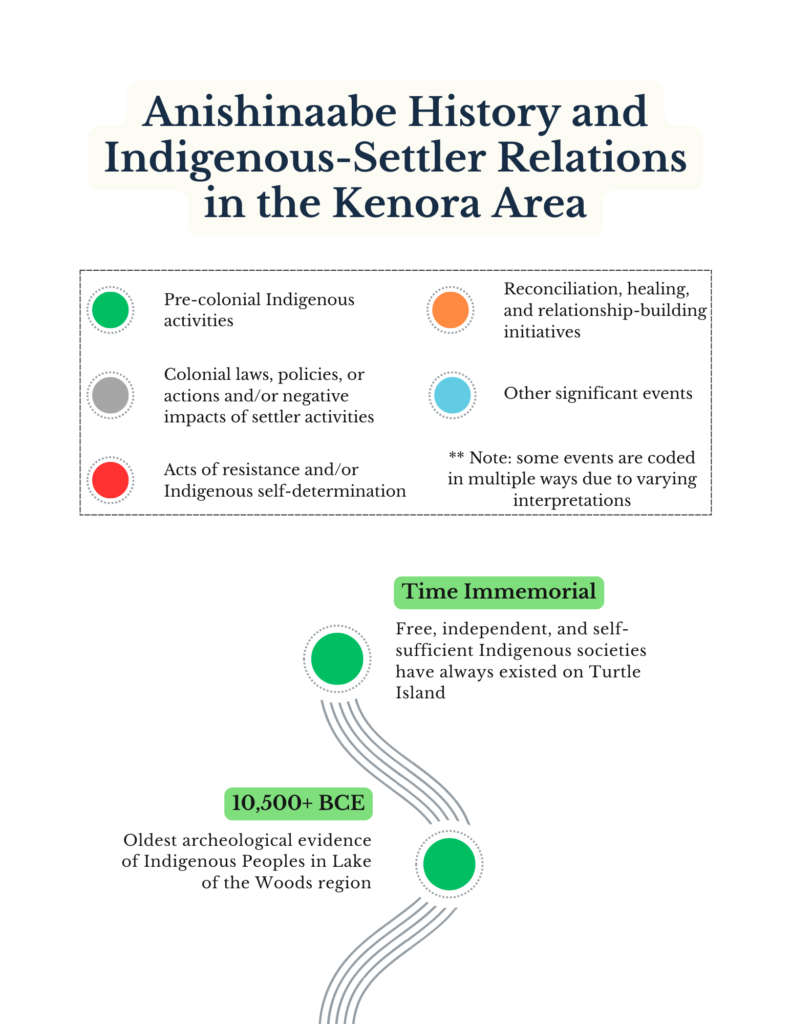
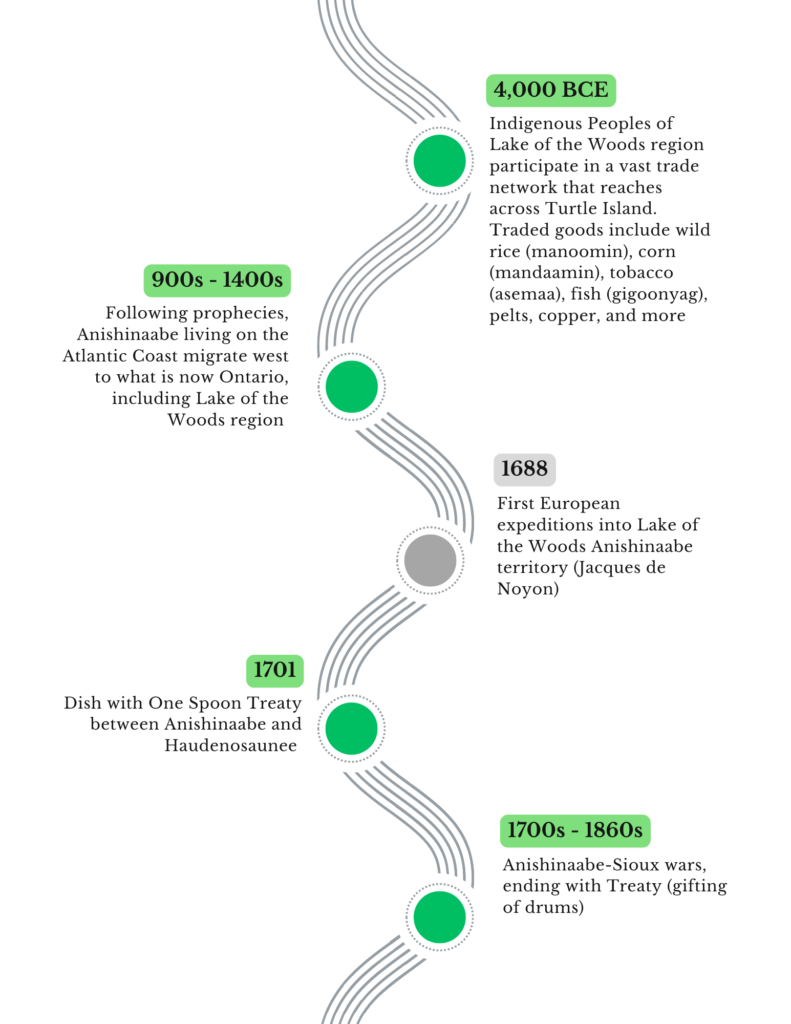
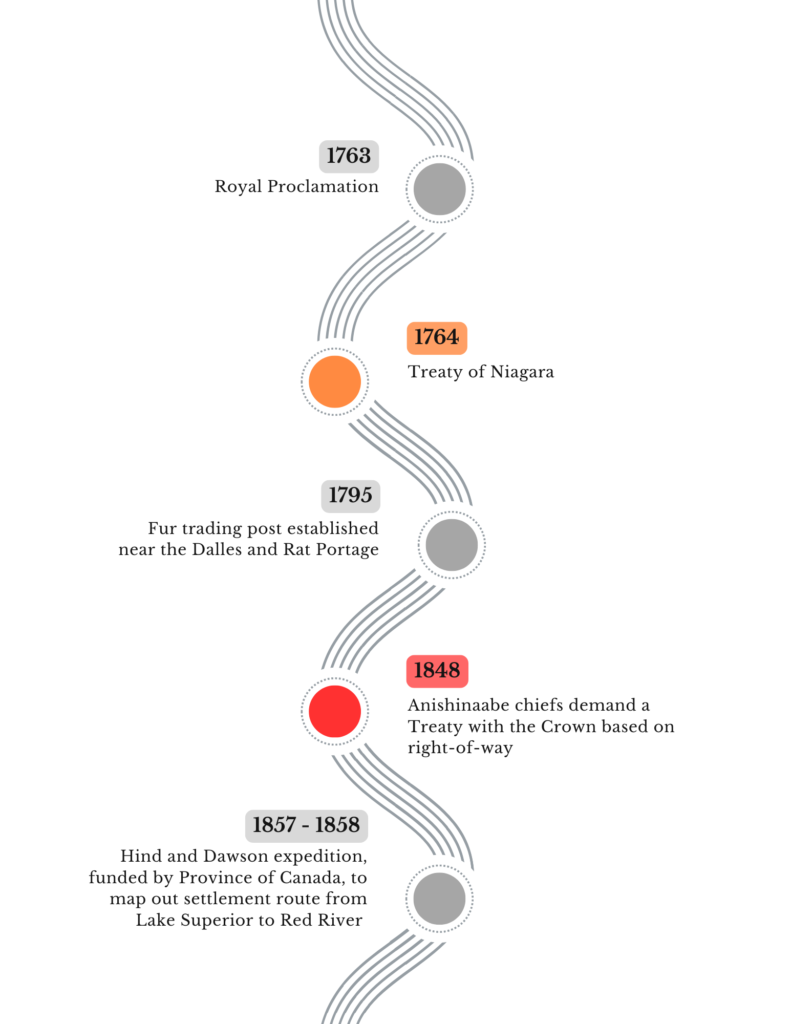
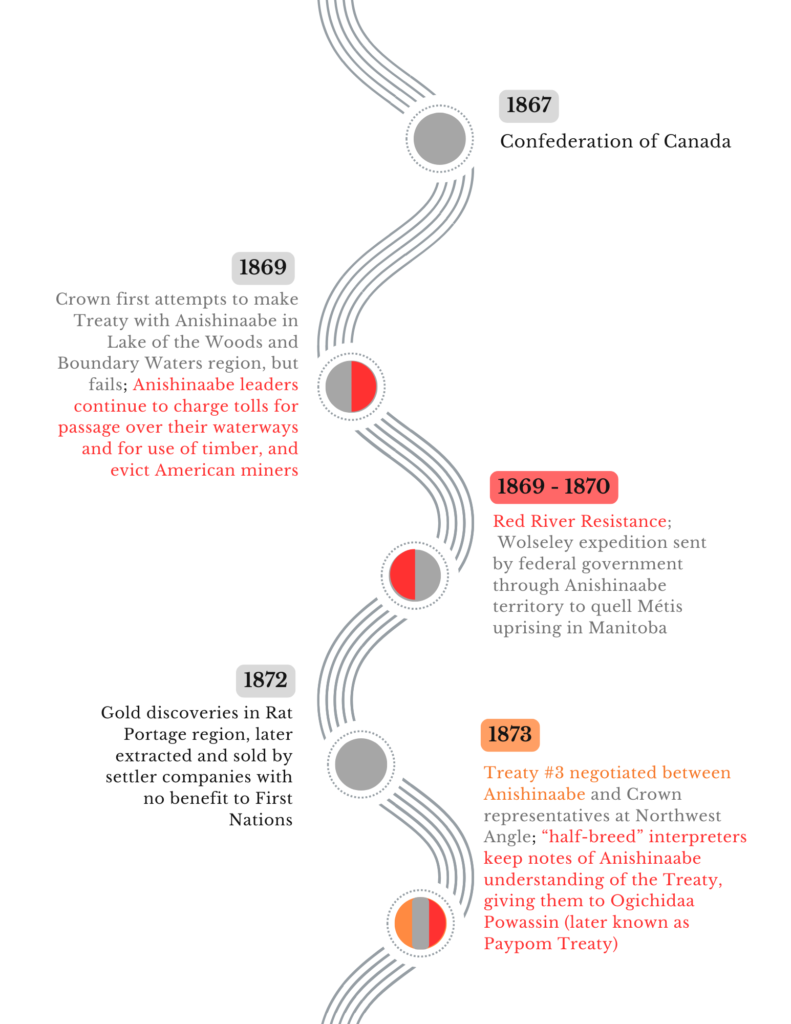
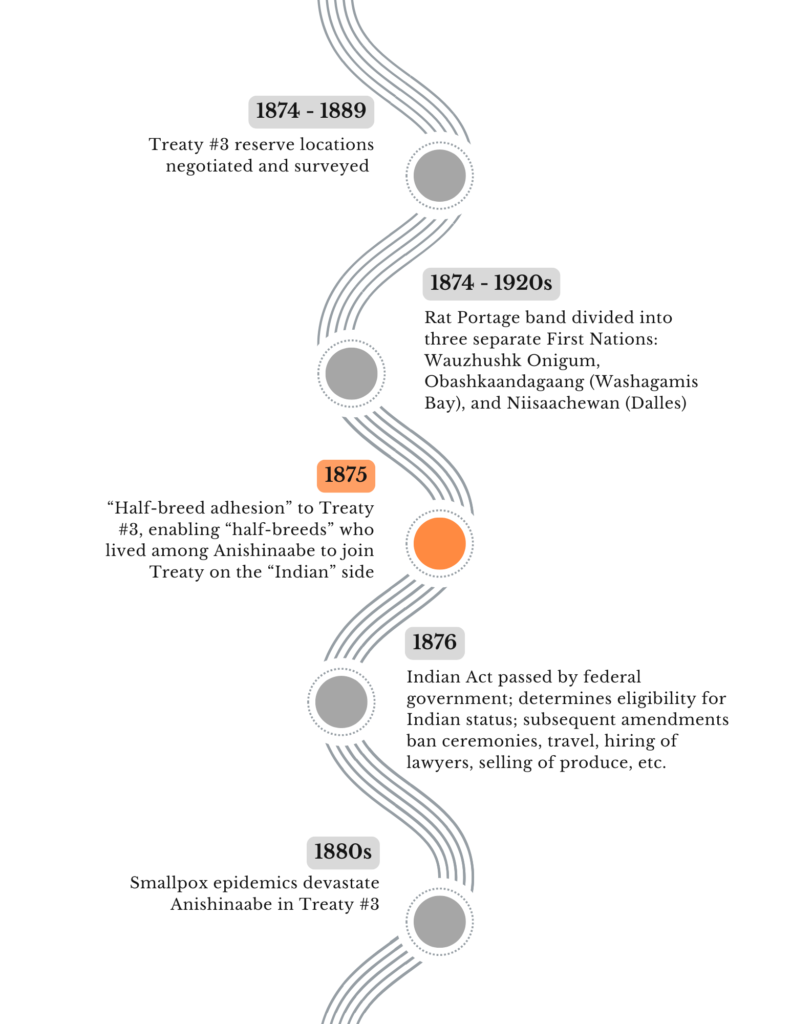
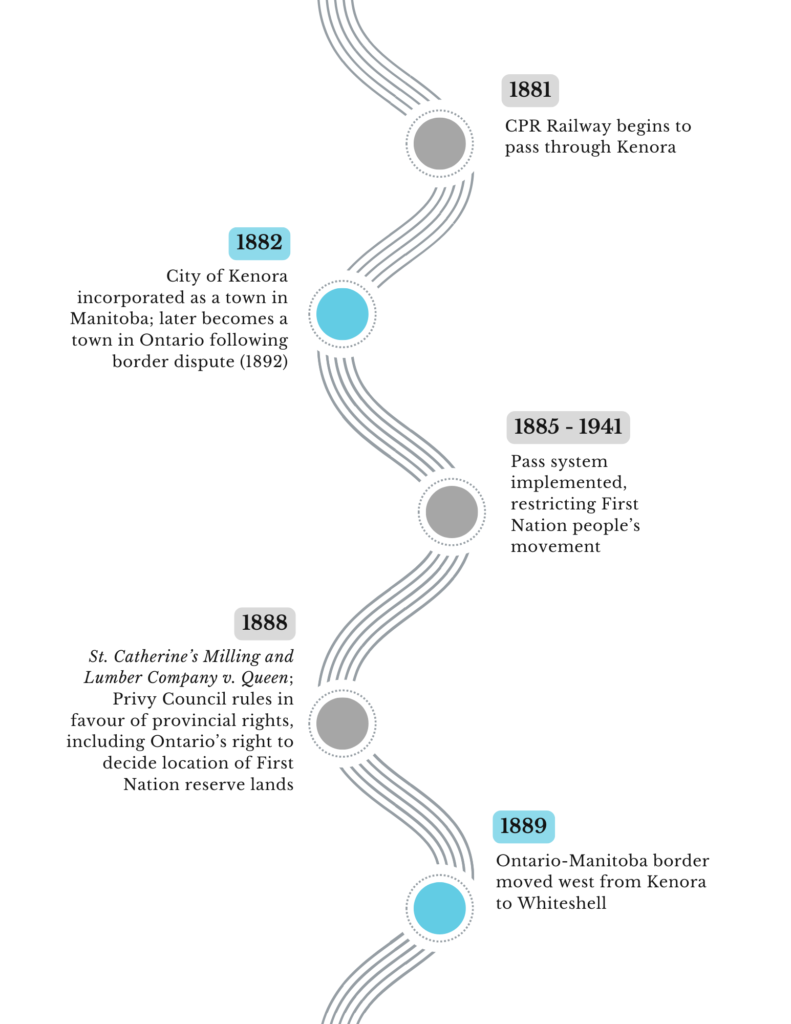
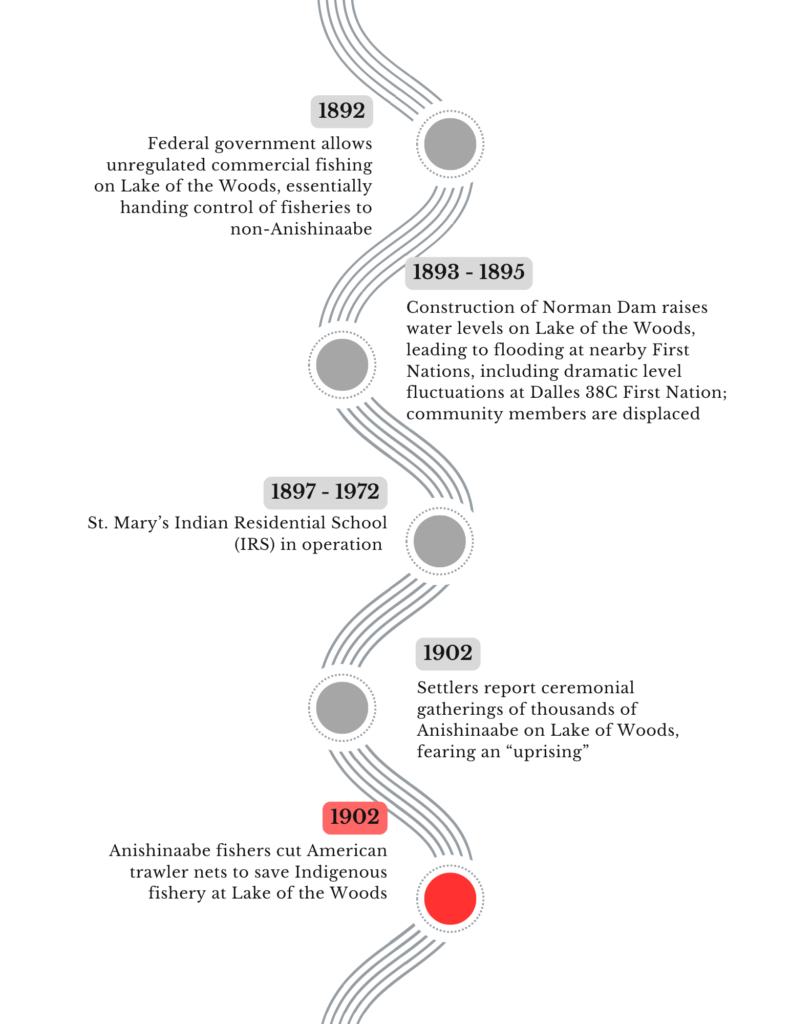
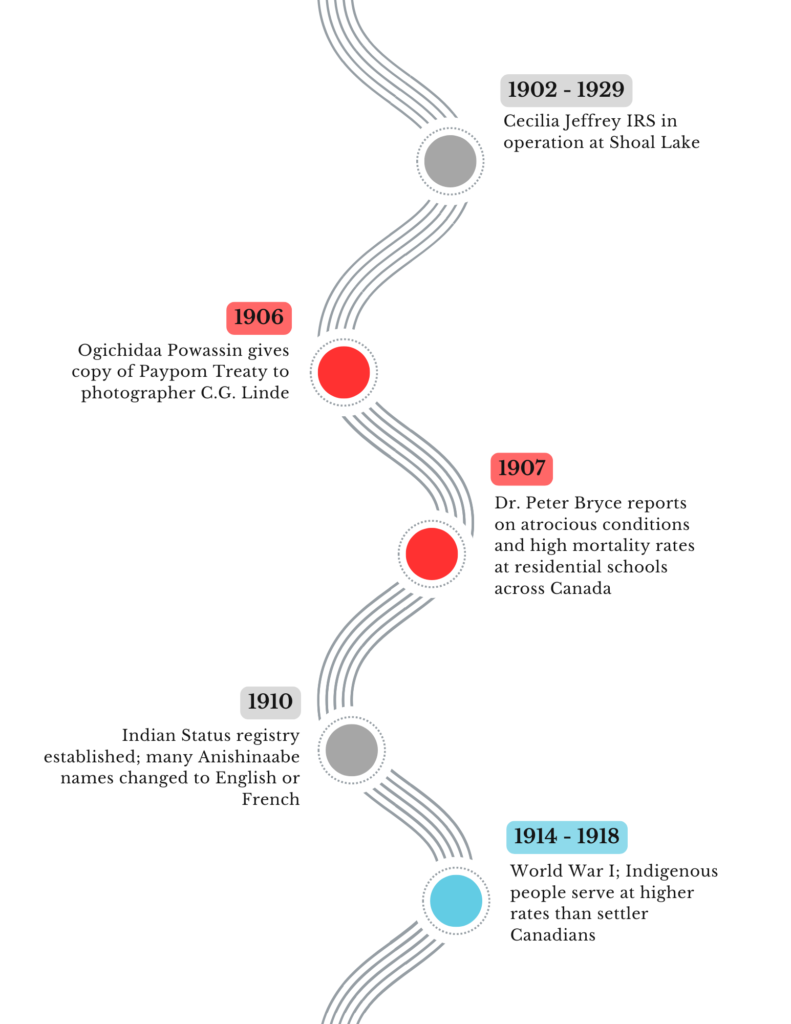
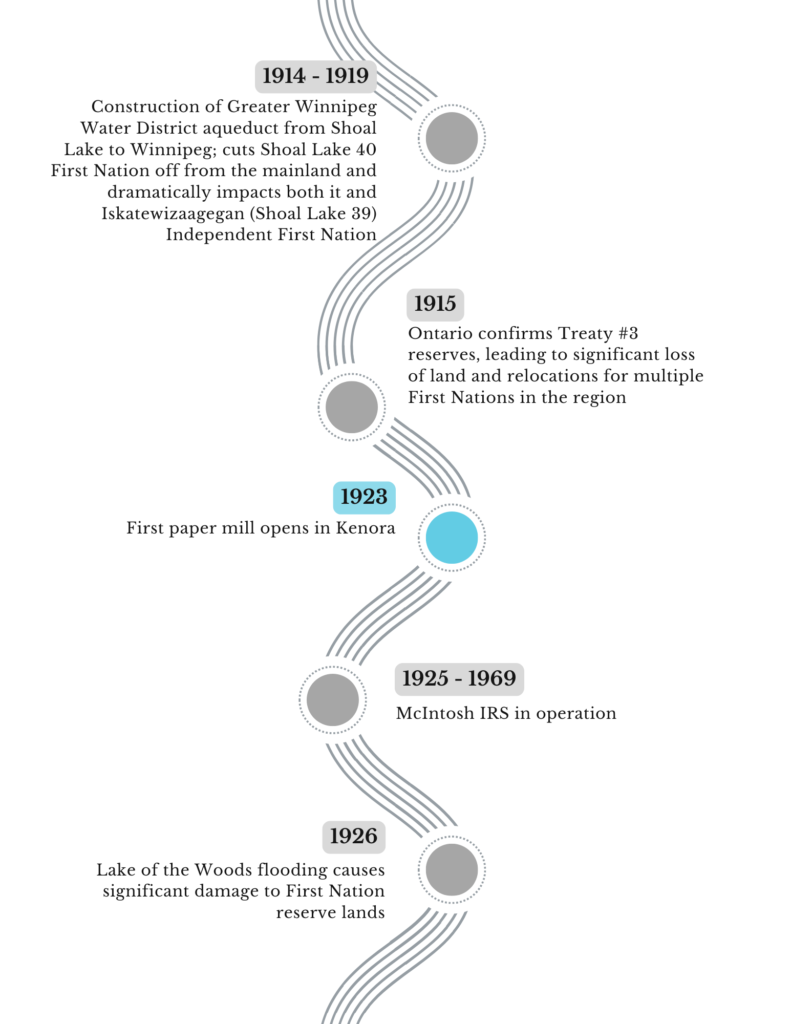
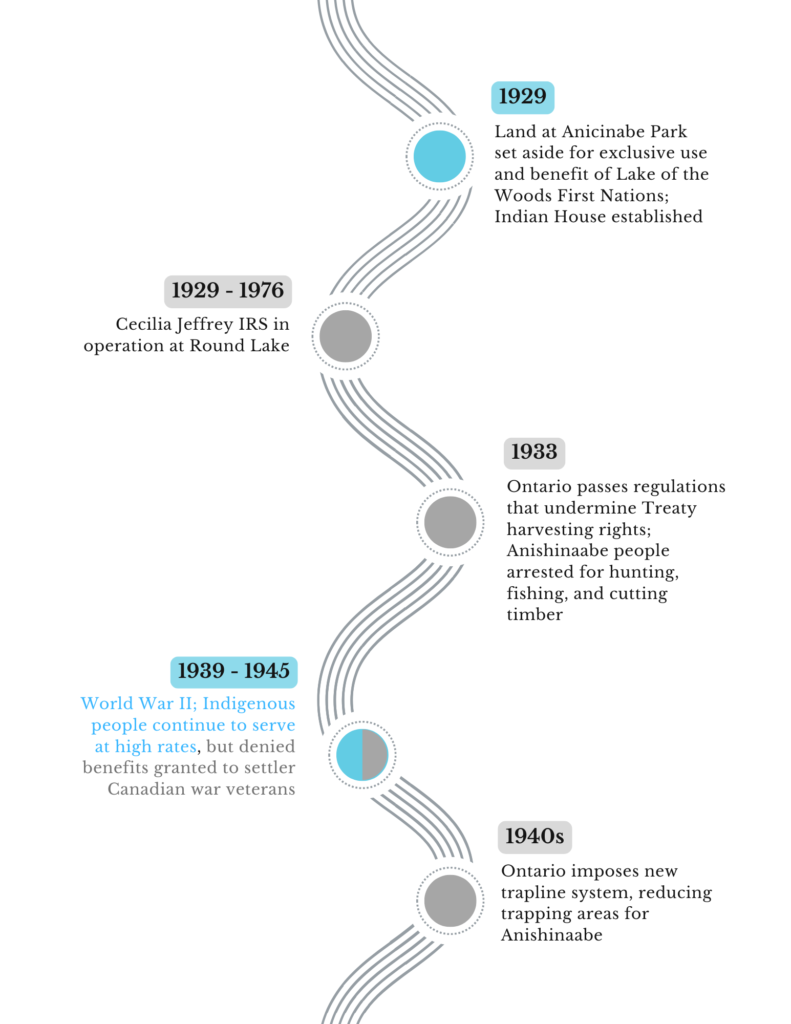
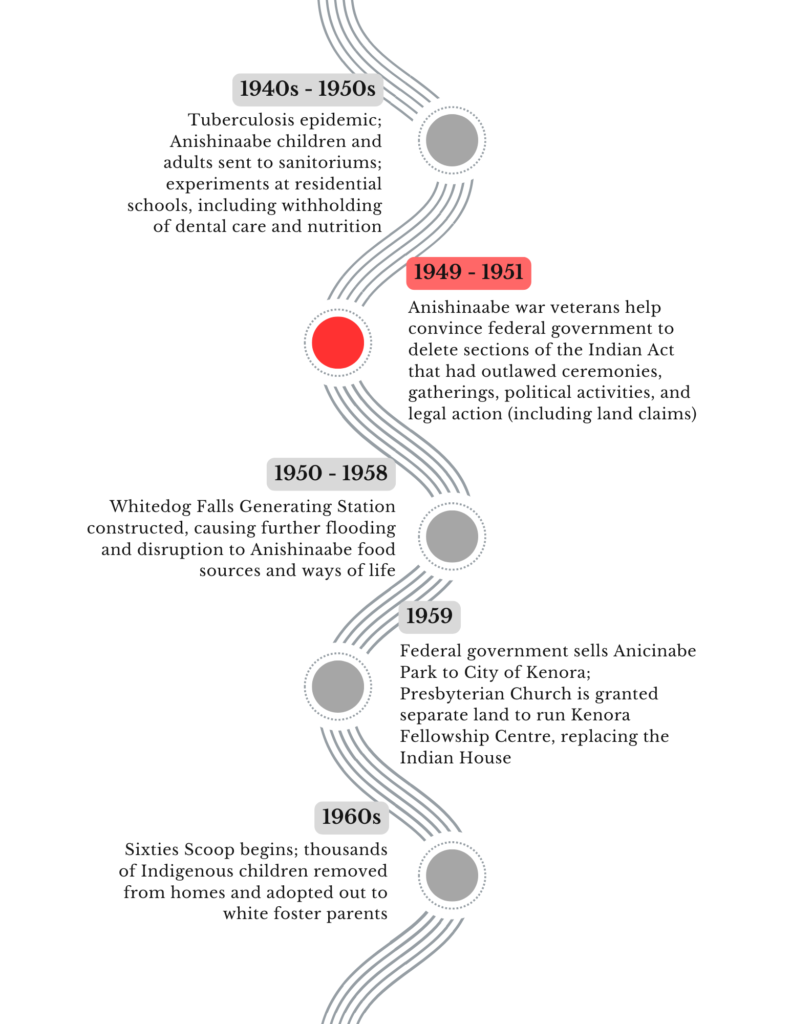
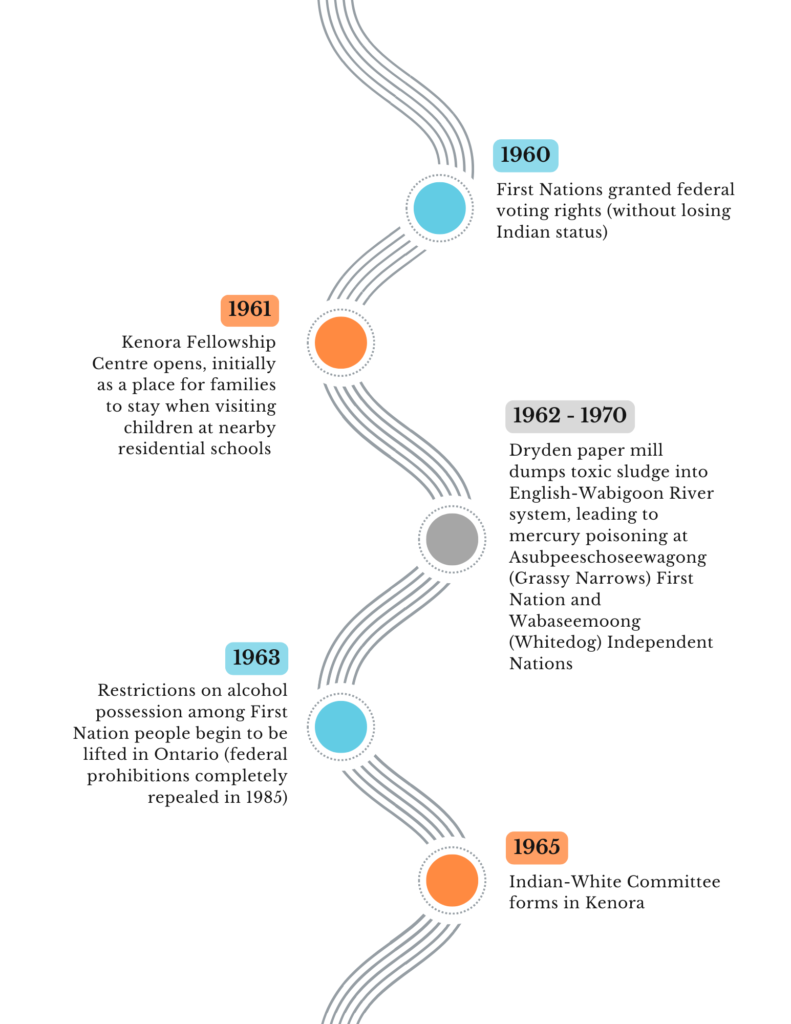
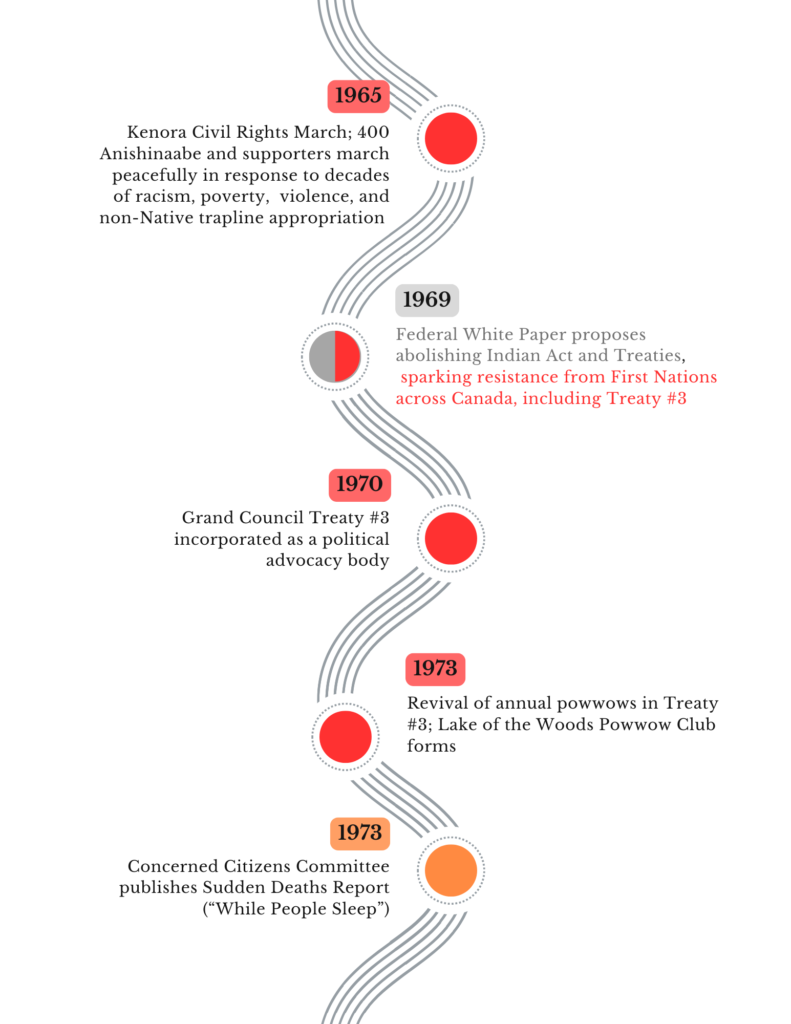
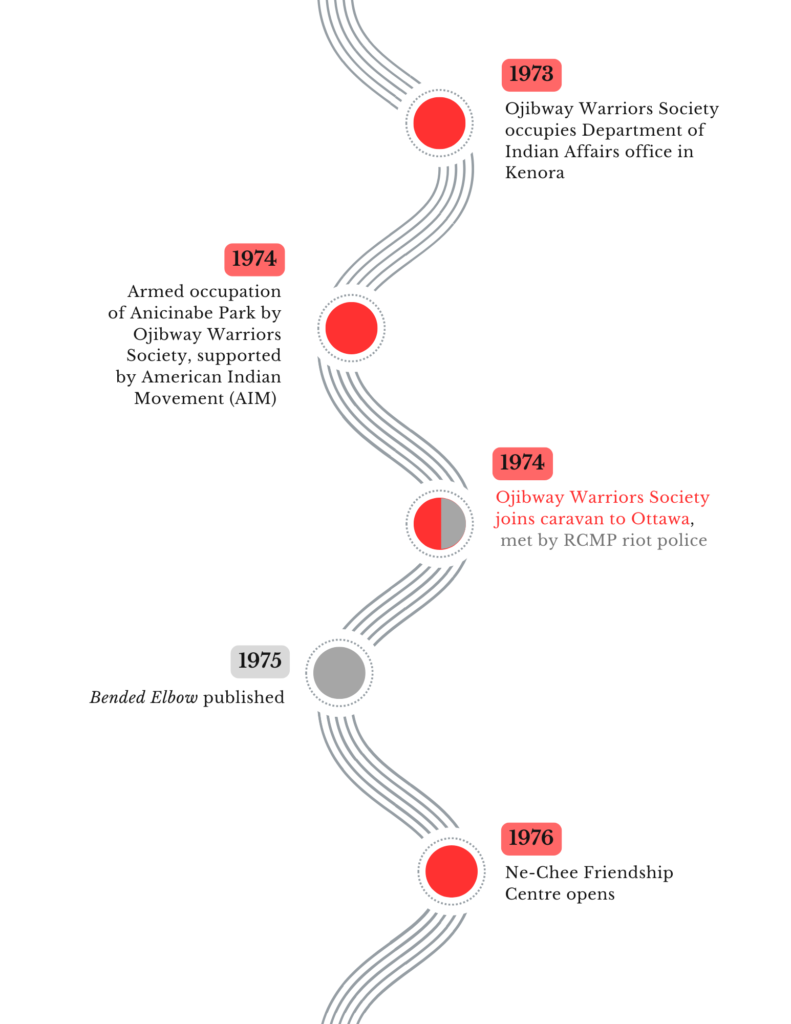
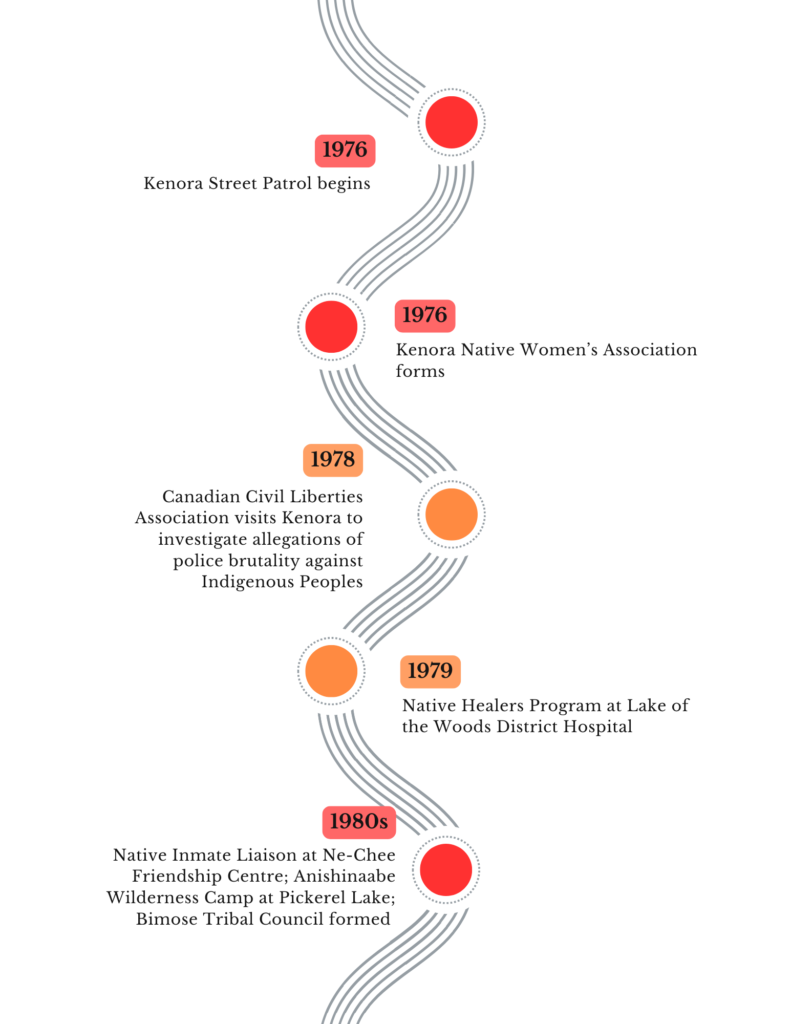
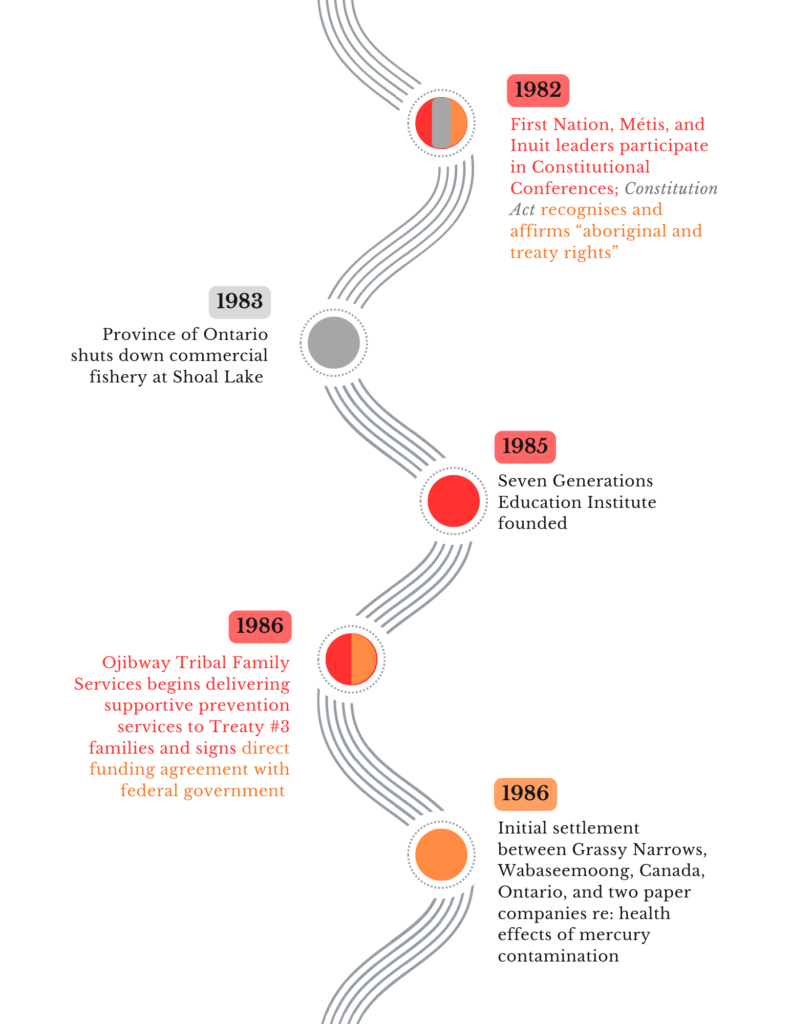
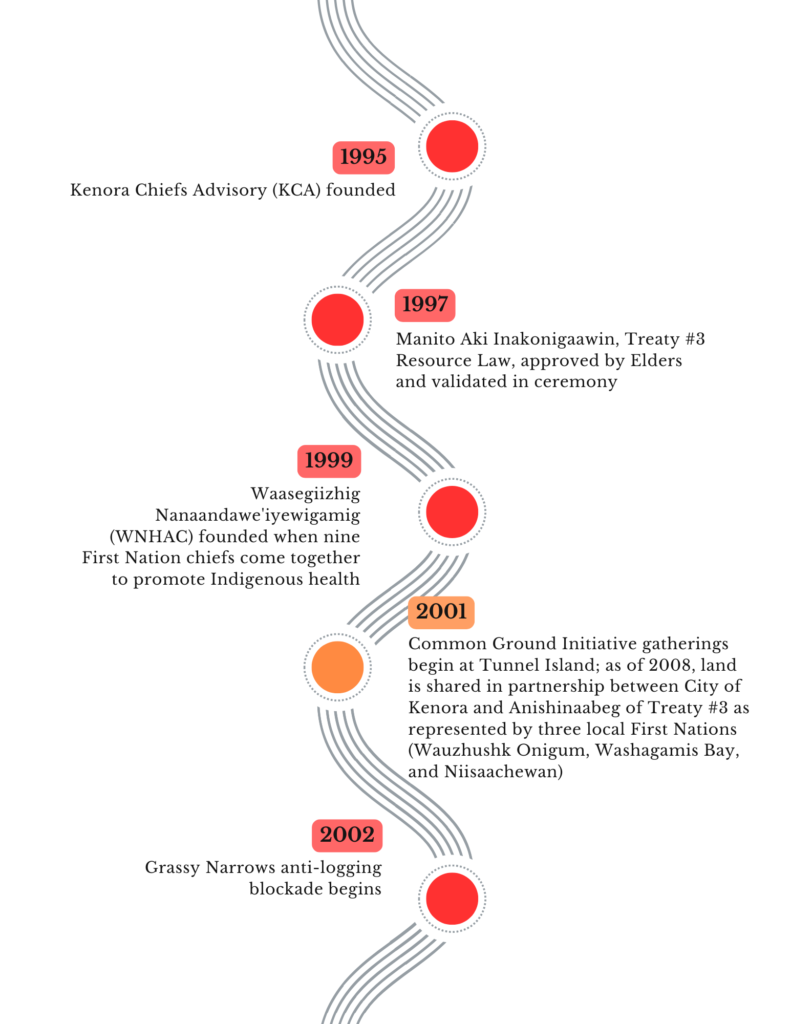
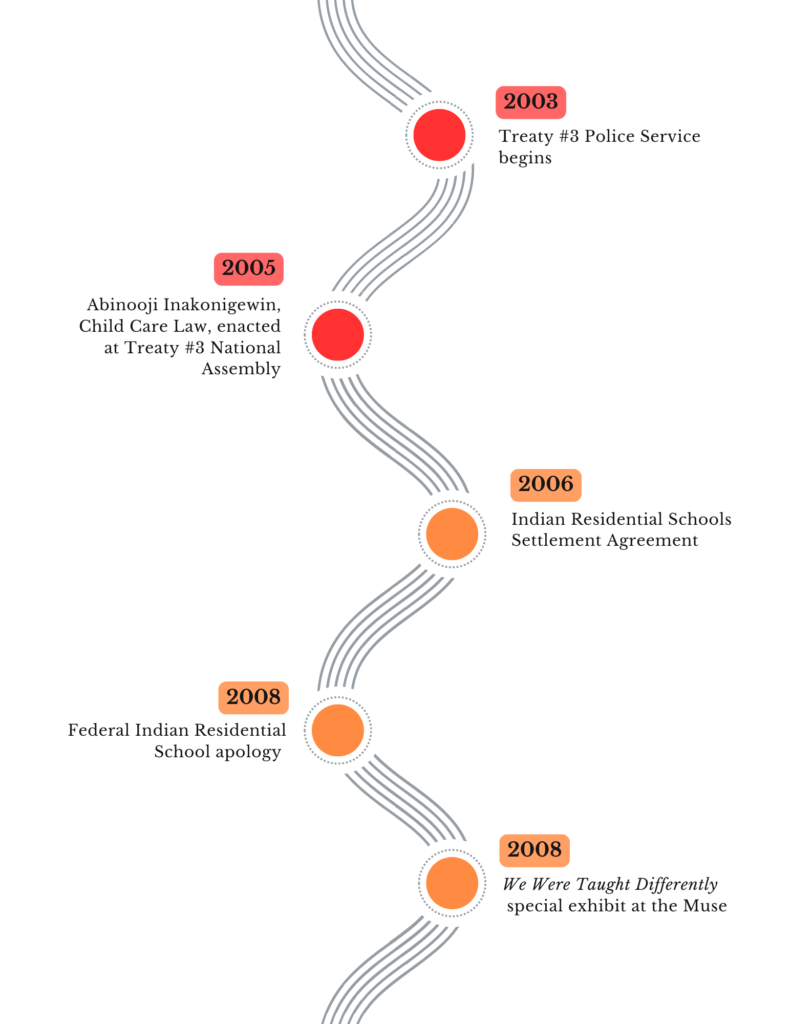
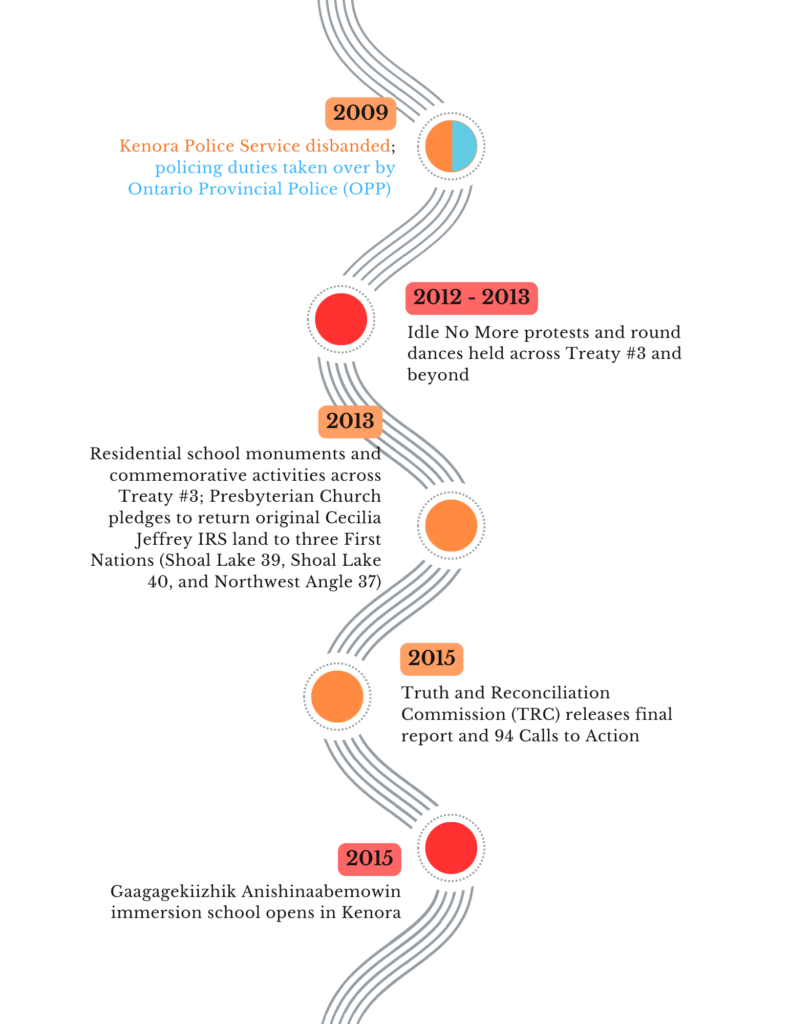
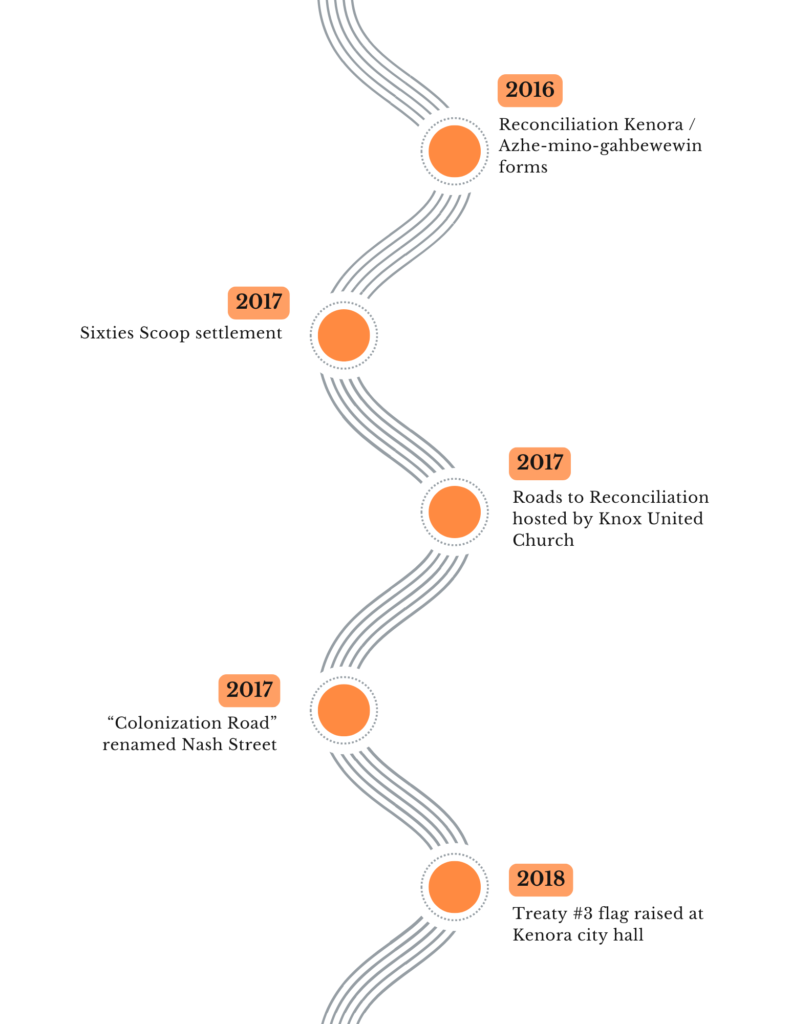
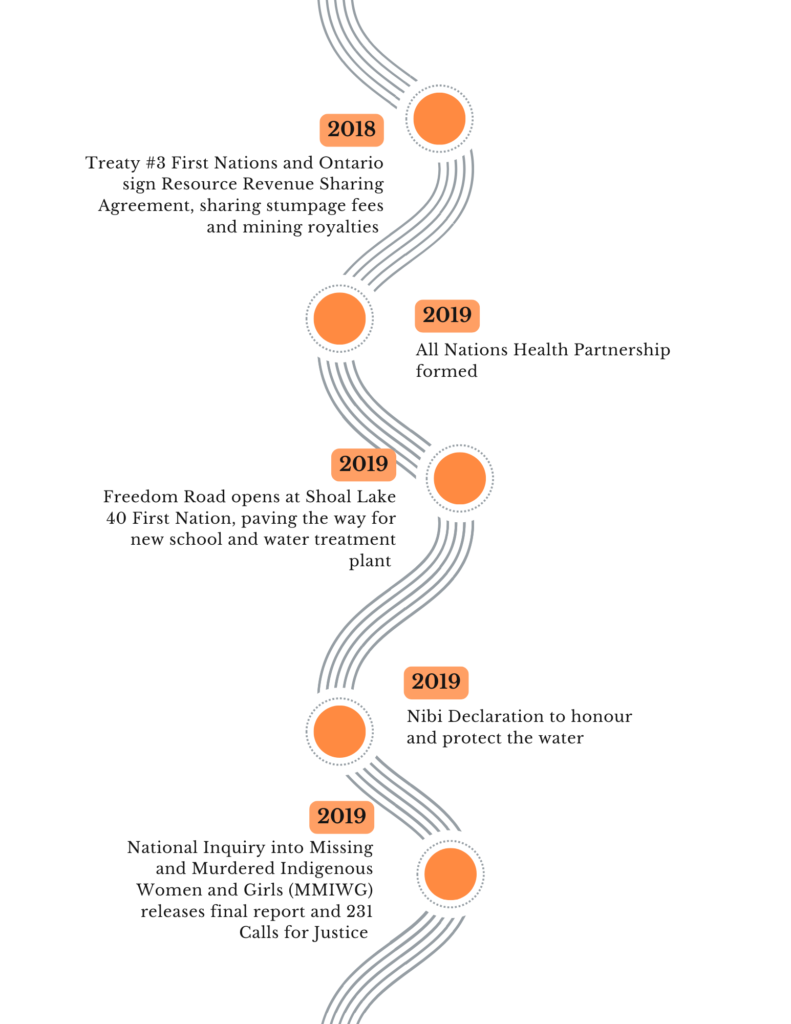
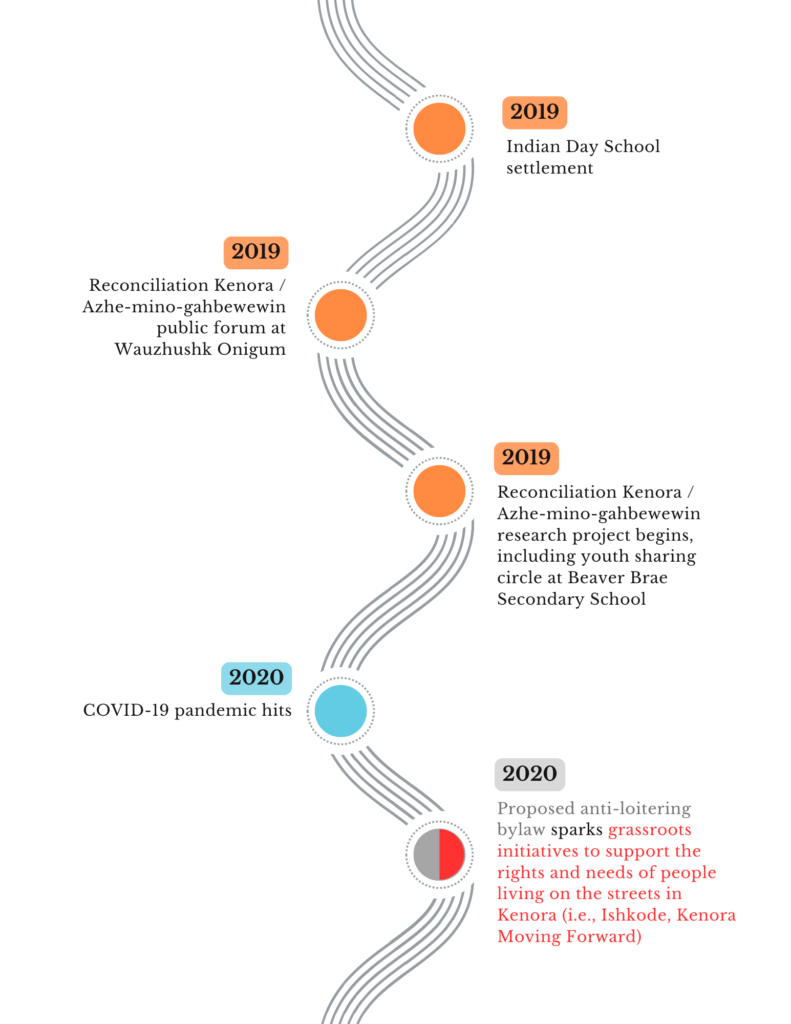
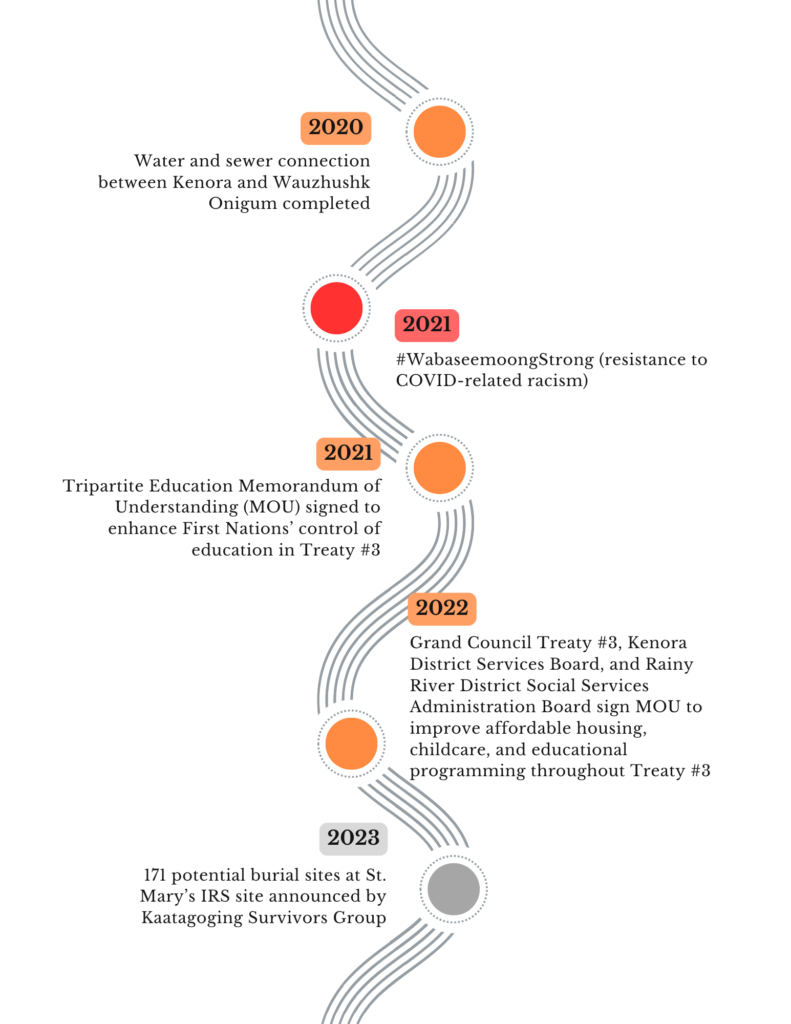
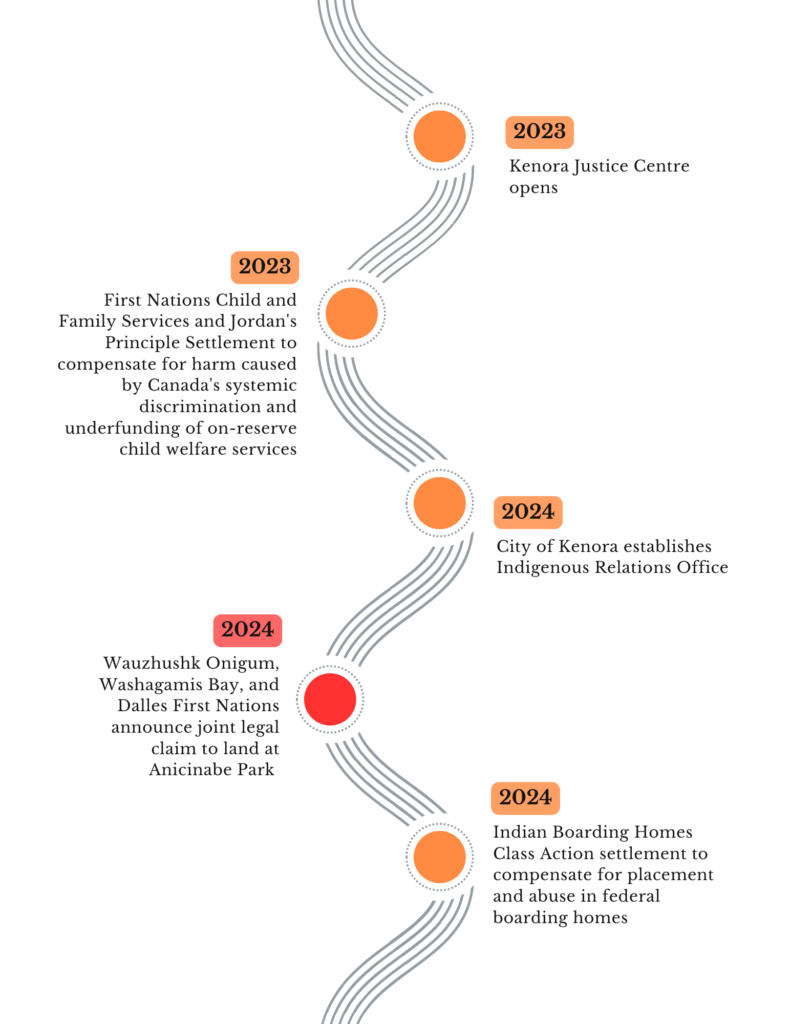
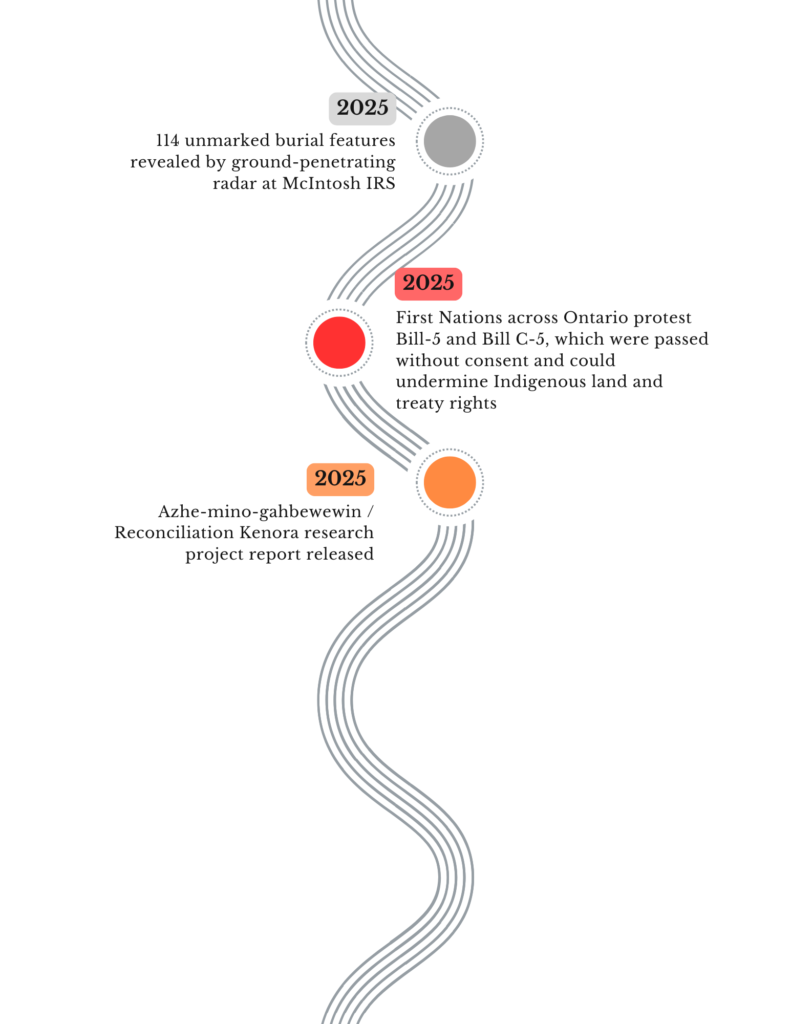

1
References
8th Fire: Aboriginal Peoples, Canada, and the Way Forward. 2012. Documentary hosted by Wab Kinew. Canadian Broadcasting Corporation (CBC).
Alfred, Taiaiake. 2009. “Restitution is the Real Pathway to Justice for Indigenous Peoples.” Pp. 179-187 in Response, Responsibility, and Renewal: Canada’s Truth and Reconciliation Journey, edited by Gregory Younging, Jonathan Dewar, and Mike DeGagné. Ottawa: Aboriginal Healing Foundation.
All Nations Health Partners. 2025. “All Nations Health Partners: Ontario Health Team.” [https://www.anhp.net/]
Allan, Michelle. 2025. “Search detects 114 ‘unmarked burial features’ on former McIntosh Indian Residential School property.” CBC, January 16. [https://www.cbc.ca/news/canada/thunder-bay/mcintosh-indian-residential-school-search-unmarked-burial-features-detected-1.7433302]
Anglin, Perry. 1965. “100 Kenora Indians plan ‘Selma’ march.” Toronto Star, November 17.
Ballingall, Alex. 2020. “‘Reconciliation is dead and we will shut down Canada,’ Wet’suwet’en supporters say.” Toronto Star, February 11. [https://www.thestar.com/politics/federal/2020/02/11/reconciliation-is-dead-and-we-will-shutdown-canada-wetsuweten-supporters-say.html?rf]
Bombay, Amy, Kimberly Matheson, and Hymie Anisman. 2014. “The Intergenerational Effects of Indian Residential Schools: Implications for the Concept of Historical Trauma.” Transcultural Psychiatry 51: 320-338.
Borrows, John, and James Tully. 2018. “Reconciliation and Resurgence in Practice and in Question.” Introduction to Resurgence and Reconciliation: Indigenous-Settler Relations and Earth Teachings, edited by Michael Asch, John Borrows, and James Tully. Toronto: University of Toronto Press.
Brant Castellano, Marlene, Linda Archibald, and Mike DeGagné. (Editors). 2008. From Truth to Reconciliation: Transforming the Legacy of Residential Schools. Ottawa: Aboriginal Healing Foundation.
Carleton, Sean. 2021. “‘I don’t need any more education’: Senator Lynn Beyak, Residential School Denialism, and Attacks on Truth and Reconciliation.” Settler Colonial Studies 11(4): 466-486.
Carver, Bronson. 2023. “Kenora Moving Forward asks Council to commit to permanent warming and cooling space.” Kenora Miner & News, February 23. [https://www.kenoraminerandnews.com/news/local-news/kenora-moving-forward-asks-council-to-commit-to-permanent-warming-and-cooling-space]
Carver, Bronson. 2025. “Miikana Ridge, Kenora’s new seniors building, open at long last.” Kenora Miner & News, May 14. [https://www.kenoraminerandnews.com/news/local-news/miikana-ridge-kenoras-new-seniors-building-open-at-long-last]
CBC, 2020. “Compassionate Kenora continues to provide primary care in spite of uncertainty.” CBC, November 19. [https://www.cbc.ca/news/canada/thunder-bay/compassionate-kenora-1.5807069]
CBC, 2021. “After a year of relationship building in the streets, Makwa Patrol looking to expand in Kenora, Ont.” CBC, September 20. [https://www.cbc.ca/news/canada/thunder-bay/makwa-patrol-kenora-1.6180620]
City of Kenora. 2022a. Charting Our Course 2027: Strategic Plan, 2022-2027. Prepared by Urban Systems Ltd. [https://www.kenora.ca/en/your-government/strategic-plan.aspx#Relations-with-Treaty-3-partners]
City of Kenora. 2022b. “Rat Portage Common Ground Conservation Organization: Summary Report.” City of Kenora: Indigenous Relations, September 16.
Clarke, Patricia. 1965. “Monthly column.” The United Church Observer. Old Series 135.8, New Series 27.1.
Colonization Road. 2016. Film directed by Michelle St. John. Toronto: Frog Girl Films. Video.
Common Ground Research Forum. n.d. “Background: Why the CGRF Was Formed.” [https://www.cgrf.ca/index.php/background-governance/background-why-the-cgrf-was-formed/]
Concerned Citizens Committee. 1973. While People Sleep: A Study of Sudden Deaths Amongst the Indian People of the Kenora Area, with Primary Emphasis on Apparent Alcohol Involvement. Kenora: Concerned Citizens Committee.
Corntassel, Jeff. 2012. “Re-Envisioning Resurgence: Indigenous Pathways to Decolonization and Sustainable Self-Determination.” Decolonization: Indigeneity, Education & Society 1(1): 86-101.
Corntassel, Jeff, and Cindy Holder. 2008. “Who’s Sorry Now? Government Apologies, Truth Commissions, and Indigenous Self-Determination in Australia, Canada, Guatemala, and Peru.” Human Rights Review 9(4): 465-489.
Coulthard, Glen Sean. 2014. Red Skin, White Masks: Rejecting the Colonial Politics of Recognition. Minneapolis: University of Minnesota Press.
Craft, Aimée, and Paulette Regan. 2020. Pathways of Reconciliation: Indigenous and Settler Approaches to Implementing the TRC’s Calls to Action. Winnipeg: University of Manitoba Press.
Daigle, Michelle. 2019. “The Spectacle of Reconciliation: On (the) Unsettling Responsibilities to Indigenous Peoples in the Academy.” Environment and Planning D: Society and Space 37(4):703–21.
Davidson-Hunt, Iain, et al. 2017. “Tunnel Island Booklet.” Common Ground Research Forum. [chrome-extension://efaidnbmnnnibpcajpcglclefindmkaj/https://cgrf.ca/wp-content/uploads/2017/11/Tunnel-Island-Booklet.pdf]
Davis, Lynne, Chris Hiller, Cherylanne James, Kristen Lloyd, Tessa Nasca, and Sara Taylor. 2017. “Complicated Pathways: Settler Canadians Learning to Re/Frame Themselves and Their Relationships with Indigenous Peoples.” Settler Colonial Studies 7(4): 398-414.
Davis, Lynne, Jeff Denis, Chris Hiller, and Dawn Lavell-Harvard. 2022. “Learning and Unlearning: Settler Engagements in Long-Term Indigenous-Settler Alliances in Canada.” Ethnicities 22(5): 619-41.
Denis, Jeffrey S. 2020. Canada at a Crossroads: Boundaries, Bridges, and Laissez-Faire Racism in Indigenous-Settler Relations. Toronto: University of Toronto Press.
Denis, Jeffrey S. 2024. “Indigenous Peoples and Canada: A Sociological Perspective.” In Sociology: Compass for a New Social World, 8th Edition, edited by Robert J. Brym. Toronto: Cengage Learning Canada.
Denis, Jeffrey S. 2025. “Treaty Relations as a Foundation for Reconciliation: Indigenous and Settler Perspectives in Treaty #3 Territory.” Forthcoming in On Settler Colonialism in Canada: Relations and Resistances, edited by David MacDonald and Emily Grafton. University of Regina Press.
Denis, Jeffrey S. and Kerry A. Bailey. 2016. “‘You Can’t Have Reconciliation Without Justice’: How Non-Indigenous Participants in Canada’s Truth and Reconciliation Process Understand Their Roles and Goals.” Pp. 137-58 in The Limits of Settler Colonial Reconciliation: Non-Indigenous People and the Responsibility to Engage, edited by Sarah Maddison, Tom Clark, and Ravi de Costa. Singapore: Springer.
Denis, Jeffrey S., and Sarah Beckman. 2022. “Azhe-mino-gahbewewin: Returning to a Place of Good Standing in Treaty #3 Territory.” Pp. 354-361 in Reading Sociology: Decolonizing Canada, 4th edition, edited by Johanne Jean-Pierre, Vanessa Watts, Carl E. James, Patrizia Albanese, Xiaobei Chen and Michael Graydon. Don Mills, ON: Oxford University Press.
Dickson, Courtney, and Bridgette Watson. 2021. “Remains of 215 children found buried at former B.C. residential school, First Nation says.” CBC, May 27. [https://www.cbc.ca/news/canada/british-columbia/tk-eml%C3%BAps-tesecw%C3%A9pemc-215-children-former-kamloops-indian-residential-school-1.6043778]
Dunk, Thomas W. 2003. It’s a Working Man’s Town: Male Working-Class Culture. Montreal and Kingston: McGill-Queen’s University Press.
Environics Institute. 2016. Canadian Public Opinion on Aboriginal Peoples. Toronto, ON: Environics. [http://www.environicsinstitute.org/institute-projects/current-projects/public-opinion-about-aboriginal-issues-in-canada]
Fleury, Clint. 2023. “Kenora woman on ‘disciplinary leave’ after Facebook comment calling for vigilante justice.” NWOnewswatch.com, January 5. [https://www.nwonewswatch.com/local-news/kenora-woman-on-disciplinary-leave-after-facebook-comment-calling-for-vigilante-justice-6326932]
Freeman, Victoria. 2014. “In Defence of Reconciliation.” Canadian Journal of Law and Jurisprudence 27(1): 213-223.
Government of Ontario. 2023. “Ontario Justice Centre Opens in Kenora.” News Release, February 6. [https://news.ontario.ca/en/release/1002690/ontario-justice-centre-opens-in-kenora]
Grand Council Treaty #3 (GCT3). n.d. “Manito Aki Inakonigaawin.” [https://gct3.ca/land/manito-aki-inakonigaawin/]
Grand Council Treaty #3 (GCT3). 2013. “‘The Creator Placed Us Here’: Timeline of Significant Events of the Anishinaabeg of Treaty #3.” [https://www.7generations.org/wp-content/uploads/2023/09/Treaty-Three-History-1.pdf]
Grand Council Treaty #3 (GCT3). 2023. “Honouring 150 Years of the Signing of Treaty #3.” [https://150.gct3.ca/]
Green, Joyce. 2006. “From Stonechild to Social Cohesion: Anti-Racist Challenges for Saskatchewan.” Canadian Journal of Political Science 39(1): 507-527.
Green, Joyce. 2019. “Enacting Reconciliation.” Pp. 237–251 in Visions of the Heart: Issues Involving Indigenous Peoples in Canada, edited by Gina Starblanket and David Long. Don Mills, ON: Oxford University Press.
Harper, Vern. 1979. Following the Red Path: The Native People’s Caravan, 1974. Toronto: NC Press.
Henderson, Jennifer, and Pauline Wakeham. (Editors). 2013. Reconciling Canada: Critical Perspectives on the Culture of Redress. Toronto: University of Toronto Press.
Hiller, Chris. 2025. “Folding Back the Covers on Canada’s History of Indigenous Dispossession: The Evolution of the KAIROS Blanket Exercise.” Journal of Canadian Studies 59(2): 129-155.
Izri, Touria. 2020. “‘The fact that it got tabled was ridiculous:’ Kenora city council votes against anti-loitering bylaw after growing criticism.” CTV News, July 21. [https://www.ctvnews.ca/winnipeg/article/the-fact-that-it-got-tabled-was-ridiculous-kenora-city-council-votes-against-anti-loitering-bylaw-after-growing-criticism/]
Jackson, Kenneth. 2021. “Tracking the Kenora Indian Beaters and passed down hate.” Aboriginal Peoples Television Network (APTN), November 19. [https://www.aptnnews.ca/investigates/tracking-the-kenora-indian-beaters-and-passed-down-hate/]
Jacobsen, Eleanor M. 1975. Bended Elbow: Kenora Ontario Talks Back. Kenora: Central Publications.
Jewell, Eva, and Ian Mosby. 2023. Calls to Action Accountability: A 2023 Status Update on Reconciliation. Yellowhead Institute. [https://yellowheadinstitute.org/report/trc/]
Joseph, Bob. 2018. 21 Things You May Not Know About the Indian Act: Helping Canadians Make Reconciliation with Indigenous Peoples a Reality. Indigenous Relations Press.
Kelly, Fred. 2008. “Confession of a Born-Again Pagan.” Pp. 11-40 in From Truth to Reconciliation: Transforming the Legacy of Residential Schools, edited by Marlene Brant Castellano, Linda Archibald, and Mike DeGagné. Ottawa: Aboriginal Healing Foundation.
Kenora Miner & News. 2023. “171 possible unmarked graves detected at former St. Mary’s Indian Residential School.” Kenora Miner & News, January 17. [https://www.kenoraminerandnews.com/news/local-news/171-possible-unmarked-graves-detected-at-former-st-marys-indian-residential-school]
Kenora Moving Forward Coalition. 2023. “Booshkegiin Kenora – It’s Up to You.” [https://www.youtube.com/watch?v=gQrWki3jxpo]
Kinew, Kathi Avery. 1995. Manito Gitigaan: Governing in the Great Spirit’s Garden: Wild Rice in Treaty #3. PhD Dissertation, Interdisciplinary Studies, University of Manitoba.
Kinew, Wab. 2015. The Reason You Walk: A Memoir. New York: Viking.
King, Hayden, Shiri Pasternak, and Riley Yesno. 2019. Land Back: A Yellowhead Institute Red Paper. Toronto: Yellowhead Institute. [https://redpaper.yellowheadinstitute.org/wp-content/uploads/2019/10/red-paper-report-final.pdf]
Krasowski, Sheldon. 2019. No Surrender: The Land Remains Indigenous. Regina: University of Regina Press.
LeMay, Rose. 2025. Ally Is a Verb: A Guide to Reconciliation with Indigenous Peoples. Page Two.
Leroux, Darryl. 2019. Distorted Descent: White Claims to Indigenous Identity. Winnipeg: University of Manitoba Press.
Lowman, Emma Battell, and Adam J. Barker. 2025. Settler: Identity and Colonialism. Halifax and Winnipeg: Fernwood.
Luby, Brittany. 2020. Dammed: The Politics of Loss and Survival in Anishinaabe Territory. Winnipeg: University of Manitoba Press.
Mainville, Sara J. 2007. Manidoo Mazina’igan: An Anishinaabe Perspective of Treaty 3. Master’s thesis, Faculty of Law, University of Toronto.
Makin, Kirk. 2004. “Kenora police framed murder charge.” The Globe and Mail, March 22. [https://www.theglobeandmail.com/news/national/kenora-police-framed-murder-charge/article1129516/]
Malone, Kelly. 2018. “The long road to reconciliation: Kenora’s not there yet.” CBC News, January 27. [http://www.cbc.ca/news2/interactives/road-to-reconciliation-kenora/]
Mathur, Ashok, Jonathan Dewar, and Mike DeGagné. (Editors). 2011. Cultivating Canada: Reconciliation Through the Lens of Cultural Diversity. Ottawa: Aboriginal Healing Foundation. [http://www.ahf.ca/downloads/cultivating-canada-pdf.pdf]
Maxwell, Krista. 2011. Making History Heal: Settler Colonialism and Urban Indigenous Healing in Ontario, 1970s-2010. PhD Dissertation, Department of Anthropology, University of Toronto.
Miisun Integrated Resource Management Company. 2025. “About Us.” [https://miisun.ca/about-us/]
National Inquiry into Missing and Murdered Indigenous Women and Girls (MMIWG). 2019. Reclaiming Power and Place: The Final Report of the National Inquiry into Missing and Murdered Indigenous Women and Girls. Ottawa: National Inquiry into MMIWG. [https://www.mmiwg-ffada.ca/final-report/]
Ne-Chee Friendship Centre. n.d. “Welcome to Ne-Chee Friendship Centre.” [https://nechee.org/]
New York Times, 1979. “Canadian hospital hires medicine man for Indians.” New York Times, September 9. [https://www.nytimes.com/1979/09/09/archives/canadian-hospital-hires-medicine-man-for-indians.html]
Niiwin Wendaanimok Four Winds Partnership. 2025. “Who We Are.” [https://niiwinwendaanimok.com/about/]
Paquette, Elisabeth. 2020. “Reconciliation and Cultural Genocide: A Critique of Liberal Multicultural Strategies of Innocence.” Hypatia 35(1): 143-160.
Paul, Alexandra. 2015. “New era of First Nations civil rights ushered in 50 years ago in Kenora.” Winnipeg Free Press, November 21.
Perry, Adele. 2016. Aqueduct: Colonialism, Resources, and the Histories We Remember. Winnipeg: ARP Books.
Phung, Malissa. 2011. “Are People of Colour Settlers Too?” Pp. 289-98 in Cultivating Canada: Reconciliation Through the Lens of Cultural Diversity, edited by Ashok Mathur, Jonathan Dewar, and Mike DeGagné. Ottawa: Aboriginal Healing Foundation. [http://www.ahf.ca/downloads/cultivating-canada-pdf.pdf]
Porter, Jody. 2014. “Ontario gives green light to clearcutting at Grassy Narrows.” CBC, December 30. [https://www.cbc.ca/news/canada/thunder-bay/ontario-gives-green-light-to-clearcutting-at-grassy-narrows-1.2885801]
Pugliese, Karyn. 2025. “A red teapot and a camera is turning silence into Anishinaabemowin language in Onigaming.” APTN, August 5. [https://www.aptnnews.ca/featured/a-red-teapot-and-a-camera-is-turning-silence-into-anishinaabemowin-language-in-onigaming/]
Ratcliffe, Glynis. 2020. “Land-based camp connects church and Indigenous communities.” Broadview, July/August. [https://broadview.org/pabaamashi-camp/]
Reconciliation Kenora / Azhe-Mino-Gahbewewin. 2017. Annual General Meeting Minutes, November 14.
Reconciliation Kenora / Azhe-Mino-Gahbewewin. 2019. “Visioning Workshop Report.”
Robertson, David A. 2025. 52 Ways to Reconcile: How to Walk with Indigenous Peoples on the Path to Healing. McClelland & Stewart.
Russell, Paul. 2017. “The difficult road to reconciliation.” United Church of Canada Blog, June 19. [https://unitedchurch.ca/blogs/roend-table/difficult-road-reconciliation]
Rutherford, Scott. 2011. Canada’s Other Red Scare: Rights, Decolonization, and Indigenous Political Protest in the Global Sixties. PhD Dissertation, Department of History, Queen’s University.
Rutherford, Scott. 2020. Canada’s Red Scare: Indigenous Protest and Colonial Encounters during the Global Sixties. Montreal and Kingston: McGill-Queen’s University Press.
Schlegel, Talula. 2016. “Field course in reconciliation: Students study with elders in the community of Shoal Lake 40.” The Uniter, September 8. [https://uniter.ca/view/field-course-in-reconciliation]
Shoal Lake 40 First Nation. 2022. “The Road to 2030: A Community Vision.”
Simpson, Audra. 2014. Mohawk Interruptus: Political Life Across the Borders of Settler States. Durham, NC: Duke University Press, 2014.
Simpson, Leanne Betasamosake. 2016. “Land and Reconciliation: Having the Right Conversations.” Electric City Magazine, March 5. [https://watershedsentinel.ca/articles/land-reconciliation/]
Simpson, Leanne Betasamosake. 2017. As We Have Always Done: Indigenous Freedom Through Radical Resistance. Minneapolis: University of Minnesota Press.
Skead, Chris. 2020. “Water and sewer connection to Wauzhushk Onigum Nation celebrated.” Wauzhushk Onigum Press Release, September 30. [https://www.kenora.ca/en/news/water-and-sewer-connection-to-wauzhushk-onigum-nation-celebrated.aspx]
Smith (McFarlane), Christine. 2013. “A Legacy of Canadian Childcare: Surviving the Sixties Scoop.” Briarpatch, September 1. [https://briarpatchmagazine.com/articles/view/a-legacy-of-canadian-child-care]
Smith, Mary Alice. 2014. “Final Report on the Lake of the Woods Powwow Club Project.” Common Ground Research Forum. https://www.cgrf.ca/index.php/community-partners/mary-alice-smith-lake-of-the-woods-powwow-club-project/#:~:text=In%20early%202012%2C%20community%20member,members%20in%20the%20early%201980s.
Smith, Mary Alice. 2021. “Wiisookodaadiwin Cultural Safety Guide.” Kenora: Ne-Chee Friendship Centre.
Snelgrove, Corey. 2021. Bound By Reconciliation? Social Criticism, Treaty, and Decolonization. PhD Dissertation, Department of Political Science, University of British Columbia.
Srivastava, Sarita. 2024. Are You Calling Me A Racist? Why We Need to Stop Talking about Race and Start Making Real Antiracist Change. New York: NYU Press.
Stark, Heidi Kiiwetinepinesiik, Aimée Craft, and Hokulani K. Aikau. (Editors). 2023. Indigenous Resurgence in an Age of Reconciliation. Toronto: University of Toronto Press.
Statistics Canada. 2022. “Focus on Geography Series, 2021 Census of Population: Kenora, Census agglomeration.” Statistics Canada, December 16. [https://www12.statcan.gc.ca/census-recensement/2021/as-sa/fogs-spg/page.cfm?topic=9&lang=e&dguid=2021S0504598]
Stimpson, Mike. 2024. “More affordable housing ahead for Northwest seniors.” NWOnewswatch.com, September 25. [https://www.nwonewswatch.com/local-news/more-affordable-housing-ahead-for-northwest-seniors-9571266]
Stimpson, Mike. 2025. “Kenora opens Indigenous relations office.” NWOnewswatch.com, February 11. [https://www.nwonewswatch.com/local-news/kenora-opens-indigenous-relations-office-10201471#:~:text=KENORA%20%E2%80%93%20The%20Indigenous%20relations%20office,relations%20adviser%20since%20last%20June]
The Muse. 2025. “The Muse: Lake of the Woods Museum and Douglas Family Arts Centre.” [https://themusekenora.ca/]
Thompson, Jon. 2017. “Northwestern Ontario debates its colonization roads.” TVO Today, September 22. [https://www.tvo.org/article/northwestern-ontario-debates-its-colonization-roads#:~:text=In%20May%2C%20citizens%20of%20Kenora,an%20extension%20of%20Nash%20Street]
Thompson, Jon. 2019. “What Freedom Road can teach Ontario about partnering with Indigenous communities.” TVO Today, June 24. [https://www.tvo.org/article/what-freedom-road-can-teach-ontario-about-partnering-with-indigenous-communities]
Thompson, Jon. 2025. “At Assembly of First Nations, one chief feels ‘sidelined’ by Manitoba’s approach to development.” Kenora Miner & News, September 17. [https://www.kenoraminerandnews.com/news/at-assembly-of-first-nations-one-chief-feels-sidelined-by-manitobas-approach-to-development]
Truth and Reconciliation Commission of Canada (TRC). 2015. Calls to Action. Winnipeg: Truth and Reconciliation Commission of Canada. [https://ehprnh2mwo3.exactdn.com/wp-content/uploads/2021/01/Calls_to_Action_English2.pdf]
Truth and Reconciliation Commission of Canada (TRC). 2015. Honouring the Truth, Reconciling for the Future: Summary of the Final Report of the Truth and Reconciliation Commission of Canada. Winnipeg: Truth and Reconciliation Commission of Canada. [https://ehprnh2mwo3.exactdn.com/wp-content/uploads/2021/01/Executive_Summary_English_Web.pdf]
Tuck, Eve and K. Wayne Yang. 2012. “Decolonization Is Not a Metaphor.” Decolonization: Indigeneity, Education and Society 1(1): 1-40.
Turner, Logan. 2021. “Baseless Facebook posts about Wabaseemoong COVID-19 outbreak a symptom of wider racism, say community members.” CBC, February 24. [https://www.cbc.ca/news/canada/thunder-bay/kenora-racist-social-mediaposts-1.5925748]
Turner, Logan. 2023. “Grassy Narrows marks 20 years of the blockade protecting its land from logging.” CBC, January 2. [https://www.cbc.ca/news/canada/thunder-bay/grassy-narrows-blockade-20-anniversary-1.6699763]
Urban Aboriginal Task Force. 2007. Kenora: Final Report. Report commissioned by the Ontario Federation of Indian Friendship Centres, the Ontario Métis Aboriginal Association, and the Ontario Native Women’s Association.
Vowel, Chelsea. 2016. Indigenous Writes: A Guide to First Nations, Métis, and Inuit Issues in Canada. Winnipeg: Highwater Press.
Waisberg, Leo G., Joan A. Lovisek, and Tim E. Holzkamm. 1996. “Ojibwa Reservations as ‘An Incubus upon the Territory’: The Indian Removal Policy of Ontario, 1874-1982” Pp. 337-352 in Papers of the 27th Algonquian Conference, edited by David H. Pentland. Winnipeg: University of Manitoba.
Wallace, Rick. 2013. Merging Fires: Grassroots Peacebuilding Between Indigenous and Non-Indigenous Peoples. Halifax and Winnipeg: Fernwood Publishing.
Ward, Dennis. 2022. “‘It’s the power we have in ourselves:’ Advocate Tania Cameron is trying to change the system.” APTN, January 25. [https://www.aptnnews.ca/facetoface/tania-cameron-advocate-ontario-face-to-face/]
Whyte, Kyle Powys. 2018. “On Resilient Parasitisms, or Why I’m Skeptical of Indigenous/Settler Reconciliation.” Journal of Global Ethics 14(2): 277-289.
Willow, Anna J. 2012. Strong Hearts, Native Lands: Anti-Clearcutting Activism at Grassy Narrows First Nation. Winnipeg: University of Manitoba Press.
Younging, Gregory, Jonathan Dewar, and Mike DeGagné. (Editors). 2009. Response, Responsibility, and Renewal: Canada’s Truth and Reconciliation Journey. Ottawa: Aboriginal Healing Foundation.